Coal Smoke and First Class: What a Train Journey from Bucharest Looked Like 100 Years Ago
- Articles
- 04 MAY 26
Bucharest in 1925 is a city that wants to forget the First World War as quickly as possible and become something greater than it has been — the streets are starting to look European, the cafés along Calea Victoriei fill with good society, and Greater Romania, freshly constituted in 1918, adds thousands of kilometres of track to the CFR network, inherited from Austro-Hungary and Russia. The train is, in all this effervescence, the primary way to cross the country — the only way, in fact, for anyone who cannot afford a carriage over long distances.
The journey begins at Gara de Nord. The building we know today was, in the mid-1920s, smaller — the transverse platforms and the southern façade would only be added in 1930–1932 — but already imposing, with the air of a serious institution, its design inspired by the Gare du Nord in Paris. The foundation stone had been laid by Prince Carol I on 10 September 1868, and the station had opened on 25 September 1872 under the name Gara Târgoviștei, only acquiring the name we know in 1888, after the street in front was renamed Calea Griviței in honour of the battles of 1877.
You enter the station and the first distinction you feel is social, not geographical. There were separate waiting rooms — one reserved exclusively for holders of first-class tickets and another open to ordinary travellers — each with its own atmosphere and its own population. In the first sit ladies in hats and men in good overcoats, with leather luggage and the air of people accustomed to waiting in decent conditions. In the other, the crowd is more mixed and more noisy: merchants, students, soldiers on leave, peasants travelling to relatives in another part of the country.
The system of dividing carriages by class had been adopted from the English and operated across all of Europe, applied in Romania with a strictness that was, at its core, a mirror of the society outside. First class offered upholstered compartments with fabric-covered benches, curtained windows and, on long routes, access to a dining car. Third class offered wooden benches and a window through which, alongside the landscape, came all the smoke from the steam locomotive.
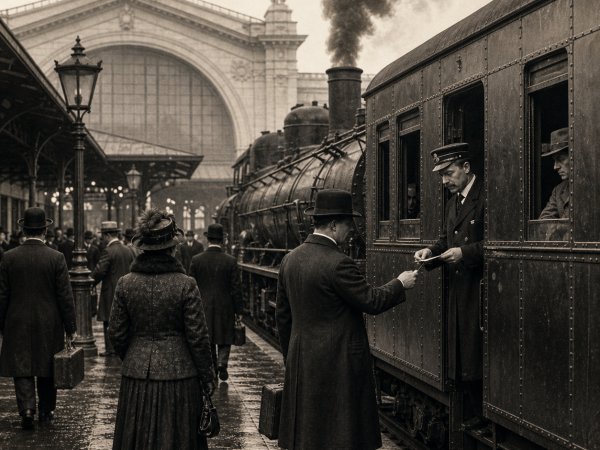
The locomotive is the central character of this story, and its presence is felt before anything else. It burns coal, and when the train enters a tunnel or the wind blows from the front, smoke seeps into the carriages through every gap, leaving a thin layer of black on collars, on sleeves, on the tablecloths of the dining car. Passengers in third class, with windows open in summer just to survive the heat, arrive at their destination with a layer of sooty grime on their clothes, which they accept without drama, as a natural cost of getting somewhere.
On the Bucharest–Brașov line, which crossed Predeal — a former border with Austro-Hungary until 1918 — trains had been running since 1879, and at the outset the journey took over seven hours, with lengthy stops at Predeal, which was then a frontier checkpoint. By 1925 the time had fallen, but it remained an experience of several good hours, with stops at every station along the route, where the conductor descended with ceremony, exchanged a few words with the stationmaster and blew his whistle before departure with an authority that nobody has quite replicated since. The historian Nicolae Iorga had described, a few years earlier in 1905, a train journey through Predeal in heavy terms — a "large and ugly hall, full of porters and customs officers" in tall caps, a border crossing treated with suspicion by Austro-Hungarian officials. The Union of 1918 had abolished the border, but the bureaucratic style of control persisted, and the conductor moved through compartments with a solicitude that was, in fact, a methodical inspection.
Average speeds on the main routes were somewhere between 40 and 60 km/h, varying considerably depending on gradient and the state of the track, and people accepted this naturally because they knew nothing else. By 1934, CFR was carrying more than 30 million passengers a year, compared to 7.5 million in 1906 — a rise that says everything about how the train had become the backbone of Romanian mobility. The Romanian railways held the role of engine of the national economy, known for their organisation and carrying the reputation of "the country's second army."
On the road, the landscape is the main spectacle — the only one, in fact, since none of the passengers has a phone, portable music or anything to read beyond what they brought from home. Some sleep with their heads resting on the shoulder of a compartment neighbour, with whom they have previously exchanged a few words and established tacitly that they will not disturb each other. Others look out the window as the Wallachian plain gradually transforms into hills, and the hills into mountains, with the patience of someone who knows they have no choice and has turned waiting into contemplation.
Food is a separate problem, solved differently depending on class and route. On short journeys, nobody thought about it. On longer ones, two solutions existed with very different characters: the dining car, reserved for the upper classes, with white-clothed tables and slow but ceremonious service where a thick soup and a modest roast were served, or the informal network of station stops where the train stands for ten to fifteen minutes and women with wicker baskets rise from the platform offering bread, cheese, hard-boiled eggs and cold water. This latter tradition would survive for many decades, standing in for everything the railway hospitality industry never quite managed to provide in earnest.
The Royal Train — commissioned by King Ferdinand I in 1926 from the Ernesto Breda factories in Milan — offered a different dimension of rail travel altogether: a protocol salon, royal cabins, carriages for state guests, a mobile court that moved along the same tracks as merchants with their baskets. At Gara de Nord there existed, for such occasions, an official reception salon built on the orders of Carol I, with impressive chandeliers, crystal mirrors, marble and drapes — a space that today sits dusty and unused, though the shell of history remains intact.
Also recommended Filaret Station, between glory and decline. The story of the first railway in Bucharest