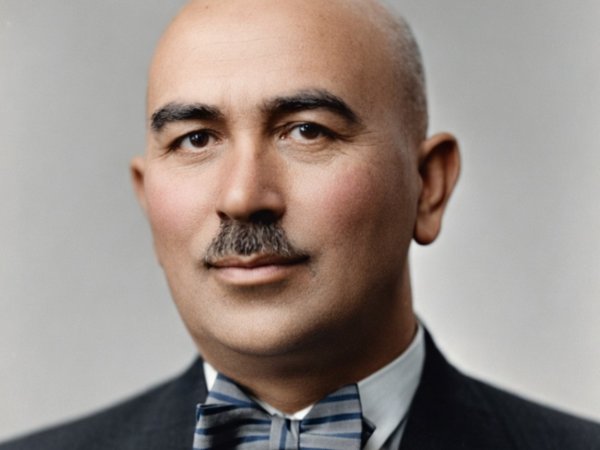
Traian Popovici, the Romanian hero who saved 20,000 Jews from Bukovina during the Holocaust, has a street named after him in Bucharest
- Articles
- 04 MAY 26
The history of Romania during the Second World War is marked by dramatic moments, but also by acts of courage and humanity that changed destinies. Among these remarkable figures is Traian Popovici, a man who managed to oppose a policy of extermination and save tens of thousands of lives. Although his name is not as widely known as that of other historical figures, his deeds place him among the great heroes of the 20th century. In Bucharest, a street bears his name as recognition of his role in saving approximately 20,000 Jews from Bukovina during a period when such actions involved enormous risks.
Origins and formation of a destiny
Traian Popovici was born on 17 October 1892 in the locality of Udești, Suceava County. He came from an area with a strong cultural tradition, and his education played an important role in shaping the values that later guided his actions.
After the end of the First World War, he graduated from the Faculty of Law at the University of Chernivtsi. However, his war experience had already left a mark: as early as 1914, at the beginning of the conflict, he enlisted in the army and fought for the Romanian state until the end of the hostilities.
During the interwar period, Popovici worked as a lawyer in Chernivtsi, building a solid reputation in the legal field. His life was deeply affected by the geopolitical events of 1940, when northern Bukovina was occupied, forcing him to flee to Bucharest, where he continued his professional activity.
Appointment as mayor and the beginning of a difficult mission
In 1941, in a tense and unstable context, Ion Antonescu proposed Traian Popovici as mayor of the city of Chernivtsi. Initially, he refused, aware of the difficulties and responsibilities involved.
However, on 1 August 1941, he was officially appointed to this position by the military governor of Bukovina, Alexandru Rioșanu. In his writings, Popovici describes the moment as unexpected, the result of a selection based on recommendations and references.
His mandate began during an extremely difficult period, when antisemitic policies were becoming increasingly aggressive. Shortly after taking office, he was asked to organize a ghetto for the Jewish population of Chernivtsi, a measure he considered unacceptable.
Opposition to the ghetto and antisemitic policies
Traian Popovici firmly opposed the idea of transforming part of the city into a ghetto. He argued that this measure was not only inhumane but also degrading, especially considering the high level of education and culture of the Jewish community in Chernivtsi.
The authorities’ plan involved overcrowding approximately 50,000 Jews into a space that could normally accommodate only 10,000 people. The conditions would have been extremely harsh: severe movement restrictions and life behind barbed wire fences.
His refusal to support these measures earned him the nickname “the Judaized one.” However, Popovici did not give in to pressure and continued to defend the rights of the Jewish community.
Intensification of repression and change of leadership
After Rioșanu’s death, leadership of Bukovina was taken over by General Corneliu Calotescu, who implemented a much harsher policy of “Romanization.”
Restrictive measures against Jews intensified rapidly: they were forbidden to practice professions, access education, and participate in religious life. They were also subjected to forced labor and deprived of financial resources.
These decisions created a climate of fear and insecurity, and the prospect of deportation became increasingly real. In this context, Traian Popovici’s role became crucial.
The decisive moment: saving 20,000 people
On 10 October 1941, Corneliu Calotescu informed Popovici that all Jews from Chernivtsi were to be deported to Transnistria. This decision was, in many cases, equivalent to a death sentence.
Initially, Popovici managed to obtain permission to save only 200 people, but he was not satisfied with this outcome. Determined to do more, he contacted Ion Antonescu directly, arguing that the deportation of Jews would severely affect the city’s economy and war production.
His arguments were convincing. As a result, many specialists – doctors, engineers, craftsmen, lawyers, and magistrates – were exempted from deportation. Through the so-called “Popovici authorizations,” approximately 20,000 Jews managed to remain in Chernivtsi.
The numbers are striking: nearly 28,000 Jews were deported from the city, but almost 20,000 were saved thanks to his intervention. Across the region, the number of deported people was much higher, estimated in the tens of thousands.
Final years and moral legacy
After the war, Traian Popovici’s life did not return to normal. He died on 4 June 1946 in the locality of Colacu, Fundu Moldovei commune, and was buried in the churchyard of the village.
Although he did not live long after the end of the conflict, his moral legacy is profound. Through his courage, he demonstrated that humanity can prevail even in the darkest moments of history.
Today, Traian Popovici is recognized as a symbol of moral resistance and solidarity. His actions are studied and appreciated both in Romania and internationally.
Recognition and memory: a street in Bucharest
In Bucharest, a street was named after Traian Popovici, a symbolic gesture that preserves his memory. In a constantly changing city, such landmarks are essential reminders of those who contributed to our history.
This recognition is not only an act of commemoration but also a lesson for future generations. The story of Traian Popovici reminds us that, regardless of context, every individual has the power to make a difference.
In a world where values are sometimes challenged, his example remains relevant. Courage, empathy, and responsibility are principles that never lose their importance.
A discreet but essential hero
Traian Popovici was not a top political leader nor a constantly featured historical figure. However, his actions had a tremendous impact on the lives of tens of thousands of people.
By opposing injustice and working to save the Jewish community of Chernivtsi, he became an example of civic courage and moral responsibility. His story deserves to be told and passed on.
The street in the Sector 3 of Bucharest that bears his name is not just an urban landmark, but a symbol of a lesson in humanity. And this lesson remains just as important today as it was more than eight decades ago.
We also recommend: Major Ion Coravu, the Romanian hero of Mărăști in the First World War, has a street named after him in Bucharest