Symbols of Bucharest: The Stella soap factory, a century of “extra-fine” products that kept the body “lively”
- Articles
- 04 MAY 26
The industrial history of Bucharest is full of fascinating stories, and one of the most interesting is, without a doubt, that of the “Stella” Soap Factory. Over more than a century, this name was synonymous with hygiene, refinement, and modernity. In a period when everyday products were often made in small workshops, and high-quality items were imported, “Stella” managed to transform the local market and become a symbol of Romanian industrial progress. The story of the factory is not only about soap or candles, but about the evolution of a city, about economic changes, and about how technology and ambition can turn a private initiative into a national landmark. From its founding in the 19th century to its disappearance from the urban landscape, “Stella” left a strong mark on Bucharest.
The beginnings of a modern industry on Șoseaua Colentina
Everything begins in the year 1883, when the Austrian doctor Iulius Hofmeyer lays the foundations of the “Stella” Factory on Șoseaua Colentina, at number 66 (today’s number 6). At the time of inauguration, the unit was specialized in the production of stearin, an essential ingredient for candle making, but also in the production of soap.
The economic context of the time was one in which such products were indispensable in households, yet most of them were made in small workshops, using traditional methods. Higher-quality products were usually imported, which made them more expensive and less accessible. The appearance of the “Stella” Factory changed this dynamic, offering local alternatives of quality.
A defining element for the early success of the factory was the use of modern technologies. “Stella” was the first unit of this kind in Romania in which the machinery was powered by steam engines. This innovation allowed a significant increase in production and contributed to maintaining a high standard of quality. Thus, the factory not only produced in large quantities, but also managed to compete with Western products.
Expansion of the range and international recognition
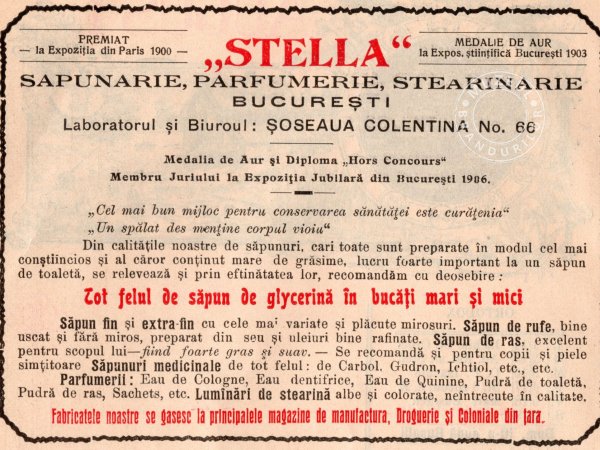
Towards the end of the 19th century, due to commercial success, the “Stella” Factory diversifies its activity. In addition to candles and ordinary soaps, toilet and perfumery products begin to be produced here, including coconut soaps, glycerin soaps, Eau de Cologne, and various scented extracts.
This expansion of the portfolio contributed to strengthening the factory’s reputation, which becomes increasingly well known not only in Bucharest, but also throughout the country. “Stella” products stood out through quality and refinement, being perceived as “extra-fine,” a characterization frequently found in the advertising materials of the time.
An important moment in the history of the factory takes place in 1903, when, within the Congress of the “Romanian Association for the advancement and dissemination of sciences,” “Stella” receives the gold medal and the diploma of honor. The distinction was all the more important as the factory was the only participant awarded in this way.
Recognition continues in 1906, when “Stella” participates in the Romanian General Exhibition, where it presents its products within the Palace of Pharmacists and the Palace of Industry. These events contribute to strengthening the brand’s image, which later becomes a supplier to the Royal Court of Romania, an achievement that confirms the prestige and quality of its products.
From joint-stock company to market leader
In the year 1915, the factory enters a new stage of development, becoming a joint-stock company. Its activity is officially extended to the production and commercialization of candles, soaps, perfumery products, oils, glycerin, and other chemical and cosmetic products.
The visibility of the “Stella” brand was impressive for that period. Its advertisements appeared in numerous publications, which demonstrated both the financial power of the company and the desire to remain in the attention of consumers. Practically, it was difficult to find a magazine or a newspaper that did not include promotions of “Stella” products.
In the interwar period, the Romanian market becomes increasingly competitive, being flooded with foreign brands, especially from France. These dominated the advertising space and brought a sophisticated air, but “Stella” manages to maintain its position. Due to constant modernization and product quality, the factory becomes a clear leader on the domestic market.
Continuous development is also reflected in infrastructure. Old buildings are replaced with new ones, adapted to the technological requirements of the time. Thus, “Stella” remains an example of adaptation and evolution in a dynamic economic context.
Nationalization and the communist period
The year 1948 brings a major change, with the nationalization of industry in Romania. The “Stella” Factory is no exception and enters state ownership. This transformation marks the beginning of a new stage, characterized by centralized organization and the limitation of private initiative.
In contrast to the interwar period, when imports were numerous, the communist regime drastically reduces access to foreign products. Instead, only the raw materials necessary for domestic production are imported. In this context, “Stella” gains an essential role in the national economy.
At one point, the factory comes to produce approximately 90% of the soap quantity in Romania, an impressive percentage that reflects its strategic importance. Practically, for entire generations, “Stella” soap becomes an omnipresent element in households, part of people’s daily routine.
Even if the diversity of products was no longer as large as in the previous period, the factory continued to operate at high capacity, adapting to the requirements of the planned economy.
Post-revolution declines and the disappearance of a symbol
After 1989, with the change of the political regime, Romania’s economy enters a transition period. The “Stella” Factory is reorganized, and through Government Decision no. 1200, the commercial company STELLA S.A. Bucharest is established.
Subsequently, it is integrated into a mixed structure, alongside the company Colgate-Palmolive Inc. and Norvea Brașov. In 1992, the factory passes into the ownership of the Colgate-Palmolive corporation, marking a radical change of direction.
However, production activity does not continue for long. In 1999, the factory completely ceases its activity, and a few years later, in 2003, the buildings are demolished. The land is capitalized, and in place of the former factory a hypermarket appears, a symbol of the new consumer economy.
The disappearance of the “Stella” Factory meant not only the loss of an industrial unit, but also the disappearance of a symbol of Bucharest. For many, the name “Stella” remains linked to memories, to the smell of soap, and to an era in which “extra-fine” products promised to keep the body “lively.”
The legacy of a factory that defined an era
Even if today it no longer physically exists, the “Stella” Factory continues to live in collective memory. Its story reflects the transformations through which Romania has passed, from Western-type industrialization to the planned economy and, later, to modern capitalism.
“Stella” was not just a factory, but a symbol of quality and innovation. It brought into Romanians’ homes accessible and well-made products, contributing to improving the standard of living. At the same time, it demonstrated that local industry can successfully compete internationally.
Today, the place where the factory once operated is completely changed, but its history deserves to be told and rediscovered. In a city in continuous transformation, such stories help us better understand the past and appreciate the evolution of the present.
We also recommend: The history of the Miraj Factory in Bucharest: from “Macul Roșu” in the 1950s to niche perfumery today