"The survivors’ block of the 1977 earthquake: Ceaușescu ensured housing for Romanians at Bucur Obor"
- Articles
- 04 MAR 26
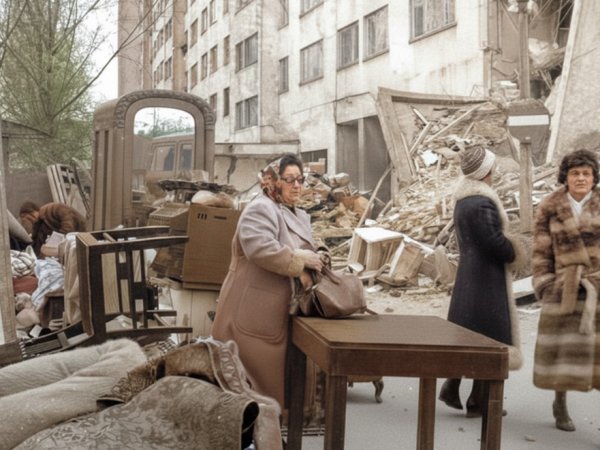
The earthquake of March 4, 1977 was one of the most devastating events in the history of Romania, causing enormous human and material losses. In Bucharest, 32 apartment buildings collapsed, and approximately 1,400 people lost their lives. Faced with this tragedy, the communist authorities were forced to find rapid solutions to shelter the families left homeless.â
The 1977 earthquake and the rapid reaction of the authorities
One of these solutions was the construction of a new apartment building on Ziduri Moși Street, in District 2 of the Capital, behind the Bucur Obor store. Less than a week after the earthquake, dozens of families affected by the disaster were moved into this building with 44 apartments.
The building was considered “one of the first apartment blocks furnished free of charge and allocated to the disaster victims,” according to reports in the press of the time. Its completion was made possible thanks to the efforts of the builders, the workers from the neighboring factories, but especially a large number of women who voluntarily participated in the general mobilization for finishing the apartments.
According to the newspaper “Scînteia,” the building should have been ready in two weeks, but due to exemplary mobilization it was completed in just a few days.
The relocation of the first families and the inspection of the Ceaușescus
On Friday, March 11, 1977, the first families moved into their new home, receiving fully furnished dwellings, equipped even with televisions and radio sets, as had been decided by the leadership of the Romanian Communist Party. On the day when the first families began to move in, Nicolae and Elena Ceaușescu personally inspected the building, wishing to ensure that everything was in accordance with the promises made. The officials of the regime used this moment to underline the efficiency and rapidity with which the state had acted in the face of the catastrophe.
On March 8, 1977, the Political Executive Committee of the Central Committee of the Romanian Communist Party had adopted a decision guaranteeing that all citizens who had lived in the collapsed buildings would receive new dwellings, fully furnished, without any expense on their part. The measure also targeted persons hospitalized following the quake, who were to be moved into the new apartments immediately after discharge.
“Citizens who lived in the collapsed buildings will immediately receive dwellings in the new apartment blocks. Hospitalized persons will also be able, upon leaving the medical units, to move into the new dwellings made available by the state.
All citizens whose homes were destroyed and whose property was ruined by the cataclysm will receive the new apartments, provided free of charge by the state, with all the necessary furniture, including radio and television sets.” Less than a week after the seismic event, the first tenants began to appear in the new building on Ziduri Moși Street:
“It was a building with 44 apartments that was supposed to be ready in two weeks, but which, through the efforts of the last days and nights of the builders, of a large number of working people from the neighboring enterprises, especially women, was ready, down to the last details, at dawn on Friday (n.r. – Friday, March 11, 1977),” it was mentioned in the publication Scînteia.
Testimonies of survivors and the reality behind the propaganda
One of the fortunate cases of people who escaped alive after the 1977 earthquake is certainly that of Elena Cloșan. In an interview granted to Historia a few years ago, the woman confessed that, at the fateful hour 21:22, she was at the Palace Hall, together with her husband, enjoying a theater play.
“We had met a year earlier, on the plane: I was returning from a delegation in Spain, and Florin Piersic was coming back to the country from filming. He insisted on inviting me and my husband to the premiere. On March 1 he even brought us the tickets.
On March 4, however, my husband was on delegation in Timișoara and I did not know if he would return by evening. He arrived around 7 and, with his hand on the doorknob, said to me: ‘Well, come on! Aren’t you ready?’ I was at home with the dressmaker and I was having outfits made.
And if we had not left for the Palace Hall, I would have been making outfits for the rest of my life. The building on Alexandru Sahia number 1 was wiped off the face of the earth. And out of more than a hundred tenants, only 5 people survived, we were the only family in the building that escaped.
In the Palace Hall, at first we thought the noise was coming from the screen, that that was how the film was… When it stopped, we went out into the street: smoke, dust, serious shots were already being fired at the gypsies who had entered the fur shops.
Arriving near the building, we saw the veterinary pharmacy that we used to see from our apartment, from the 4th floor. And in the opposite curb, a bag of mine with three pairs of stockings, which I had in the wardrobe,” the survivor of the earthquake recounted.
In the context of the 1970s, when state dwellings were generally poorly equipped, the fact that the disaster victims in the Ziduri Moși building were receiving apartments with complete furniture, televisions and radio sets was an exceptional aspect. These endowments were presented by the official propaganda as an example of the communist regime’s care for the people.
“Scînteia” reported that the dwellings were equipped “with all those necessary for a decent life: modern furniture, gas stoves, televisions, refrigerators, curtains and carpets,” which represented an important support for the families who had lost not only their homes, but also all their belongings following the earthquake.
The building on Ziduri Moși Street thus became a symbol of the rapid response of the communist state in the face of a major crisis.
In reality, however, many disaster victims did not benefit from the same conditions and were forced to manage as they could, either by living temporarily with relatives, or in improvised shelters. Nevertheless, officially, the building at Bucur Obor remained an example of mobilization and administrative efficiency.
Today, the survivors’ building from the 1977 earthquake is still standing, being a silent testimony of that tragedy and of the way in which the communist regime tried to manage the disaster. For those who lived through those dramatic moments, the building remains a symbol of a painful page in the recent history of Romania.
We also recommend: The Titan Toma Caragiu, Lost in the ’77 Earthquake: “Someone Told Me I Would Die in a Collapse!”