The Street Food of Old Bucharest. From the Oltenian Hawker to Bragă and Halva
By Eddie Țone
- Articles
- 09 MAR 26
Interwar Bucharest often appears in collective memory through sepia-toned images: gentlemen in tailcoats and ladies wearing elaborate hats, strolling gracefully toward Capșa for a slice of Joffre cake. Beyond the elegant display windows of grand confectioneries and the French-inspired menus of luxury restaurants, the city pulsed with a far more democratic culinary life unfolding under the open sky.
The Bucharest sidewalk served as the main stage for a culinary spectacle where hurried hunger met the ingenuity of small street vendors, creating a culture of immediate consumption that rivaled, in both variety and freshness, any modern fast-food concept.
This world of food-to-go was regulated less by illuminated advertising signs and more by the distinctive cries of each trade. The interwar Bucharester, whether a municipal clerk, a literature student, or a porter in the Obor market, had access to a vast network of suppliers of freshly prepared calories, ready to be eaten on the move or on a bench in Cișmigiu Park.
The atmosphere was dominated by the smell of roasted corn, the sharp aroma of pastrami sizzling on open grills, and the comforting fragrance of warm pretzels. Together, these elements formed the backbone of everyday urban sustenance.
The Oltenian Hawker and His Shoulder Pole: The Mobile Supermarket of the Neighborhood
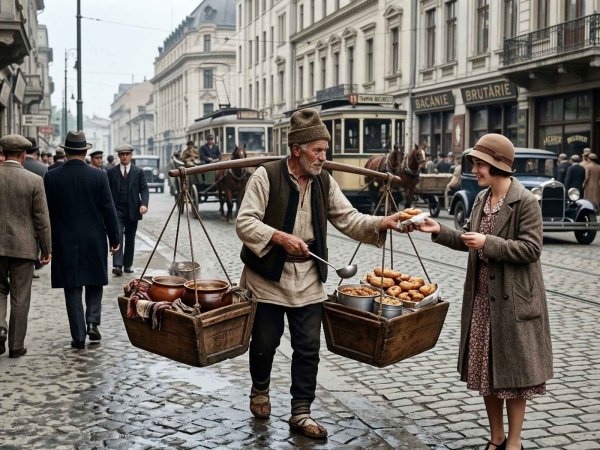
At the center of Bucharest’s street trade stood the Oltenian hawker, an omnipresent figure who carried an entire gastronomic household across his shoulders. His cobiliță, a curved wooden pole used for balancing heavy loads, supported two enormous baskets filled with delicacies.
These vendors formed the vital link between the vegetable gardens on the city’s outskirts and the table of the urban resident. From their baskets, passersby could purchase fresh fruit, burduf cheese preserved in fir bark, or chilled yogurt kept in glazed clay pots covered with walnut leaves to maintain a low temperature.
Yogurt bought from the Oltenian hawker represented the ideal breakfast for those heading to work. It was served in small ceramic bowls that customers either emptied on the spot or took home, returning them the next time the vendor passed through the neighborhood. It functioned as an early form of circular economy built on community trust, a system that worked remarkably well.
The Oltenians also excelled in the art of auditory marketing. Each had a distinctive call announcing his goods, turning the streets into a polyphony of culinary offers.
Mititei and Pastrami: The Grill as Social Theater
Today, street food often comes with refrigerated displays and plastic gloves. During the interwar years, freshness came straight from open flames. Grills placed at street corners, especially in busy areas such as Gara de Nord or Obor Market, offered the perfect solution for a quick and hot meal.
The undisputed star was the mititel, which had already earned its status as a national symbol. It was served with a piece of dark bread and a generous spoonful of Tecuci mustard, eaten directly from a sheet of wax paper that absorbed the flavorful juices.
One famous grill master from the Moșilor district, known simply as Nenea Iancu, became a local legend thanks to the speed with which he flipped the mititei and the precision with which he seasoned them. Long lines of customers waited patiently for their portion of “patrioți,” the slang term for mititei in the jargon of the era.
Alongside them, quickly grilled sheep pastrami cooked over glowing embers became the ultimate autumn delicacy, often accompanied by a mug of fresh grape must pressed right before the customers’ eyes. This was true Bucharest street food: intense, noisy, and unapologetically honest in its flavors.
Pretzels and Simit Sellers: Architects of the Morning Taste
Pretzel bakeries served as fixed landmarks in the urban landscape, usually located on the ground floor of buildings along major boulevards or near schools. The sesame or poppy-seed pretzel functioned as the unit of measurement for morning hunger and was produced in enormous quantities to satisfy overwhelming demand.
The preparation itself was a form of public performance. Through large windows, passersby could watch the dough being shaped rapidly, briefly boiled in large copper cauldrons, and then baked to a golden brown in stone ovens fired with beech wood.
A particularly interesting aspect of pretzel consumption was the pairing with yogurt or buttermilk, a combination that provided a complete meal at a negligible price. Pretzel sellers often carried large trays balanced on their heads, maneuvering through the crowd with acrobatic dexterity while shouting: “Hot, folks, hot!”
More sophisticated versions also existed, such as Brașov pretzels or honey-boiled varieties, which attracted a more demanding clientele looking for a sweet snack between business meetings.
Boiled Corn and Seeds: The Universal Boulevard Snack
As the sun set over Bucharest, the profile of street food shifted subtly. Pretzel sellers gradually gave way to vendors of roasted or boiled corn who set up small mobile stoves at the corners of parks.
The steam rising from salted boiled corn created an atmosphere of domestic comfort in the middle of urban bustle. These vendors often appeared as picturesque figures surrounded by children and young people strolling along Calea Victoriei or through Grădina Icoanei.
Sunflower or pumpkin seeds, sold in paper cones made from old newspapers, became the primary pastime of those occupying park benches. Authorities occasionally tried to restrict this habit for reasons of cleanliness, yet Bucharest residents remained loyal to the meditative ritual.
True connoisseurs even claimed expertise in seeds, possessing secrets about the ideal roasting time and the precise quantity of salt required to keep a consumer happily occupied for hours.
Halva and Bragă: Sweetness and Refreshment on the Corner
For those with a sweet tooth, the street offered equally diverse options. Vendors of alviță, a dense confection made from sugar and nuts, carried large slabs of sticky white mixture sprinkled with walnut kernels. Using small chisels, they carved precise portions for customers.
This task required significant strength, as high-quality alviță possessed remarkable density. Nearby stood sellers of halva and Turkish delight, reminders of the Oriental influences still embedded in the city’s cultural fabric.
Bragă, the slightly sour beverage obtained through the fermentation of millet, served as the national drink of Bucharest’s streets. Bragă vendors, often of Albanian or Turkish origin, carried large insulated metal containers on their backs and served the drink in thick glass cups rinsed quickly in a basin of water.
Although the hygiene standards of the time might horrify a modern inspector, the popularity of bragă remained immense. It was widely considered the best antidote to the July heat. The Romanian expression “cheap as bragă” originates precisely from this extraordinary affordability.
Seasonal Delicacies: From Roasted Chestnuts to Ice Cream
The culinary calendar of the streets followed the rhythm of the seasons with remarkable precision. In winter, Bucharest smelled of roasted chestnuts sold by vendors warming their hands above trays of glowing charcoal.
Customers often slipped the chestnuts into their coat pockets, using them as temporary hand warmers before eating them. The contrast between the cold air and the warmth of the chestnut formed an essential part of the charm of Bucharest winters.
Summer belonged to ice-cream sellers pushing colorful carts insulated with natural ice harvested from the city’s lakes during winter and stored in deep cellars packed with straw.
The flavors remained simple: vanilla, chocolate, and fruit. The quality of the ingredients, however, stood out thanks to rich milk and real sugar. Ice cream was served between two round wafers, forming a sweet sandwich meant to be eaten quickly before the sun turned it into a small puddle on the pavement.
Salep and Warm Drinks for Winter Nights
During freezing nights, alongside the chestnut vendors, salep sellers made their appearance. Salep, a warm drink of Oriental origin prepared from ground wild orchid tubers mixed with milk and cinnamon, was widely regarded as a remedy for colds.
Salep vendors operated mainly near theaters and cinemas, offering spectators leaving evening performances a comforting way to warm up before heading home. The slightly viscous texture and exotic aroma added a note of street-corner mystery to a city aspiring to Western modernity.
Tea and sand-brewed coffee could also be found at certain strategic locations, although these tended to stabilize in small permanent kiosks. Mobility remained the guiding principle. Interwar Bucharest functioned as a city constantly chewing, and the availability of both hot and cold beverages perfectly complemented the solid foods that sustained urban life.
Legislation and the Control of Street Food
Despite the romantic aura surrounding street food, administrative reality involved constant attempts at regulation. The Bucharest City Hall periodically issued ordinances requiring uniform attire for street vendors and the observance of basic sanitation standards.
White coats became mandatory for those handling food directly on the street, although their shade of white occasionally raised questions. Inspectors existed to verify the quality of milk or meat, yet the sheer size of the city and the mobility of vendors rendered these controls largely symbolic.
The tension between European-style urban modernization and the Balkan tradition of street commerce appeared everywhere. While the city center attempted to impose strict standards, the outskirts remained loyal to older customs where freshness depended on the honor of the vendor rather than the stamp of an institution.
This contrast contributed to the unique charm of the era, creating an environment where luxury and simplicity shared the same stretch of pavement.
What Remains of the Taste of the Past
Street food in interwar Bucharest represented a social mechanism of integration and a way of life. From a hurried breakfast bought from an Oltenian hawker to a late dinner consisting of mititei eaten straight from the grill, Bucharest residents treated the street as an extension of their own kitchen.
The interwar period left behind recipes and a philosophy of quick consumption built on direct contact with the producer and the honesty of ingredients.
Today, when looking at the standardized displays of international fast-food chains, one can see that the need for quick and satisfying meals remains constant. What disappeared, however, is the human spectacle that once accompanied every transaction on the boulevards of old.
Interwar street food offered a genuine form of survival and pleasure, perfectly adapted to the rhythm of a city learning to become a metropolis while still remembering its neighborhood roots.
You may also like: 10 Forgotten Habits of Old Bucharest