The Five Years That Shaped Today's Bucharest — and the Marks They Left Behind
- Articles
- 22 APR 26
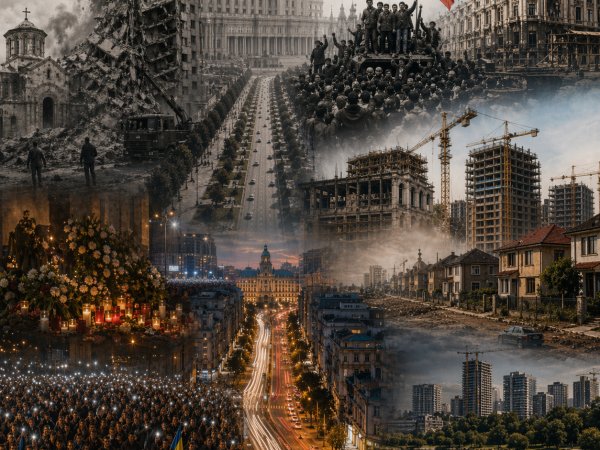
Bucharest was built in noise and haste, always under the pressure of something — an earthquake, an ideology, a crisis, a wave of money that arrived too fast. It went through demolition and reclamation, through celebration and neglect, sometimes within the same century, sometimes within the same decade. A handful of years in its history explain more than all the others combined: why it looks the way it looks, why it works the way it works, and why the same problems return with a regularity that has, over time, become something of a character trait.
1977 — The Earthquake That Handed a Dictator a Construction Permit
At 9:22 p.m. on March 4, 1977, a 7.4-magnitude quake lasted 56 seconds and took 1,424 lives in Bucharest alone. Entire buildings on Magheru Boulevard — the Scala, the Casata, the Continental — simply vanished. The central streets looked like the aftermath of a bombing. Ceaușescu saw the opening. Four days after the earthquake, he was already summoning architects to discuss a new political and administrative center for the capital. The chosen site shifted quickly to Arsenal Hill, where the complex now known as the Palace of Parliament would rise.
The earthquake became the justification for the most extensive demolition program in the city's history — and not all the buildings brought down had cracks in their walls. Some were simply inconvenient. The Enei Church, next to the Intercontinental Hotel, disappeared within hours, pushed down by army machinery while architects and artists tried to stop the demolition. The Unirii Boulevard, the colossal apartment blocks, the vast urban void in the southern center of the city — none of these were born from a natural disaster. They came from a political decision that the earthquake accelerated and justified, in front of a population too stunned to ask why.
Also recommended "The survivors’ block of the 1977 earthquake: Ceaușescu ensured housing for Romanians at Bucur Obor"
1989 — Freedom as a Blank Page, With No Pen in Sight
On December 22, 1989, Ceaușescu fled by helicopter from the roof of the Central Committee building. Hours later, Bucharest residents filled the Boulevard of Socialist Victory and celebrated in front of the House of the People. The geographical irony was complete — the very street built as a monument to absolute power had become the stage for its collapse. The demolitions stopped. Private property became possible again. The city stayed suspended, for several years, between what it had been and what it might become.
Freedom, translated into urban terms, also meant chaos. Without a transition plan, the spaces of former state enterprises, properties subject to restitution and the city's markets entered an accelerated redistribution in which the state was too weak and the citizen too caught off guard to respond. Bucharest in 1990 was a city with its scaffolding down but no architect in sight. That absence left marks still visible today — in broken urban grids, in neighborhoods with no center, in buildings abandoned for decades in the heart of the city.
2002 — The Money Arrives, the Plan Stays on Paper
In the early 2000s, Bucharest's real estate market woke up suddenly. Banks were offering accessible mortgage loans, the economy was growing, and the appetite for private property had been sharpened by decades in which housing had been a privilege distributed by the state. Buying any property was automatically a good deal. Apartment prices rose up to tenfold between 2002 and 2008, even though a studio flat in Titan or Colentina had nothing fundamentally different to offer than it had in the nineties.
It was a bubble, but nobody was calling it that. Meanwhile, the city was building fast and without coherence — tower blocks appearing in improbable locations, satellite neighborhoods in Ilfov county with no infrastructure, historic buildings left to decay while characterless new ones rose in their place. The bubble burst in 2008. Prices fell sharply. But the improvised infrastructure of those years — urban, real estate, administrative — remained, and continues to shape, in 2026, what new neighborhoods look like, why traffic is a permanent collapse and why Ilfov keeps growing faster than it can absorb.
2015 — The Night Victory Square Acquired a Different Meaning
On October 30, 2015, indoor pyrotechnics at the Colectiv club killed 64 people. The nightclub was operating without a fire safety permit. When that became public, grief rapidly gave way to anger. Within days, tens of thousands of people were on the streets of Bucharest. Prime Minister Ponta resigned. The mayor of Sector 4 resigned. It wasn't enough — and many people knew it — but something had happened that hadn't happened with this clarity before: the street was functioning as a real instrument of political pressure in a city that had understood it could demand accountability.
What remained after Colectiv is not easily measured in laws or regulations, though some did follow. It is measured in the way a generation of Bucharest residents recalibrated their relationship with public space. The protests of 2017 and 2018, among the largest in post-communist Romanian history, would not have looked the same without November 2015. Victory Square had gained, in the eyes of those who had stood there, another layer of meaning — one that no urban planning manual can produce.
2023 — A City That Knows What It Wants to Be, but Not Who Gets to Decide
In 2023, Bucharest was still operating under a General Urban Plan drawn up in the year 2000. The new plan, contracted in 2013 and relaunched in 2022, remained blocked for bureaucratic and financial reasons. Green space had fallen below 10 square meters per resident, under the minimum recommended by the World Health Organization. At the same time, Bucharest generated 26% of national GDP that year, with an economy larger than many European capitals and a concentration of talent, companies and opportunity found nowhere else in Romania.
Entire cities in the south of the country were emptying out in favor of the capital. The pressure kept growing, the infrastructure kept stalling. Civic groups were saving parks, architects were raising alarms, the city's mayor was ending up in court with his own city council members over building permits. Urban planning had become the subject of scandal, litigation and local referendums. Bucharest in 2023 was a city with a clear sense of its own problems and an unresolved question about who holds the authority — and the will — to fix them.
Each of these years left something in the structure of the city — sometimes a boulevard, sometimes a civic habit, sometimes an administrative wound that reopens on schedule. Today's Bucharest is the sum of these overlapping urgencies, never fully resolved, always picked up again by new people with the same old tools.
The city you move through today carries all these moments at once. Not sequentially, not neatly — but layered, like coats of plaster applied before the one underneath had time to dry. Some wounds have scarred over, others have reopened under a different government, a different mayor, a different crisis. That may be the most Bucharest thing of all: the city keeps moving forward without ever having finished with what came before.