Pandelică Watches Over. The Only City Hall in Bucharest Built Specifically for That Purpose
- Articles
- 21 APR 26
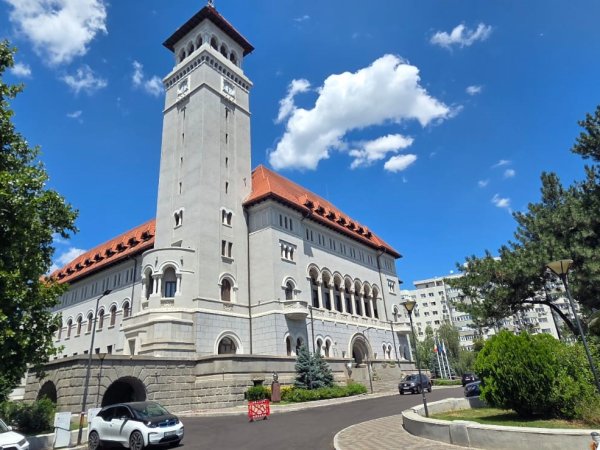
On Boulevard Banu Manta nr. 9 stands a building with a simple and rare résumé: it was conceived as a city hall, built as a city hall, and has remained a city hall. Every other similar institution in Bucharest ended up playing that role by circumstance — the General City Hall operates out of a palace built at the turn of the twentieth century as the headquarters of the Ministry of Public Works, impressive and grand, but designed for someone else entirely. The one on Banu Manta started with a single purpose in mind and held onto it.
The Green Sector and a Plot Called Elefterescu
It all begins in 1926, when interwar Bucharest reorganizes itself administratively. After the Great Union, the capital had been divided into four sectors — Yellow, Black, Blue, and Green — each with its own administration, its own budget, and, in the ambitious logic of the era, its own administrative residence to match.
For the Green Sector, the municipality purchases a plot of roughly 20,000 square meters, the former Elefterescu property, which the urban planners of the time envisioned as a complete civic center: city hall, school, dormitory, community theater, market. A city in miniature, drawn up on paper with genuine seriousness. Of that entire plan, what remained was the city hall. In hindsight, that's enough.
Construction begins in 1928 and runs for nine years, at a cost of 35 million lei. Nine years for a building that was meant to represent local authority not through borrowed grandeur, but through architecture conceived from scratch and dedicated to its function.
Two Architects With Different Visions
The project lands with an unlikely pair: Nicu Georgescu, drawn toward Art Deco, and George Cristinel, the author of several solid Neo-Romanian monuments — the Mausoleum at Mărășești, the Metropolitan Cathedral in Cluj-Napoca. Two men working in different architectural languages, asked to sign the same building.
The tension between them is still visible in the structure today. There is something of the sober civicism of Venetian Renaissance communal palaces in the way the volumes are composed, yet everything is dressed in the Neo-Romanian vocabulary of the period. A synthesis that produces something distinctive in the city's landscape, something difficult to pin to a single label.
Inside, the building held 50 offices and a large marble hall for council meetings and ceremonies. On the tower's façade, a decorative band originally supported an exterior fresco depicting King Ferdinand and Queen Maria. The fresco vanished in the 1950s, plastered over with reinforced render. It remains there, buried under the masonry, impossible to recover.
Pandelică, the Sentinel at the Top
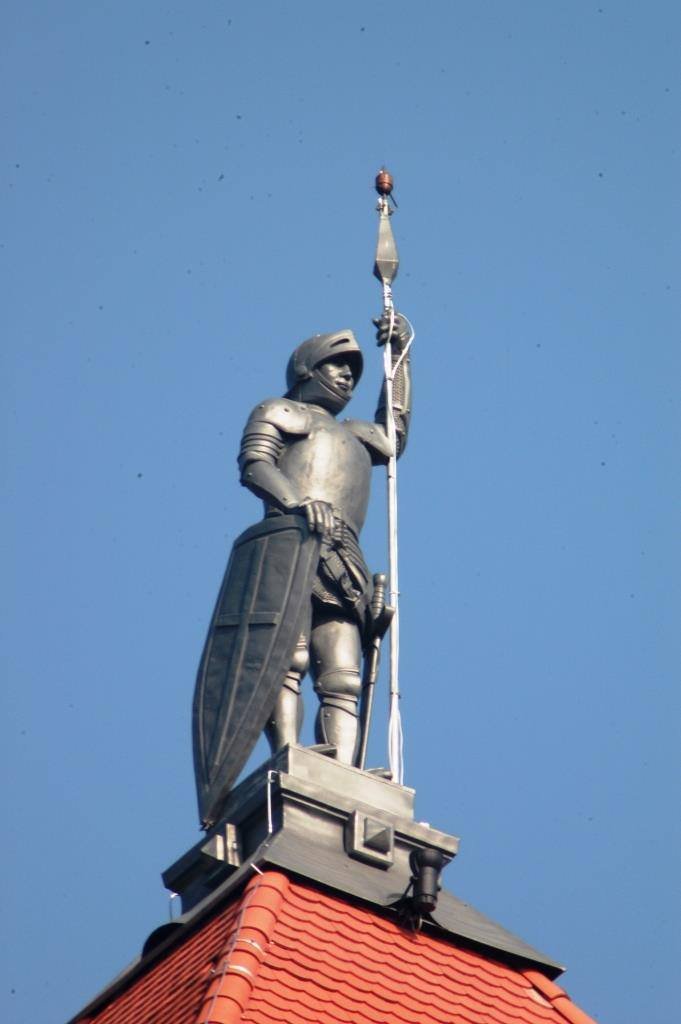
Cel most recognizable element of the building is neither the marble hall nor the interior frescoes depicting King Carol II. It is a tin knight standing 3.5 meters tall, perched atop the 56-meter tower.
The tower was far from decorative. In the interwar period it was the tallest structure in the area, and firefighters used it as a proper fire watchtower — an observation post from which they monitored the city. The story goes that their chief was named Pandele, and the neighborhood's residents baptized the knight with his name, in its affectionate diminutive form: Pandelică. A nickname that says more than it appears to — that the statue had been adopted, that it had become theirs, that the city hall's own employees considered it a colleague, not an ornament.
The knight had been created by Alexandru Dimitriu, a decorative tinsmith with an impressive catalog of metalwork — the ornamentation of the Romanian Athenaeum, the Patriarchal Palace, Bucharest's North Station. An almost identical version of Pandelică stands on the craftsman's own house on Strada Episcopul Radu, a kind of double signature left in the same city.
In the 1980s, the Ceaușescu regime lined Boulevard Banu Manta with monolithic apartment blocks that cut into the building's presence and buried it visually in a context it never chose. Pandelică stayed up there, looking out over a concrete wall that had risen after he was put in place.
Fire, Communism, and a Renovation Full of Setbacks
From 1950 until the mid-1960s, the building housed the People's Council of the Grivița Roșie District — the Soviet-inspired administrative division that had replaced the interwar sectors. The institution's name changed, the people changed, the function stayed the same.
The modern ordeal began in 2008, when the building entered a seismic consolidation process. The works damaged the architecture of the interior spaces, and in the autumn of 2009, in the middle of the construction site, a fire destroyed almost the entire original roof structure. Funding was frozen in 2011, the project stalled for several years, and when work resumed, the multidisciplinary team brought in started with a serious historical study as its foundation. The new roof structure replicates the geometry of the original, restoring the building's silhouette, while the interior use of laminated timber also allowed for a few new functional spaces. The city hall returned to Banu Manta in 2015.
The building at Banu Manta nr. 9 passes largely unnoticed on the city's tourist circuit, hemmed in by the rows of apartment blocks from the 1980s that make it harder to read. And yet it still stands out from that context — the tower with its pointed belfry, Pandelică at the top, the proportions of a structure built to mean something.
What makes it unique in Bucharest's administrative landscape is its consistency. It was designed for a single purpose and has kept it, regardless of how many times the name of the institution inside has changed. And Pandelică continues his watch from 56 meters up, tin shield in hand, with a gaze that has taken in kings, commissars, and mayors.
Also recommended 10 streets in Sector 1 of Bucharest that have interesting stories.