Symbols of Bucharest: Hotel Ambasador, “born” in the interwar period, witness to crimes and passionate suicides
- Articles
- 20 APR 26
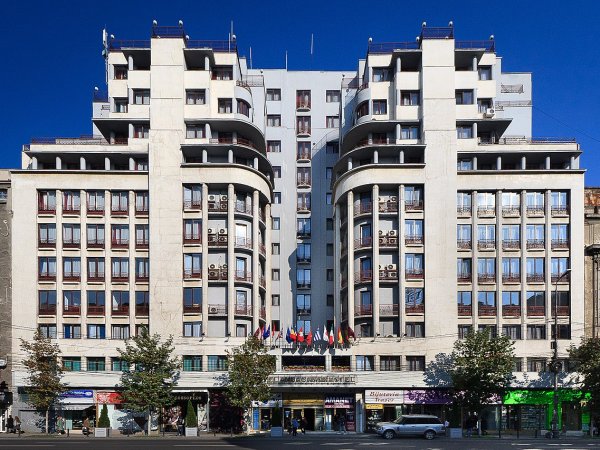
In the heart of the Capital, on one of the most well-known urban arteries, Bulevardul Magheru, rises a building that has crossed almost a century of history, transformations, and dramatic events: Hotel Ambasador. Considered a symbol of interwar Bucharest, this hotel is not only an emblematic construction from an architectural point of view, but also a silent witness to some tragic episodes that marked both the history of the city and individual destinies. Positioned between the Ciclop garage and Cinema Patria, the hotel has been, over time, both a landmark of urban elegance and the scene of dramatic events that captured public attention. Its story is a complex one, in which architecture, history, and tragedy intertwine in a particular way.
The birth of an interwar symbol
Built between 1937 and 1939, Hotel Ambasador is the work of the architect Arghir Culina, one of the important figures of Bucharest architecture in the interwar period. He was not only the designer of the building, but also a co-owner, alongside Constantin S. Mihăescu, a well-known name at the time for the development of urban infrastructure.
Initially, Culina’s plans did not aim at building a hotel, but a residential building with commercial spaces on the ground floor. However, the project evolved, and the final result was spectacular: a modern hotel, adapted to the requirements of a European capital in full development.
Officially inaugurated on May 4, 1939, Hotel Ambasador was described by the press of the time as one of the most modern accommodation units in Europe. With approximately 300 rooms and just as many bathrooms equipped with state-of-the-art sanitary installations for that period, the hotel offered a level of comfort rarely encountered.
The adopted architectural style, art deco, was Culina’s favorite and is also found in his other projects, such as Hotel Union and Hotel Negoiu. These buildings contributed to shaping a modern and cosmopolitan image of interwar Bucharest.
Elegance, luxury and transformations over time
During the glory period of the 1930s and early 1940s, Hotel Ambasador was part of the luxury hotel circuit of the Capital, alongside renowned names such as Athénée Palace or Grand Hotel du Boulevard. It was a place frequented by businessmen, diplomats, and foreign tourists, quickly becoming a symbol of refinement.
The building impressed not only through its facilities, but also through its dimensions. With its 12 floors, it was at the time of its inauguration the tallest construction in the area. Its façade, dominated by two massive and symmetrical columns, offered an imposing image over the boulevard.
After the Second World War, the hotel went through a difficult period. It was closed between 1949 and 1954, being later reopened in a completely different political and social context. Nevertheless, it kept its status as an urban landmark, even if the level of luxury and exclusivity gradually began to decline.
At present, the hotel has 209 rooms, including apartments, studios, and double rooms, as well as a restaurant located on the first floor, which offers dishes from Romanian and international cuisine. The building also includes conference rooms, adapted to modern needs.
Tragic events from the 1940s
The history of Hotel Ambasador is not, however, only one of elegance and modernity. In the 1940s, it was the witness of a dramatic event that was going to influence the political evolution of Romania.
On January 18, 1941, in front of the hotel, Helmuth Doring, a German aviation major and member of the German Military Mission in Romania, was fatally shot. The incident had a major impact, being used as a pretext by Ion Antonescu to trigger violent actions against the Legionary Movement.
This episode contributed to the escalation of political tensions and culminated in the Legionary Rebellion of 1941, one of the most troubled moments in the contemporary history of the country. Thus, the hotel became, without its will, part of a dramatic historical context.
Contemporary dramas and echoes in the press
Decades later, Hotel Ambasador returned to public attention for equally tragic reasons. About two and a half years ago, the building was the scene of a suicide that shocked public opinion.
A 26-year-old young man threw himself from the 12th floor after he had killed his wife in an act of extreme violence, motivated by jealousy. The case was intensely covered by the media and brought back into discussion not only the individual drama, but also the symbolism of the place.
This episode consolidated the image of the hotel as a space loaded with dramatic stories, in which past and present intersect in a disturbing way.
A new beginning: the transformation into “The Julius Bucharest”
After years in which the hotel’s popularity declined, 2024 marked a turning point. The building, with an area of approximately 12,600 square meters, was acquired by the company Julius Meinl Living.
The acquisition process took place in two stages: initially, the company took over Ambasador SA, which owned part of the property, and later it acquired the rest of the building. The investment includes both own funds and bank financing.
The plans for the future are ambitious. After extensive renovation and modernization works, the hotel is set to reopen in 2027 under the name “The Julius Bucharest”, a modern hospitality concept inspired by the model already implemented in The Julius Prague.
The new unit will pursue high sustainability standards, aiming for LEED Gold certification, awarded by the U.S. Green Building Council. This reflects a global trend toward energy-efficient and environmentally friendly buildings.
Between past and future: a landmark of the city
Hotel Ambasador remains, in essence, a symbol of Bucharest, regardless of the transformations it goes through. From interwar elegance to postwar decline and up to contemporary rebirth, the building reflects the evolution of the city itself.
Its stories – some brilliant, others tragic – are part of the collective memory of the Capital. Whether it is seen as an architectural monument, as a place of history, or as a space of human dramas, the hotel continues to fascinate.
With its planned reopening, there is hope that this urban symbol will regain some of its former brilliance, while integrating modern standards of the hospitality industry. Thus, Hotel Ambasador is not only a relic of the past, but also a promise for the future of Bucharest.
We also recommend: Dunărea Hotel, the architectural jewel turned ruin. Destroyed by earthquakes, abandoned by the Romanian state