The Mosques and Muslim Community of Bucharest: Five Centuries of Presence, Disruption and Revival
By Eddie Țone
- Articles
- 26 OCT 26
Bucharest takes great pleasure in telling its own history through churches, inns, palaces and cafés, usually with a story about some aristocrat who spent his fortune in a manner spectacular enough to earn himself a commemorative plaque. Yet the city also has a Muslim history that remains almost invisible. And still, Turkish merchants were passing through the Romanian capital back when Bucharest was barely learning how to be a city. Ottoman soldiers and craftsmen lived here, coffee was enjoyed in the Istanbul fashion, a small place of worship was mentioned by the famous traveller Evliya Çelebi, and in 1906 King Carol I built a mosque right in the middle of his grand Jubilee Park.
The appealing notion of “500 years of continuous Muslim community life” moves rather faster than the historical evidence. The sources provide strong support for a documented Muslim presence in Bucharest spanning approximately five centuries, although its intensity varied considerably from one period to another. A settled community, institutionally organised and visible through its own places of worship, emerged much later. Research into Wallachia highlights precisely what made the region unusual: exceptionally strong political and commercial ties with the Ottoman Empire, combined with a relatively small Muslim settlement compared with provinces governed directly from Istanbul.
And this is where the story becomes interesting. For centuries, Bucharest lived with the Orient beside it, passing through it and occasionally settling within it. The traces run far deeper than the convenient image of a “Little Paris” that apparently emerged fully formed from a top hat and a croissant.
The Earliest Trace Leads to a Turkish Merchant in the 16th Century
One of the earliest pieces of evidence comes from the world of commerce. A document dating from the early 16th century describes the arrival in Bucharest of a Turkish merchant carrying a substantial quantity of goods, at a time when Wallachian rulers were encouraging trade with Brașov and the Ottoman world. Research into southeastern European trade routes confirms the presence of Ottoman merchants in Wallachia from the early modern period.
In other words, Muslims appear in Bucharest's historical records before the boulevards, before the Phanariots, and roughly three centuries before the city began practising its French.
The relationship with the Ottoman Empire was rather unusual. Wallachia was under Ottoman suzerainty while retaining its own administration and local political structures. This helps explain something that may seem surprising today. For a very long time, Moldavia and Wallachia remained almost entirely devoid of the major Islamic architectural landmarks found in Ottoman territories such as Bosnia, Bulgaria and Albania. Historian Michał Wasiucionek argues that the absence of monumental mosques was largely connected to the low density of Muslim settlement and local political arrangements, rather than to any supposed absolute prohibition established by treaty.
Bucharest had therefore become a city deeply connected to the Ottoman world, yet one with remarkably few Islamic buildings.
Evliya Çelebi and the Small Mosque Bucharest Lost
Around the middle of the 17th century, one of the Ottoman world's most entertaining chroniclers enters the story: Evliya Çelebi. An indefatigable traveller and storyteller whose imagination occasionally caused historians to raise an eyebrow, Evliya nevertheless remains an essential source for understanding the urban geography of his time.
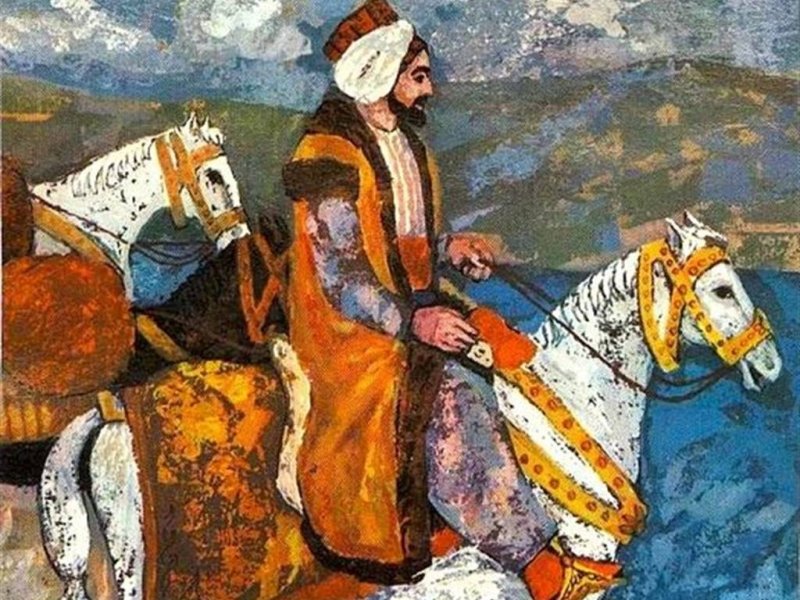 Evliya Çelebi
In his description of Bucharest, he mentions an inn intended for Muslims and a small prayer space. The Encyclopaedia of Islam published by the Türkiye Diyanet Foundation records his account of a caravanserai with approximately 50 rooms, located near the Dâmbovița River, where there was also a mosque and several graves.
Modern research describes the place of worship as a masjid, a small Muslim building intended for prayer. Historian Viorel Achim and studies devoted to Muslim communities in Wallachia point to a discreet presence consisting of merchants, officials and other categories of Ottoman subjects.
Thus, 17th-century Bucharest already offered at least a minimum of infrastructure for Muslims staying in the city, whether temporarily or for longer periods. The spectacular minaret may have been missing from the skyline, but the prayer rug had nevertheless found its place.
By the 18th Century, Turkish Merchants Were Already Doing Serious Business in Bucharest
The Phanariot period brought a dramatic intensification of ties with Istanbul. Fashion, gastronomy, commerce and the social etiquette of Bucharest's elite all carried a distinctly Levantine flavour. Coffee, sherbets and tobacco became part of the daily rituals of those with sufficiently healthy purses, while clothing and luxury goods reached the local market through trading networks extending across the Ottoman Empire.
An excellent indication of the scale of this activity appears in a study of the circulation of Ottoman products in the Romanian Principalities. In 1745, the Catholic bishop Antonio Becich recorded the presence of approximately 500 Turkish merchants in Bucharest.
Bucharest had a population of several tens of thousands at the time. Five hundred traders arriving from the Ottoman world represented a substantial enough presence to influence the city's commercial streets, consumer habits and everyday conversations.
Other studies mention hundreds of yamaci, soldiers associated with the Danubian garrisons who simultaneously practised various trades and commercial activities. Some ran inns, others sold food or worked as craftsmen. Local authorities periodically attempted to limit their numbers, particularly when commercial disputes became rather more colourful than the administration would have liked.
The Oriental Bucharest that today's popular imagination often reduces to a few cups of coffee and some Turkish loanwords had real people behind those influences.
Why “Ottoman” Bucharest Had So Few Mosques
There is something paradoxical about it. The city could have hundreds of Muslim merchants and an urban culture strongly influenced by Istanbul, while its religious landscape remained overwhelmingly dominated by Christian churches.
Bucharest belonged to the Ottoman political and economic system without having the status of an ordinary Ottoman province. Local elites retained control over land and institutions. Recent historical research links precisely this political structure to the relatively limited emergence of permanent Muslim settlements. Without sizeable Muslim neighbourhoods, there was little of the momentum that led to the construction of large community mosques in other Balkan cities.
At various times, there were Ottoman soldiers, merchants, officials and even small local Muslim groups. Studies mention, for example, communities of Muslim Roma in Wallachia.
The 19th century then radically changed the city's orientation. Following the Organic Regulation and particularly after 1859, Bucharest embarked on a rapid process of institutional and architectural Europeanisation. French influence became an urban obsession, while the older Levantine layer gradually slipped into the category of things considered unfashionable.
Paris was winning the battle of appearances, while Istanbul remained in the vocabulary, the kitchen and a handful of everyday gestures.
Muslims Arriving from Dobruja and the Emergence of a Permanent Community
After the Romanian War of Independence and the incorporation of Dobruja into Romania, Bucharest's relationship with the Muslim population took on a new form. The Romanian Cultural Institute cites research indicating that, after 1878, several hundred Turkish-speaking Muslims arrived in the capital from Dobruja, including the Mangalia area, and settled in the southern part of the city.
From this point onwards, the history of a permanent Muslim community in Bucharest becomes considerably easier to trace through documentary evidence.
Romania now had a significant Muslim population in Dobruja, consisting mainly of Turks and Tatars. The Muslim religious community was institutionally organised after 1877, and the Romanian state integrated Islamic communities into its official system of religious recognition. The State Secretariat for Religious Affairs documents Romania's Islamic tradition, the development of communities in Dobruja and the existence of an organised community in Bucharest.
But the most spectacular moment was still to come, in 1906.
Carol I Builds the Capital's First Major Mosque
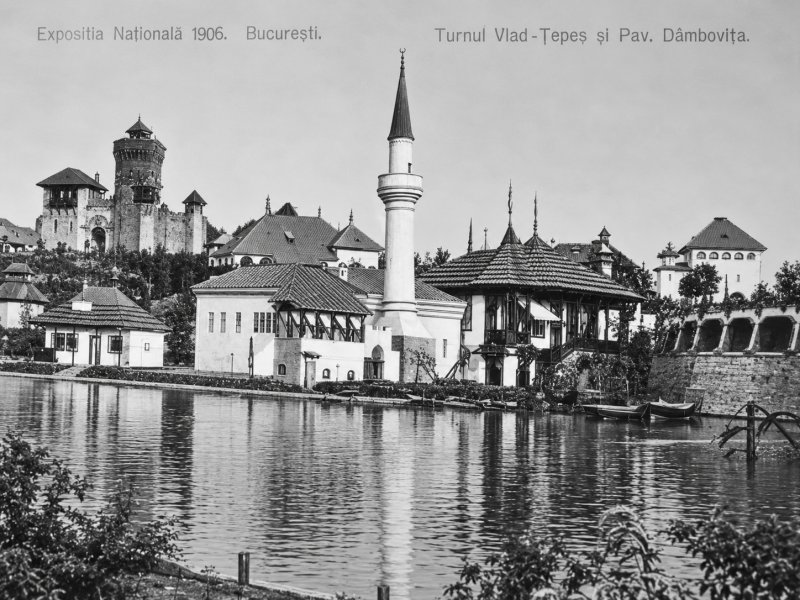 The mosque in Carol Park, built in 1906 and later demolished in the late 1950s. / Image restored with the help of AI.
The Romanian General Exhibition of 1906 was intended to showcase everything Romania had achieved during the forty years of Carol I's reign. On Filaret Hill, an entire temporary city was effectively constructed, complete with pavilions, the Roman Arenas, the Palace of Arts and a multitude of buildings through which the state presented its own celebratory vision of itself. Among them stood the Carol-Hunchiar Mosque.
Romania's National Heritage Institute dates the building to 1906 and attributes its design to the French architect and landscape designer Édouard Redont, who was responsible for laying out Carol Park. The mosque stood on an island in the lake, giving it a surprisingly theatrical presence in a Bucharest that was discovering its enthusiasm for world exhibitions.
The building served the capital's Muslim community while also performing an obvious symbolic function. The King of Romania, the Christian monarch of a state that had gained its independence from the Ottoman Empire less than three decades earlier, was providing the capital's Muslims with an official place of worship.
The Mosque Demolished and Rebuilt in Pieptănari
The original setting survived until the communist-era transformations of Carol Park, which was renamed Liberty Park. In 1959–1960, the reorganisation of the area around the monument dedicated to communist leaders affected the old mosque.
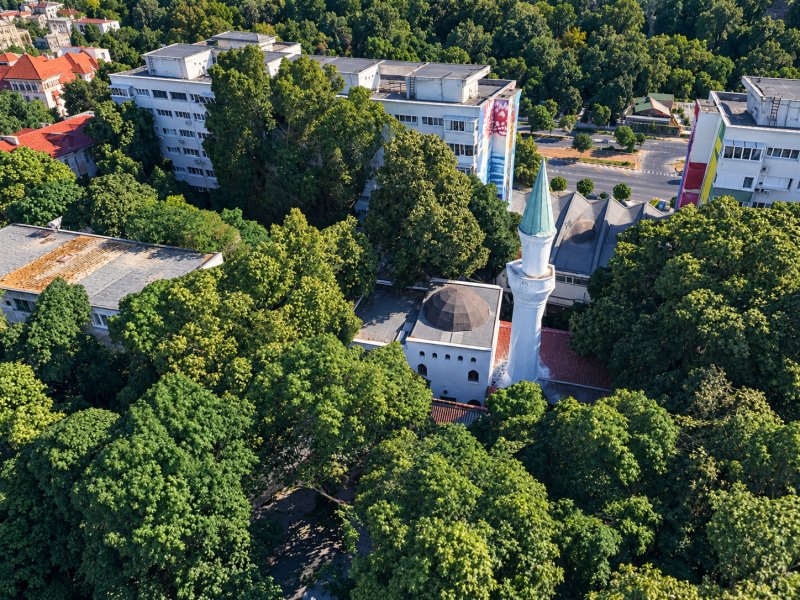 Carol-Hunchiar Mosque in Bucharest
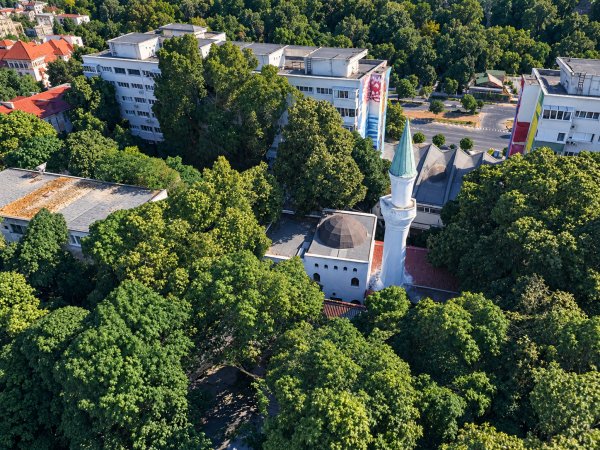
The National Heritage Institute records the demolition of the building at its original location and its reconstruction in 1960 on Constantin Mănescu Street, near the Pieptănari area, close to today's Eroii Revoluției Square.
This is the mosque that Bucharest still has today, known as Carol-Hunchiar or the Pieptănari Mosque.
Through its very existence, the building tells an extraordinary story about Romania's 20th century. It was built under a monarchy, demolished under a communist regime and reassembled a few streets away, while prayers continued throughout.
Until the fall of the communist regime, it remained the capital's main Islamic place of worship. A guide to religious architecture produced under the auspices of the Romanian Order of Architects subsequently identifies the major transformation that followed 1989, when new Muslim communities emerged, consisting largely of students and immigrants from the Middle East and other parts of the Islamic world.
Crângași, 1994: A Mosque Built by the New Community
After the Romanian Revolution, the map of Islam in Bucharest changed rapidly. Foreign students, businesspeople and families settling in Romania established their own organisations and cultural centres. The most significant development took place in Crângași.
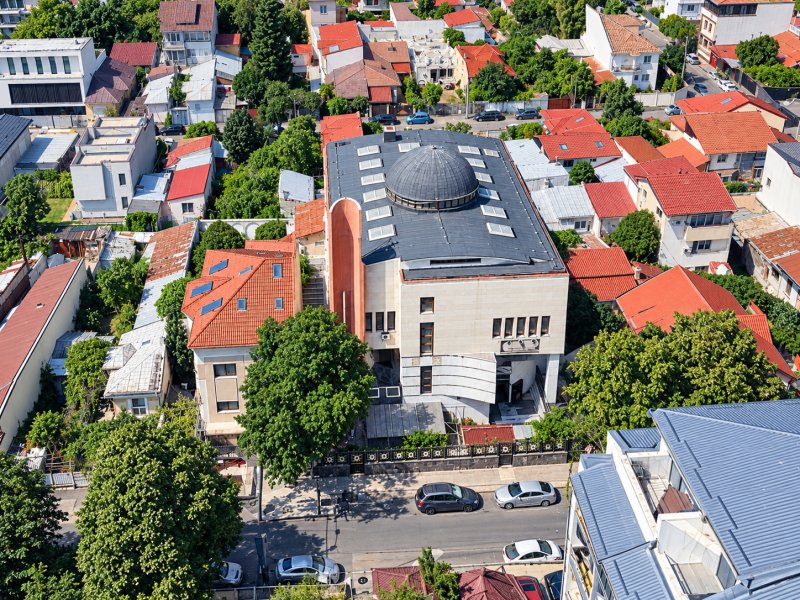 Ar-Rahman Mosque
The Ar-Rahman Mosque, part of the Semiluna Islamic Cultural Centre, traces its origins to the early 1990s. The Romanian Order of Architects' guide dates its emergence to 1994 and links it to an initiative by foreign Muslim students. Other community sources indicate that construction began in 1993, followed by the subsequent development of the complex.
The difference from 1906 is significant. Carol-Hunchiar had been established through an initiative of the Romanian state, whereas Ar-Rahman emerged from within a growing urban Muslim community.
Today, the mosque operates daily and also hosts Friday prayers. The community's own website presents it as a space for worship and community life on Munții Gurghiului Street.
Bucharest Today Has an Entire Islamic Geography
The image of a single mosque tucked away near Bellu Cemetery already belongs to the past. A recent study prepared for the urban planning documentation of Bucharest City Hall identifies several active Muslim spaces in the capital, including the Carol-Hunchiar Mosque, Ar-Rahman, Al Quds on Fabrica de Gheață Street and Islamic centres in the Colentina area.
The Romanian Order of Architects' guide indicated that, around 2015, Bucharest may have had approximately nine prayer houses or mosques belonging to various communities. The exact number was difficult to establish because some operate through foundations and associations independent of the network directly administered by the Muftiate.
There is a fundamental difference between Bucharest and Dobruja. Islam in Dobruja is largely associated with the historic Turkish and Tatar communities, whereas contemporary Islam in Bucharest has a far more cosmopolitan composition, shaped by migration, university studies and economic mobility after 1989.
The city has thus moved from the Ottoman merchant temporarily staying at an inn to the Syrian doctor who has settled here, the student from a Muslim family and the Bucharest resident of Turkish or Tatar descent whose family has lived in the capital for three generations. Their biographies are different, but the prayer hall brings them into the same space.
How Many Muslims Live in Bucharest Today?
The 2021 census recorded 8,015 people who identified themselves as Muslim in the municipality of Bucharest. The final figures published by Romania's National Institute of Statistics recorded 58,347 people of the Muslim faith across the country.
These figures must be treated with some caution, because religious affiliation was listed as unavailable for approximately 471,000 residents of the capital in the census database, since declaring one's religion was voluntary. Consequently, the 8,015 figure represents people explicitly recorded as Muslim, rather than a comprehensive estimate of everyone who practises Islam or comes from a Muslim family.
Earlier academic studies estimated Bucharest's Muslim community at approximately 10,000 people. The differences reflect methodology and the fact that a mobile urban population does not fit particularly neatly into the tidy drawers of statistical classification.
The Mosque That Sparked a National Debate
In 2015, the visibility of Bucharest's Muslim population suddenly became the focus of a nationwide public debate. The Romanian government granted the Muftiate the right to use an 11,295-square-metre plot of land on Expoziției Boulevard for the construction of a mosque and cultural centre. Official documentation referred to earlier requests from the Muslim religious community for such a facility.
The project provoked political reactions and public disputes concerning the building's size, its financing and relations with Turkey. In 2018, the Muftiate abandoned the investment and returned the land to the state. Mufti Iusuf Murat cited a lack of financial resources as the reason for cancelling the project.
The episode reveals quite a lot about the distance between everyday reality and public perception. The Muslim community had been living in Bucharest for a very long time, with its own places of worship and organisations, yet a large part of the city only discovered the subject when the prospect of a large building on Expoziției Boulevard appeared.
A History That Began Long Before the First Mosque
The Muslim history of Bucharest therefore deserves a somewhat more precise description than the convenient legend of “500 years of continuous community life”.
There are almost five centuries of documented Muslim presence, beginning with the Ottoman merchants of the 16th century and extending to the thousands of Muslim believers living in contemporary Bucharest. Between these two points lie very different periods: visiting merchants, soldiers, small settled groups, Muslims relocating to the capital from Dobruja, then an institutionally organised community and, after 1989, a much more cosmopolitan Islamic world within Bucharest.
The mosques themselves tell a miniature version of this story. A small masjid mentioned during Evliya Çelebi's time disappears from the landscape. In 1906, Carol I builds the city's first major representative mosque. The communist regime relocates it. After 1989, Ar-Rahman emerges, and a network of Islamic centres and prayer houses develops around it.
Bucharest remains, as usual, considerably more complicated than the official portrait it likes to paint of itself. Beneath the French-inspired architecture of the city centre and its nostalgia for the interwar years lies a city that spent centuries looking towards Istanbul, negotiating with its people, buying their goods, borrowing tastes, words and customs, and welcoming Muslim worshippers long before the first modern minaret appeared in photographs of the Romanian capital.
You may also like: Bucharest of Miracles: Churches Known for the Help Believers Say They Have Received