The December 1918 Printers’ Strike in Bucharest. How the Protest Turned into the Massacre at the National Theatre
- Articles
- 20 OCT 26
Just days after the Great Union of December 1, 1918, Bucharest became the scene of a dramatic episode that would go down in history as one of the harshest crackdowns on a workers’ movement in interwar Romania. On December 13, 1918, printers on strike and workers from several enterprises in the capital took to the streets demanding higher wages, shorter working hours and better working conditions. What began as an action centered on labor demands turned into a violent confrontation with the army and the security forces. The events must be viewed within the extremely complicated context of Romania at the end of the First World War. The country was emerging from a devastating war, Bucharest had been occupied by the Central Powers, supplies were difficult, prices had risen, and social tensions were being fueled by the impact of revolutionary and workers’ movements in Russia, Germany, Austria and Hungary. In this climate, the printers’ demands acquired a political dimension that the authorities viewed with suspicion.
Why did the printers go on strike?
The first signs of the social conflict appeared several days before the December 13 demonstration. Workers at the “Sfetea” and “Minerva” printing houses went on strike on December 6, demanding, among other things, higher wages and the introduction of an eight-hour working day. Their demands were not isolated. After the war, workers were facing declining purchasing power and difficult living conditions, while the cost of food and other basic goods had increased considerably.
Printers were a well-organized trade with an important trade-union tradition. Their profession required specialized skills, and workers in the printing industry generally had a stronger professional and political culture than many other categories of laborers. In December 1918, however, their grievances went beyond a few workshops and attracted the solidarity of workers from other enterprises and factories in Bucharest.
On December 13, almost 600 printers in the capital stopped working and headed toward the city center, accompanying a delegation that was to present the workers’ demands. Other workers also mobilized around them, transforming the printers’ strike into a large-scale workers’ demonstration.
Postwar Bucharest was a city under pressure
To understand why a wage strike could escalate so quickly, one must consider the situation in the capital after the withdrawal of the occupying forces. Romania was experiencing a period of economic and administrative instability, and the return to normality was difficult. Food shortages, inflation, unemployment and deteriorating living conditions were fueling popular discontent.
At the same time, Europe was experiencing unprecedented political upheaval. The Bolshevik Revolution in Russia in 1917 had been followed by workers’ and revolutionary unrest in several countries. Radical political changes were taking place in Germany and Austria, while in Hungary, in 1919, the Soviet Republic led by Béla Kun would emerge. For the Romanian authorities, who were in the process of consolidating the enlarged state created after December 1, the prospect of a social revolution was a real threat.
This also explains the suspicion that the workers’ protest represented more than an economic dispute. Some of the demonstrators’ slogans and demands clearly had a political dimension, while Bucharest socialists played an important role in mobilizing workers. Nevertheless, historical research shows that the strike cannot simply be reduced to a Bolshevik conspiracy. There were genuine social grievances, and workers’ protests had also erupted spontaneously in the postwar period.
The workers’ column reaches the National Theatre Square
On the morning of December 13, columns of workers made their way toward the center of the capital. The demonstrators passed through the area around Sfântul Ionică Street and Câmpineanu Street, intending to express their demands and reach the vicinity of the Royal Palace.
The authorities, however, were prepared. Troops, police officers and gendarmes had been concentrated in the area around the National Theatre. The military deployment was commanded by General Alexandru Mărgineanu, commander of the Bucharest garrison, while the prefect of the Bucharest Police was General Ștefan Ștefănescu. Some of the troops had been positioned around Câmpineanu Street and the Romanian Passage.
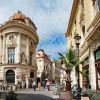
The National Theatre Square, located in the area where Calea Victoriei meets what is now Ion Câmpineanu Street, thus became the central point of the confrontation. The National Theatre building that stood there at the time no longer exists, having been destroyed during the 1944 bombings. The site is now occupied by the complex that includes the Novotel Hotel.
The demonstrators were ordered to disperse. Tensions increased, and eventually the soldiers opened fire. Historical sources confirm that there were deaths and numerous injuries, although there is no consensus regarding the exact number of victims.
How did the order to open fire come about?
One of the most controversial aspects of December 13 concerns responsibility for the opening of fire. Memoirs and documentary sources offer different versions of the precise sequence of orders.
An important testimony comes from Emilian Ionescu, who was near the prefect of the Bucharest Police. His account, preserved in archival sources and later reproduced by Radio Romania International, describes the extremely tense atmosphere that morning and the moment when, instead of repeated warnings and a gradual intervention, an order was heard to fire at the crowd.
Other sources mention an episode in which a demonstrator, Marin Niculescu, allegedly fought with a soldier and took his weapon, after which he was immediately shot. This episode was later used to explain or justify the military intervention, but it should be treated cautiously, since accounts of how the shooting began differ.
What is certain is that the army used firearms against the demonstrators, and the National Theatre Square became a scene of violence. The event would later enter collective memory as the “December 13 Massacre.”
How many workers died that day?
One of the most difficult questions concerning this episode is establishing the number of victims. Very different figures have circulated over time. Some sources contemporary with the event or close to it mentioned only a handful of victims, while Ilie Moscovici, one of the socialist leaders, later spoke of approximately 50 to 100 dead and several hundred wounded.
During the communist period, official propaganda imposed a much higher figure. In 1948, the monument erected in memory of the victims stated that 102 workers had been killed. This figure became part of the regime’s official historical narrative, although subsequent historical research has not been able to confirm it through documentary evidence.
It is therefore more accurate to say that the exact death toll remains unknown. Historical sources indicate figures ranging from several dozen victims to a higher number of deaths, depending on the criteria used and the moment at which the deaths were recorded. Radio Romania International, for example, mentions an immediate toll of six dead and 15 wounded, while other historical sources refer to 16 deaths following the intervention.
This discrepancy should not be concealed. On the contrary, it is essential for understanding how the event was subsequently reinterpreted politically in the decades that followed.
The arrests and the death of I.C. Frimu
After the demonstration was suppressed, the authorities launched a large-scale wave of arrests. Hundreds of workers and leaders of the socialist and trade-union movements were taken into police custody. Many were accused of incitement and participation in actions considered hostile to the established order.
Among those arrested was Ion Costache Frimu, one of the most important figures in the Romanian socialist movement. The treatment inflicted on the detainees was extremely harsh. Even Ion G. Duca, a member of the government, later recorded that police officers had beaten some of the movement’s leaders so severely that Frimu eventually died from the injuries he had suffered.
I.C. Frimu died on February 6/19, 1919, in Văcărești Prison. His death intensified the scandal surrounding the suppression of the demonstration and transformed him into a symbol of the Romanian workers’ movement.
The trial of those arrested did not, however, confirm wholesale the theory of a revolutionary conspiracy. Ultimately, several defendants were acquitted, while some convictions concerned individuals accused of incitement and political activities considered dangerous by the authorities.
How the memory of the massacre was rewritten
After the communist regime came to power, the events of December 13, 1918, were given an official political meaning. The suppression of the workers was presented as proof of the repressive nature of the pre-communist Romanian state, while the victims were transformed into heroes of the working class.
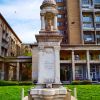
In 1948, a monument was inaugurated at Reînvierea Cemetery in connection with the victims of the demonstration. The monument bore the figure of 102 workers allegedly killed, and the site became one of the principal places where the event was commemorated.
In 1968, the communist regime officially established “Printers’ Day” through Council of Ministers Decision No. 2,733 of December 11, 1968. The day was to be marked annually in connection with the anniversary of the struggles of the printers of 1918.
The political appropriation of the memory of the event does not mean, however, that the repression did not take place or that the workers’ demands were invented. On the contrary, documents confirm the strike, the demonstration, the military intervention, the deaths, the injuries and the arrests. What must be viewed critically is the way in which the death toll and the political significance of the event were subsequently reinterpreted by the regime after 1948.
Why December 13, 1918, still matters
The printers’ strike of December 1918 is one of those pages of history that cannot be understood solely through the lens of a single event. It speaks of postwar Romania, of workers demanding higher wages and an eight-hour working day, but also of a political and military establishment afraid that the revolutionary unrest spreading across Europe might reach Romania as well.
At the same time, the episode demonstrates how quickly a social conflict can escalate when state institutions respond with force. A strike that began at the “Sfetea” and “Minerva” printing houses turned, within just a few days, into a large demonstration followed by military intervention, deaths, injuries and hundreds of arrests.
More than a century later, December 13, 1918, remains a controversial and painful episode. It is neither simply the story of printers demanding social rights nor exclusively the story of an alleged revolutionary conspiracy. It is the story of a Romania emerging from war, where the Great Union did not automatically mean that economic and social problems had been solved.
Perhaps the most important lesson of that day is precisely the need to separate documented facts from myths constructed later. The exact number of victims remains disputed, individual responsibility must be assessed through documentary evidence, and the role of the socialists must be distinguished from the genuine economic causes of the strike.
What can no longer be disputed is that, on December 13, 1918, in the center of Bucharest, workers who had taken to the streets to support their demands were met with firearms, and the confrontation resulted in deaths, injuries and a wave of repression that would deeply mark the history of the Romanian workers’ movement.
We also recommend: How did the first public bath in Bucharest come about: 200 years since the brilliant idea of a French entrepreneur