From Izbânda to Sahia and Tomis: How the Famous Cinema on Calea Văcărești in Bucharest Disappeared
- Articles
- 21 OCT 26
In old Bucharest, cinemas were not merely places where people went to watch a movie. For the neighborhoods where they operated, they were genuine landmarks, meeting places, and locations around which everyday life revolved. One such place stood on the old Calea Văcărești, near Sfânta Vineri Square and in an area that today preserves almost nothing of its former urban configuration. Known successively as Izbânda, Alexandru Sahia, and Tomis, the cinema at numbers 19–21 on Calea Văcărești went through several stages in the history of the capital. It witnessed interwar Bucharest, the transformations brought about by the communist regime, and, ultimately, one of the most radical urban demolition operations in the history of the city. Today, the building no longer exists. Its disappearance was not an isolated event, but part of the vast systematization process that permanently transformed this part of Bucharest during the 1980s. Documents, photographs, and the memories of former residents have nevertheless preserved the image of the cinema that became, for entire generations, a landmark of Calea Văcărești.
Izbânda, the cinema in the heart of the old Văcărești neighborhood
The story of this place begins during the interwar period, when Calea Văcărești was one of the important thoroughfares of the commercial and working-class area southeast of central Bucharest. Sources dealing with the history of cinemas and summer gardens indicate the existence of the Izbânda complex in the 1930s, while contemporary newspapers prove that a major entertainment venue was already operating at Calea Văcărești 21 in 1932. In June 1932, for example, the newspaper Curentul announced performances by the “Izbânda” Theater at this address.
However, a distinction should be made between the history of the summer garden and that of the cinema auditorium. Some local sources give October 1, 1932 as the opening date of the Izbânda cinema, while research devoted to Bucharest's summer gardens confirms without doubt that the Izbânda Garden entered the city's entertainment circuit in 1932. Therefore, the date is best presented as the beginning of the Izbânda period, without turning a memorial or secondary source into an absolute documentary certainty.
The location had an important feature for neighborhood residents: behind the building there was also a summer garden, a space that could accommodate theatrical performances and, later, open-air film screenings. Vera Molea, in her research on Bucharest's summer gardens, shows that the Izbânda Garden was located at Calea Văcărești no. 21 and that theatrical and operetta companies performed there as early as the 1930s.
From interwar performances to the Alexandru Sahia cinema
Izbânda was not an isolated venue in Bucharest's cultural landscape. Calea Văcărești had several cinemas, and the interwar press repeatedly mentioned the Izbânda auditorium in film programs. In August 1938, for instance, Izbanda cinema was included in the weekly program of Bucharest cinemas, showing films such as The Healer and Tarantella.
For local residents, the cinema thus became part of everyday life. Accounts published later recall the atmosphere of the neighborhood and the fact that people went to Izbânda as one of the few nearby places of entertainment. An interview published by Realitatea Evreiască, for example, mentions a confectionery opened in 1942 on Calea Văcărești, “next to the Izbânda cinema,” confirming the importance of the auditorium as a local landmark.
After the change of political regime and the nationalization of the film industry, the cinema entered a new phase. Beginning in 1951, it was known as Alexandru Sahia, a name under which it also appeared in the press of the 1960s. A 1963 issue of Scînteia explicitly listed the “Alex. Sahia” cinema on Calea Văcărești 21 among Bucharest's cinemas.
The name was not accidental. Alexandru Sahia had become one of the symbolic figures of Romanian documentary and propagandistic cinema, and in 1950 the film studio that bore his name was established, specializing in documentaries and newsreels.
When the cinema became Tomis
During the 1960s, the auditorium underwent another name change. Sources devoted to the history of Bucharest cinemas place the Alexandru Sahia period between 1951 and 1963, after which the cinema appears under the name Tomis.
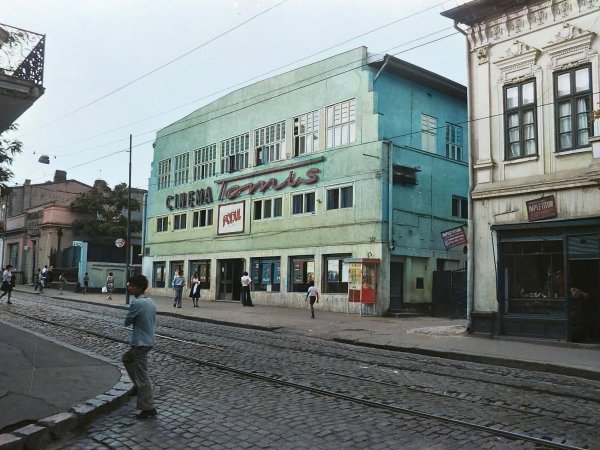
For the generations who grew up in Bucharest during the 1960s, 1970s, and 1980s, the name Tomis became the most familiar one. Photographs from that period show it as a landmark of the old Calea Văcărești, near the intersection with Clucerul Udricani and Mămulari streets. Behind it was the Sfânta Vineri Square area, while numerous shops, restaurants, and other neighborhood meeting places could be found nearby.
Tomis also had the advantage of its summer garden. During the communist period, cinemas offering open-air screenings were extremely popular in the summer, and the garden behind the building provided an alternative to the enclosed auditorium. Photographs and recollections of the old Calea Văcărești confirm the existence of this garden, which remained associated with the cinema's memory until its final years.
According to the historical data available about the cinema, the auditorium had 476 seats, allowing it to accommodate a considerable audience. The building was important not only because of its cinematic function. Cinematography administration structures also operated there, while a projection room was located upstairs. The building was therefore part of communist Bucharest's cinematic infrastructure, rather than simply being a neighborhood cinema.
Calea Văcărești before the great demolition
To understand why Tomis disappeared, one must look at the entire neighborhood in which it stood. The old Calea Văcărești was one of the main arteries of a densely built-up area containing houses, shops, restaurants, cinemas, churches, and institutions. It was not a neighborhood constructed according to a single plan, but an urban fabric that had developed gradually, where 19th-century and early 20th-century buildings coexisted with more recent constructions.
Even in the 1970s, when Bucharest was beginning to undergo radical redevelopment, Calea Văcărești still preserved many of these characteristics. The documentary film Calea Văcărești, made in 1975 at the request of the Museum of the History of the Municipality of Bucharest, captured precisely this urban world. Today, the film is one of the important visual sources for understanding the thoroughfare before the demolitions of the 1980s.
In those images, Calea Văcărești appears as a lively street, with shops, houses, and buildings belonging to different historical periods. Among its landmarks was the cinema that would become Tomis. Only a few years later, however, the entire urban landscape was to be almost completely destroyed.
How the Tomis cinema disappeared
The fate of the cinema was directly linked to the systematization projects of Nicolae Ceaușescu's regime. During the 1980s, Bucharest underwent one of the most extensive forced urban transformations in its history. Entire neighborhoods were demolished to make way for the new political and administrative center and for the major boulevards associated with it.
The Calea Văcărești area, together with the surrounding streets, became part of this transformation. Houses, shops, institutions, churches, and other buildings that made up the neighborhood's collective memory disappeared. A historical study prepared as part of Bucharest's urban planning documentation explicitly lists the Central Cinema – Tomis / Alexandru Sahia / Izbânda among the buildings destroyed during the systematization process.
Photographs from 1985 demonstrate that the building was still standing at that time. The Tomis cinema can be seen on the old Calea Văcărești, in an urban landscape that was soon to disappear. Sources devoted to the history of Bucharest cinemas place the building's disappearance in the second half of the 1980s, while local documentation dates its demolition to 1987.
Its disappearance was therefore not the result of the cinema's decline or the arrival of a new owner. Tomis was sacrificed as part of the radical transformation of the city. In place of the old urban fabric, the regime planned new boulevards and buildings forming the new civic center.
A cinema that remained in Bucharest's memory
Perhaps one of the strongest indications of the importance of the Tomis cinema is the fact that its name continues to appear in accounts of the old neighborhood, even though the building has been gone for almost four decades. For former residents of the area, Tomis was more than a screen and several hundred seats. It was a geographical and emotional landmark.
A photograph taken in the 1970s by Dan Vartanian captures it in the context of the old Calea Văcărești, while images from 1985 show how close the moment of its disappearance had become. These photographs are particularly valuable because they visually reconstruct an urban area that was almost completely erased from the map.
Today, as Bucharest gradually rediscovers its vanished neighborhoods, the story of Izbânda–Alexandru Sahia–Tomis provides a clear example of how profoundly the city changed within only a few decades. From the interwar performances at the Izbânda Garden and the films shown in the auditorium on Calea Văcărești to the cinema evenings of the communist period, the venue accompanied several generations of Bucharest residents.
The cinema is gone, and the old Calea Văcărești has largely been absorbed into a new urban configuration. What remains, however, can be found in photographs, documentaries, and the memories of those who knew Bucharest before the great demolitions. The journey from Izbânda to Alexandru Sahia and finally to Tomis is not merely the story of a cinema changing its name. Ultimately, it is the story of a city that lost part of its identity when the places that gave it its character were demolished.
We also recommend: Cinema Eforie and the story of one of the only remaining historic cinema halls in Bucharest