Cinema Eforie and the story of one of the only remaining historic cinema halls in Bucharest
- Articles
- 09 DEC 25
The story of Cinema Eforie begins long before the hall became what it is today – a symbol of art film and of the Romanian cinematographic memory. The first events dedicated to film culture appeared in the 1960s, when, on February 24, 1962, the first show of the program “Friends of Film” was organized. The event took place in the hall that today is known as Cinema Capitol and was dedicated to Ion Popescu-Gopo, one of the pioneers of Romanian animation.
The origins of heritage cinematography in Bucharest
Shortly afterward, the initiative continued in the hall of the former Vasile Alecsandri cinema in Lahovari Square, where films signed by the Soviet filmmaker Vsevolod Pudovkin were screened. These cultural events began to gain regularity and were organized weekly in the Carpați Hall, later known as the Studio Hall. Over time, this habit became a true tradition, contributing to the formation of an audience interested in art film and in the history of cinematography.
The establishment of the Cinematheque and the successive relocations
A crucial moment for Romanian film took place in September 1964, with the establishment of the Romanian Cinematheque, an institution dedicated to educating the public through classic films, heritage titles, and productions representative of the evolution of cinematographic language.
The first activities of the Cinematheque took place exclusively at Studio Hall, where up to 18 screenings per week were organized, a sign that the public was already showing interest in this type of cinema.
In 1969, the Romanian Cinematheque relocated to Union Hall, another location with tradition, which remained a central point of cultural cinematographic activities. But the moment that marks the true identity of the institution came in 1982, when the Cinematheque found a new venue, one that would define its image to this day: Eforie Hall. On July 1, 1982, regular screenings began there, and the hall became the new home of heritage film.
Also in the autumn of 1982, the Cinematheque inaugurated a film history course lasting 2–3 years. The program consisted of theoretical lectures, film analyses, and illustrative screenings, offering complete training to those interested in deepening the art of film.
This initiative contributed decisively to the development of an educated community made up not only of cinephiles but also of critics, film historians, and filmmakers.
Starting in 1990, the activities of the Cinematheque also took place partially in Union Hall, known at the time as Paul Călinescu, which strengthened the connection between the two historic spaces. In 1993, the main hall of the Cinematheque received the official name Jean Georgescu Hall, in honor of the Romanian director, but for the public, it continued to be known as Eforie Hall.
The current location and the specifics of the building where the cinema operates
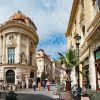
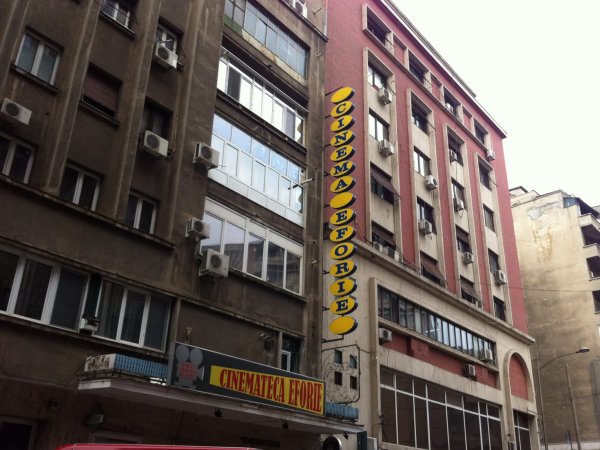
Today, Cinema Eforie is located at 2 Eforie Street, in Sector 5 of Bucharest, near Calea Victoriei, in a central area filled with history and urban architecture. The street is a discreet, short, intimate one, hidden between buildings built in modernist and art-deco style.
The cinema operates on the ground floor of a block constructed in the second half of the 20th century, in an area with a mixed purpose, where the commercial spaces on the ground floor blend with residential apartments in the upper stories.
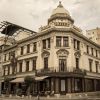
The entrance to the cinema is slightly hidden from view, placed on a narrow alley between two emblematic buildings for the area: Hotel Capitol and Hotel Majestic. Passersby can easily walk by without realizing that inside lies one of the most important heritage cinema halls in the Capital. Once the threshold is crossed, the atmosphere changes: the lobby, the stairs, and the hall exude the air of another era, with architectural details that are simple but authentic, emphasizing functionality and the cinematic atmosphere.
Eforie Hall – an emblematic space of Romanian cinematography
Eforie Hall, officially known as Jean Georgescu Hall, has a capacity of 380 seats. It is administered by the National Film Archive, which gives it the authority and responsibility to present classic films, restored films, and valuable productions of world cinematography. Unlike modern multiplex cinemas, Eforie does not aim to screen commercial films but preserves the tradition of viewing heritage films, rare titles, or films important to the history of cinema.
The audience that crosses its threshold is diverse: students from film faculties, passionate film enthusiasts, cultural information collectors, but also spectators curious to discover an experience different from that offered by contemporary cinemas.
The program is carefully curated, focused on films that changed the world, whether through style, message, or filmmaking technique. From silent films with live accompaniment to masterpieces of European and Asian cinematographies, the selection is always a journey through time and space.
The atmosphere in the hall is special: the discreet lights, the comfortable seats, and the silence that precedes each screening create an environment where the film is respected as an art form. The affordable ticket prices are an important part of the Cinematheque's philosophy, which aims to remain a space open to everyone.
Cinematheque Eforie today – the resilience of a cultural tradition
Today, Cinematheque Eforie is one of the few historic cinema halls still operating in Bucharest. In a city where many old cinemas have disappeared or have been transformed into commercial spaces, Eforie endures as a place dedicated exclusively to art film. Along with Union Cinematheque, it represents one of the last refuges for cinephiles looking for an authentic experience.
The hall’s program reflects the constant concern for quality and variety. Here, retrospectives of major directors, thematic cycles dedicated to lesser-known cinematographies, educational projects, anniversary screenings, restored films, and special events are organized, keeping cinematographic tradition alive. Cinematheque Eforie is not only a place for screenings but also a space for cultural encounter, dialogue, and reflection.
The cinema continues to be administered by the National Film Archive, the institution responsible for preserving Romanian cinematographic heritage. This collaboration ensures that cultural activity is carried out with a high professional standard and guarantees the public access to rare films or titles difficult to find in other formats.
Why you should visit Cinematheque Eforie
Visiting Cinematheque Eforie does not mean simply watching a film, but entering a space where tradition, memory, and art meet. It is the ideal place for those who want to get closer to the history of cinema, discover international masterpieces, or understand the evolution of cinematic language.
In a hurried city, the cinema offers a calm, profound, and authentic experience. Each visit is an act of respect toward film and toward the efforts of those who have kept this institution alive for decades. And the fact that the hall operates in a historic space, hidden between modern buildings and the urban bustle, adds a touch of mystery and charm.
Cinema Eforie remains today a cultural landmark, a bridge between past and present, and an essential place for all who believe that film is more than entertainment – it is memory, art, and history lived on screen.
We also recommend: Cinema București, the history of the former interwar Trianon cinema where Romania’s first sound film was screened