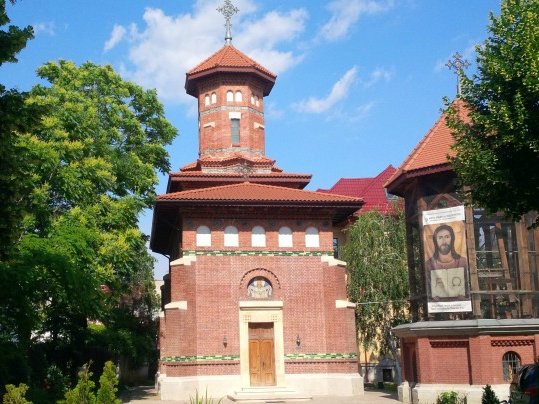
The Greek-Catholic Cathedral “St. Basil the Great”, the church where Demetriu Radu served, the bishop killed in a bomb attack at the Romanian Senate
By Bucharest Team
- Articles
- 30 DEC 25
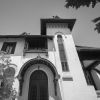
The Greek-Catholic Cathedral “St. Basil the Great” in Bucharest is one of the most discreet yet historically significant places of worship in the Romanian capital. Located at 50 Polonă Street, the building is considered the smallest Catholic cathedral, with a capacity of around 150 people, but its historical and symbolic importance far exceeds its physical size.
Throughout its existence, the church has been closely linked to the fate of the Romanian Greek-Catholic Church and to the lives of prominent bishops and public figures, many of whom became victims of political repression in the first half of the 20th century.
A small cathedral shaped by sacrifice
The “St. Basil the Great” Cathedral is the first Romanian Greek-Catholic church built in Bucharest. The community behind its construction was formed mainly of Transylvanian Romanians who had settled in the capital of the Old Kingdom. Although the parish had existed since 1829, it lacked a dedicated place of worship for decades.
The land on which the church stands today was purchased in 1892 by Demetriu Radu, then parish priest of the Greek-Catholic community in Bucharest. Due to restrictions imposed by the authorities of the time, the property was registered in the name of the Roman Catholic Church, and the building was erected set back from the street, inside the courtyard.
The church was built and consecrated in 1909, in a remarkably short period, under the coordination of Roman Catholic Archbishop Raymund Netzhammer. The architectural project was entrusted to Nicolae Ghica-Budești, one of the most important architects of the era, renowned for his expertise in medieval Moldavian architecture. Inspired by churches from the time of Stephen the Great and Petru Rareș, the chosen style gives the building a distinctive identity within Bucharest’s urban landscape.
Demetriu Radu and the Senate bombing that marked Romanian history
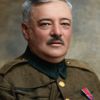
One of the central figures associated with the cathedral is Demetriu Radu, the first parish priest of the Transylvanian Greek-Catholic community in Bucharest and one of the main supporters of the church’s construction. He later became Bishop of the Eparchy of Oradea Mare.
His death occurred during the bomb attack at the Romanian Senate on December 8, 1920, an act of political violence carried out by communist militants. The explosion claimed several lives, and Demetriu Radu was among the victims of this dramatic episode in modern Romanian history.
Historians regard the event as a turning point, both politically and symbolically. The bishop’s connection to the cathedral on Polonă Street adds a profound historical dimension to the church.
Martyred bishops and communist repression
After Demetriu Radu, ministry at the “St. Basil the Great” church was continued by priests and bishops whose lives were deeply affected by the establishment of the communist regime. Ioan Bălan, the first priest to serve in the newly built church, later became a Greek-Catholic bishop. He was arrested in 1949, endured imprisonment at Sighet, and died in 1959 while under house arrest.
Another key figure was Vasile Aftenie, appointed in 1940 as the first Greek-Catholic auxiliary bishop for Bucharest and the Old Kingdom. He refused to renounce his faith despite offers made by the communist authorities and died in 1950 at Văcărești Prison, becoming the first martyr bishop of the Romanian Greek-Catholic Church.
Tit Liviu Chinezu, protopope of Bucharest, was consecrated bishop clandestinely in 1949 and died in detention at Sighet in 1955. They were followed by Zenovie Pâclișanu, historian, diplomat and corresponding member of the Romanian Academy, appointed vicar general in secrecy, who died in 1958 at Jilava Prison.
From confiscation to restitution and the cathedral today
In 1948, with the support of the communist authorities, the church was taken over by an Orthodox parish, and Greek-Catholic worship was banned. After 1989, the Greek-Catholic community resumed efforts to recover the building, a legal process that lasted 14 years.
You also might be interested in:
St. Joseph's Cathedral in Bucharest - probably one of the most beautiful cathedrals in the capital
5 self-guided walking tours to discover Bucharest on foot
The cathedral was officially returned to its rightful owners on December 28, 2006. In 2008, a Greek-Catholic auxiliary bishop for Bucharest was installed, and in 2014 the first bishop of the Eparchy of St. Basil the Great of Bucharest was appointed, marking the full restoration of the cathedral’s ecclesiastical role.
Today, the Greek-Catholic Cathedral “St. Basil the Great” remains a spiritual and historical landmark of Bucharest, a modest yet powerful place that embodies a profound story of faith, persecution and collective memory.