The Republicii Stadium and the Forgotten History of the Capital: Bombed During World War II, Completely Destroyed in Communism
- Articles
- 23 FEB 26
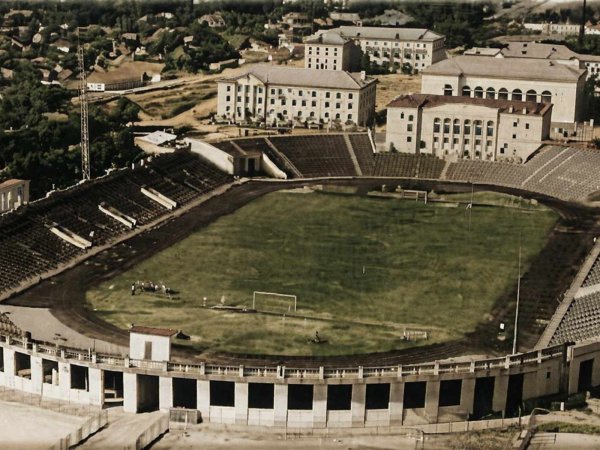
It was not the largest, but it was certainly the most beautiful stadium in Bucharest and, until the construction of the “23 August” Stadium, it was the most modern sports complex in Romania. Skillfully placed on the slope of the terrain, it was also very popular, with a pleasant atmosphere, hosting not only matches and athletics competitions, but also a series of training halls and sports facilities accessible to Bucharest residents under its stands.
The most beautiful stadium in Bucharest
Its memory is extremely vivid. What is less known outside the world of architects is that the stadium’s image is largely due to the intervention of probably the most important Romanian architect of the 20th century, Horia Creangă. Today, Bucharest residents have almost completely forgotten the Republicii Stadium. It was bombed during World War II and later rebuilt, only to be demolished by dictator Nicolae Ceaușescu together with the entire Uranus neighborhood in order to construct the House of the People.
On May 9, 1926, the ONEF Stadium was inaugurated, which later changed its name to ANEF (after the National Agency for Physical Education). It was considered the first modern stadium in Romania, being equipped with the country’s first grass field with a drainage system.
From ONEF to Republicii
During World War II, the stadium was damaged by the bombing of Bucharest, and the communist authorities were forced to rebuild it. Later, it was reopened under the name “Republicii” on September 3, 1948, on the occasion of the first edition of the International Athletics Championships of the Romanian People’s Republic.
For a long time, athletics and football coexisted on this stadium, which was the largest in the country, with a capacity of 28,026 seats.
The decline began after the appearance of the 23 August Stadium (today the National Stadium in the Lia Manoliu Complex), inaugurated in 1953 on the occasion of the World Youth Festival.
In 1958, filming for the movie “The Ball,” directed by Andrei Blaier and Sinișa Ivetici, took place at the Republicii Stadium.
The Republicii Stadium hosted 42 matches of the national team, one match of the Olympic team, 15 European cup matches, 22 Romanian Cup finals, and countless championship, cup, and junior matches.
Unfortunately, the stadium had the misfortune of being located far too close to the newly built House of the People. Elena and Nicolae Ceaușescu decided to transform the arena into a helicopter landing site.
Even though their wish did not become reality before December 1989, the destruction suffered by the Republicii Stadium proved irreversible. On the site of the former stadium there is now the underground garage of the Chamber of Deputies.
The National Office for Physical Education (O.N.E.F.) was part of the national structures encouraging the practice of physical education; it was founded in 1921, and the following year the National Institute for Physical Education (INEF) was established to train specialized teachers.
The Office was later renamed ANEF. After 1950, until its destruction in the 1980s, the stadium bore the name “Republicii.”
The ONEF Stadium, equipped with a football field, athletics track, and other facilities, was officially inaugurated in 1926.
The single stand, made up of improvised wooden terraces placed directly on the steep slope of the terrain on Dealul Spirii, allowed spectators to access the upper part from a street that opened into Uranus Street.
Architecture and modernization
The modernization of the stadium took place after 1930. Horia Creangă’s contribution was, above all, the construction of a large stand with a reinforced concrete structure, partially covered, resulting from collaboration with engineer Mihai Gheorghiu.
The project for the main stand naturally incorporated the difference in level between the playing field and the ONEF enclosure, while on the side toward former Izvor Street the stands were expressed through a continuous wall, rhythmically interrupted only by entrances.
Beyond the engineering performance of the structure — the stand having a cantilever canopy with an opening of more than 14 meters — architecturally significant was the plastic formula adopted for its façade, the logic of adapting to the terrain, ensuring public access, and using the space under the stands as efficiently as possible.
There were locker rooms, training halls, strength-training rooms, and all the other annexes necessary for athletes.The stand, approximately 200 meters long, closed the northern side of an elongated square through which access was also made to the terraces and the official area.
The façade was reduced to the flat surface of the wall which, through the sober accents of the entrances to the terraces provided with canopies, had the role of rhythmically marking the considerable length of the façade.A narrow and continuous glazed slit emphasized the horizontality of the entire composition.
This general line was interrupted only by the special treatment of the honorary entrance which, through the new architectural idea adopted, gained importance.Its generously glazed surface ensured complete transparency from the entrance all the way to the playing field.
The evolution of the design of the main stand confirms the crystallization of a coherent language subordinated to geometric simplicity. According to Radu Patrulius (in Horia Creangă, the man and the work, Technical Publishing House, Bucharest, 1980), the ONEF Stadium was used as a model for the construction of the stadium in Warsaw.
A place loved by Bucharest residents
“The whole neighborhood was here. (…) The Republicii Stadium was a stadium very much loved by Bucharest residents. A tradition that remained from those times and is still practiced today is the burning of newspapers. Do you know why this tradition exists?
At that time, the stadium had no floodlights. There were athletics competitions — high jump, long-distance races — 5,000 meters, 10,000 meters — which lasted longer, until it got dark. And people lit torches from newspapers.
At the Republicii Stadium it was difficult to get a ticket to the international athletics competitions — it was full. In the horseshoe section the high jump and pole vault events took place and the finals of the national boxing championships. Under the main stand there was the rowing hall, used during the winter — the ergometer, we used to say ‘let’s go to the ergometer.’At matches we spent hours on the stadium.
Especially because you arrived early.At one point I went to a match that started at 8 in the evening and we went at 12 noon.You lived the moment there, you set up your camp, you talked to people… real conversations! Otherwise you didn’t really talk to people on the street.This was an extraordinary place for socializing.We were passionate about football at that time and that’s why we practically had a subscription to Republicii when matches were played.”, people would say.
Demolition and disappearance
In most early versions of Nicolae Ceaușescu’s project for the new Civic Center on the site of Dealul Spirii, the stadium, like Mihai Vodă Monastery toward Izvor, was proposed for preservation.
The project, however, evolved toward an increasingly exaggerated scale, including demolitions. Since the complex had to become a Forbidden City, a hermetically sealed fortress, a public function such as a stadium no longer had any chance.The building of the main stand and most of the terraces were destroyed.
The fact that demolition was not complete is strictly due to practical conditions: the building was converted into shelter for workers, materials, and other needs, as part of the gigantic construction site organization, and was meant to disappear completely after the completion of the works (see in this regard the testimony of Ioan Popa in the book Slaves on Uranus).
The stopping of the construction site in December 1989 also meant the stopping of demolition. There is no clear information about how much of the current situation is due to interventions after the Parliament moved into Ceaușescu’s palace.
In any case, today most of the stadium lies under the new artificial hill around the building, and a concrete slab covers the former playing field.Its current function is that of a garage for Parliament. Looking through the transparent gate from Izvor Street, it can be seen that significant portions of the original curved wall have been preserved.
Unfortunately, a recent intervention altered the façade cladding. With the exception of a reduced security area around the Palace of Parliament, the entire current courtyard should normally be accessible and used by the public.
Even if this happens through the creation of a park, it should include public facilities that the city desperately needs.This also includes sports fields and sports buildings. In this context, it seems important to restore the construction to its original function.
Obviously, this would not mean a museum-like reconstruction, but a new stadium and new sports buildings that would integrate as much as possible from what has been preserved. Together with a series of fields and annexes for tennis, basketball, and other sports, part of the new green space around Parliament would gain the function of a sports park.
We also recommend: Uranus, the vanished neighborhood of old Bucharest. What once stood where the People's House—now the Palace of the Parliament—rises today