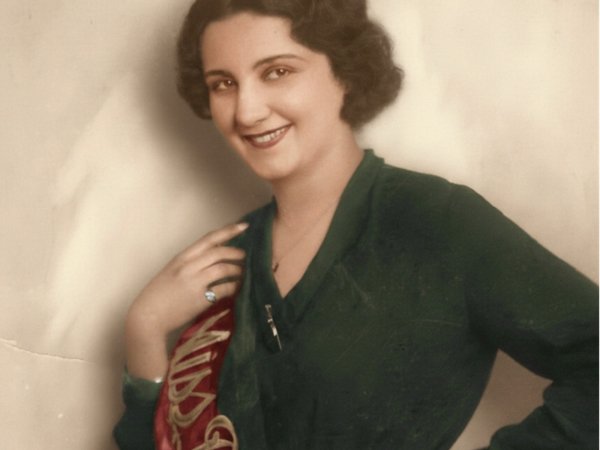
“The First Miss Romania, a 17-Year-Old Orphan from Bucharest. After the Contest, Magda Demetrescu Received a Watch and 100 Dollars”
- Articles
- 24 FEB 26
At the beginning of 1929, Romania took an important step toward modernity by adopting a phenomenon that was already popular in the Western world: beauty contests. For the first time in the country’s history, on February 23, 1929, the idea was launched to organize a national competition that would designate the most beautiful young Romanian woman.
The beginnings of beauty contests in Romania
The initiative belonged to the illustrated magazine Realitatea Ilustrată, a modern and influential publication of the time that aimed to introduce European models and customs to the Romanian public. The Miss Romania contest was not only a social event but also a cultural manifestation that reflected the spirit of an era undergoing profound transformation.
Interwar Romania was a society aspiring to refinement and international recognition, and the organization of such a competition was seen as a sign of progress and integration into the European cultural circuit. Beauty contests were perceived as a way to demonstrate that Romania was keeping pace with Western trends.
In the January 1, 1929 issue of the magazine, the organizers launched an enthusiastic invitation addressed to young female readers. The announcement text had a poetic and optimistic tone, encouraging participants to take advantage of their youth and beauty by entering a competition that would begin at local and regional levels and later continue internationally.
It was a promise of glory and adventure, but also an invitation to self-affirmation in a society that was beginning to offer women greater visibility.
The orphan girl who became Miss Romania
The interest generated by the contest was enormous. No fewer than 800 young women from across the country registered for the preliminary selections, hoping to gain the opportunity to participate in the national final. This was an impressive number for that period and demonstrated the fascination that the idea of a beauty competition exerted on the female public.
Out of the 800 candidates initially registered, only 72 were selected for the final stage of the competition. Among them was a 17-year-old girl from Bucharest, Magda Demetrescu, who would become the first Miss Romania in history.
Magda came from a family marked by tragedy. Her mother had died only six weeks after the girl’s birth, and her father, the architect Nicolae Demetrescu, also passed away when the child was only five years old. Left an orphan, the young girl was raised by an aunt who provided the support she needed to develop harmoniously.
Her enrollment in the contest was made at the urging of relatives and friends, who encouraged her to make use of her beauty and natural grace. The competition rules were strict: participants had to be between 16 and 25 years old, unmarried, and of impeccable moral reputation.
These criteria reflected the values of interwar society, in which public image and morality were considered essential.
The grand final and the emotions of victory
The final of the contest took place on March 3, 1929, and it was a large-scale event followed with great interest by both the press and the public. The jury was made up of important personalities of the time, including Interior Minister Alexandru Vaida-Voevod, Professor Tzigara-Samurcaș, writer Liviu Rebreanu, and Princess Alexandrina Cantacuzino, a prominent figure of the Romanian aristocracy.
The jury’s final decision favored Magda Demetrescu, who impressed with her elegance, naturalness, and harmonious features. The moment when the winner was announced was so emotional that the teenager fainted on stage, overwhelmed by emotion.
The press of the time described the first Miss Romania in highly appreciative terms. Magda Demetrescu was presented as a young woman of remarkable beauty — tall, dark-haired, graceful, and elegant. Journalists emphasized that she embodied the classical type of Romanian beauty and that she was going to represent the country in international competitions.
Writer Liviu Rebreanu was among the most enthusiastic admirers of the young winner. He described her in a poetic style, emphasizing the delicacy of her features and her physical harmony.
In his vision, Magda Demetrescu possessed a sculptural beauty comparable to a work of art carved from fine marble. His appreciation was not merely a conventional compliment but reflected the way cultural elites of the time perceived beauty as a form of national representation.
Miss Romania was not just a beautiful young woman but also a symbolic ambassador of the country. The presence of Princess Alexandrina Cantacuzino on the jury confirmed the importance of the event.
As a leader of the Romanian feminist movement and an influential personality, she supported women’s participation in public life and believed that such competitions could contribute to their social affirmation.
International competitions and success abroad
After winning the national title, Magda Demetrescu became the first representative of Romania in international beauty competitions. She first participated in the Miss Europe contest held in Paris, where she had the opportunity to meet contestants from other countries and experience the cosmopolitan atmosphere of the French capital.
The Parisian experience was followed by participation in the Miss Universe contest organized in the United States. For Romania, this was an absolute premiere, and expectations were moderate, given that the country had no tradition in such competitions.
At Miss Universe, 40 contestants from around the world participated, and Magda Demetrescu achieved the remarkable performance of ranking sixth. The result was considered a major success because it confirmed that Romania could compete successfully on the international stage.
The prize received by the young Romanian consisted of the sum of 100 dollars and a bracelet watch, objects that had significant symbolic value at that time. Beyond the material rewards, however, Magda Demetrescu’s success represented an affirmation of Romania’s image abroad.
Participation in Miss Universe demonstrated that interwar Romania was capable of integrating into modern international culture. Beauty contests thus became not only social events but also instruments for promoting national identity.
The legacy of the first Miss Romania
Almost a century after the organization of the first Miss Romania contest, the figure of Magda Demetrescu remains a symbol of interwar elegance and optimism. Her story reflects an era in which Romania was searching for its place in Europe and in the world, and the success of a young woman could become a source of national pride.
The contest organized in 1929 opened the path to traditions that would continue, with interruptions, throughout the decades. It demonstrated that beauty could become an element of cultural representation and that women could occupy a visible place in the public sphere.
Magda Demetrescu remained in history not only as the first Miss Romania but also as a representative figure for the generation of young women of the interwar period. Through her naturalness and elegance, she managed to impress remarkable personalities of the time and to carry Romania’s name abroad.
Today, when beauty contests are sometimes viewed with skepticism, the story of the first Miss Romania recalls the moment when they represented a promise of modernity and openness. Magda Demetrescu was more than a beautiful teenager: she was the symbol of a Romania that dreamed of being admired by the world.
We also recommend: Miss Romania, Poisoned at 27 by a Jealous Maid. The Story of the Beautiful Tita Cristescu