Famous boulevard names: Burebista, founder of the Dacian state, betrayed and killed by his own people
- Articles
- 23 FEB 26
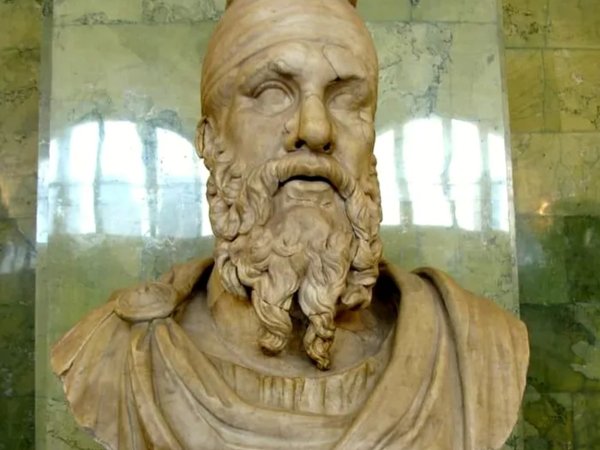
The figure of Burebista dominates the beginnings of the organized history of the Carpathian-Danubian-Pontic space. Considered by most historians the first great ruler of the Dacians and the founder of a powerful state, Burebista was one of the most feared political and military personalities in Eastern Europe in the 1st century BC. In an era dominated by conflicts between tribes and by the expansion of the Roman Republic, he managed to unite the Dacian populations and to create a regional power capable of influencing the political balance of the time.
The origin and rise of an unusual leader
Although his name is today associated with modern boulevards and neighborhoods, the story of Burebista remains a dramatic one. His spectacular rise was followed by a violent and mysterious death, most likely caused by the betrayal of his own subjects. His destiny, ending almost simultaneously with that of his Roman rival Julius Caesar, continues to fascinate historians and enthusiasts of the ancient past.
The origin of Burebista remains shrouded in uncertainty, and the historical sources are few and fragmentary. The main source about his life is the Greek geographer Strabo, who describes him as an energetic ruler who managed to raise a people weakened by wars and to transform it into a formidable force. In his work “Geography”, Strabo showed that Burebista imposed discipline and sobriety, reorganizing society and the army, which allowed him to build a powerful state in a relatively short time.
Modern historians have tried to establish the place of origin of the Dacian king. Researchers such as Ioan Horațiu Crișan or Radu Vulpe suggested that he may have come from southwestern Transylvania or from the area of the Wallachian Plain. Regardless of the exact place, it is clear that Burebista began as the leader of a local community, gradually managing to extend his authority over other tribes.
His rise was probably the result of a combination of military talent, diplomatic skill, and organizational capacity. He understood that the Dacian tribes could not resist external pressures if they remained divided. Thus, he began a systematic process of unification, defeating or integrating tribe after tribe and forming a loyal army.
In 82 BC, Burebista becomes the supreme ruler of the Dacians, his title being compared by some sources with that of “great basileus”. From that moment begins the period of maximum expansion of the Dacian state.
The unification of the tribes and the formation of the Dacian state
The greatest achievement of Burebista was the unification of the Dacian tribes into a centralized political structure. Before him, the populations of this region were organized in autonomous communities, often in conflict with one another. Through military campaigns and strategic alliances, he managed to create a stable political entity.
The Dacian state formed under his leadership was impressive in size. The territory controlled by Burebista included areas from present-day Bulgaria and Serbia, extended westward to the Middle Danube and Moravia, and northward to the Forested Carpathians. To the east it reached as far as the Greek colony of Olbia, and Dobruja was included entirely. To the south, the border was represented by the Balkan Mountains.
This vast territory was not inhabited only by Dacians. Within it lived numerous populations and tribes, each with its own traditions and social structures. Burebista managed to integrate them into a common political system, which represents one of his most impressive achievements.
The centralization of power allowed the organization of a strong army, capable of defending the borders and waging wars of conquest. This army was to play a decisive role in transforming the Dacian kingdom into a major regional power.
Sarmizegetusa, the center of Dacian power
The political and military center of the Dacian state was established in the Orăștie Mountains, in a complex of fortified fortresses that formed a true defensive system. The capital was Sarmizegetusa, the place where the royal residence was located and where the important decisions were made.
Sarmizegetusa was not only a political center, but also a spiritual one. Burebista relied heavily on religious authority in order to consolidate his power. His most important collaborator was the high priest Deceneu, considered the representative of the god Zalmoxis.
Deceneu was not only a religious leader, but also an influential political adviser. He is believed to have contributed to the reorganization of Dacian society and to the introduction of strict rules of discipline and morality. This collaboration between political and religious power strengthened the authority of the king and contributed to the stability of the state.
The capital was protected by a belt of fortified fortresses, which made any attempt at conquest difficult. The defensive system demonstrates the high level of military organization achieved during the reign of Burebista.
The military campaigns and territorial expansion
Burebista did not limit himself to internal consolidation of the state. He conducted numerous military campaigns, expanding his influence over vast territories. One of the most important achievements was the defeat of Celtic tribal unions.
The tribes of the Boii and the Taurisci represented a considerable force in Central Europe. The victory against them strengthened the position of the Dacians and opened the way for expansion toward the west and northwest. Through these successes, Burebista became one of the most powerful barbarian leaders of the era.
He also fought conflicts with the Bastarnae and other neighboring populations, managing to impose his domination over important regions. The Dacian army had become a feared force, and the reputation of the king was constantly growing.
His power was so great that it attracted the attention of the Romans, who viewed with concern the consolidation of the Dacian state. For the Roman Republic, the appearance of an organized power north of the Danube represented a serious threat.
Burebista and the Roman civil wars
Burebista’s influence was not limited to the Carpathian-Danubian region. He even became involved in the internal conflicts of the Roman Republic, a sign of his political importance.
During the civil war between Julius Caesar and Pompey, the Dacian king chose to support Pompey. This decision was not accidental. Burebista considered that Caesar’s victory would have meant a direct threat to the Dacian state.
In exchange for his support, Pompey would have promised recognition of his rule over the conquered territories. This alliance shows that Burebista was not only a warrior, but also a skilled diplomat.
The situation changed radically in 48 BC, when Pompey was defeated and killed. Caesar became the master of Rome and began to prepare a campaign against the Dacians. The state of Burebista had become too powerful to be ignored.
Caesar’s plans would not be carried out, however, because the events of the year 44 BC changed the course of history.
The mysterious death of the Dacian king
The year 44 BC was fatal both for Burebista and for Julius Caesar. While the Roman leader was assassinated by conspirators in the Senate, the Dacian king died in equally mysterious circumstances.
Strabo mentions that Burebista was overthrown by an internal revolt before the Romans could march against him. After his death, the Dacian state quickly disintegrated, being divided into several smaller formations.
There are several hypotheses regarding his assassination. The most accepted theory maintains that the tribal aristocracy revolted against the centralization of power. Many local leaders had lost their autonomy and may have considered that eliminating the king was the only solution to regain their freedom.
Another hypothesis suggests that Deceneu might have played a role in the conspiracy. After the death of Burebista, the high priest became the ruler of the political center in Transylvania, which raises questions about his ambitions.
There is also the theory of Roman involvement. Rome often used intrigues and the corruption of local leaders to weaken adversaries without waging costly wars. It is possible that the Romans supported a conspiracy against the Dacian king. Regardless of the truth, the death of Burebista marked the end of an era.
The legacy of Burebista in history
After the disappearance of Burebista, his vast kingdom quickly disintegrated. The territories were divided first into four, and then into five separate political formations. The center in Transylvania was led by Deceneu, while other regions were controlled by local leaders.
The fragmentation of the Dacian state weakened resistance against Roman expansion. About a century later, the Romans would conquer Dacia, taking advantage of the lack of a strong central authority.
Nevertheless, the importance of Burebista remains enormous. He is considered the first great king of the Dacians and the creator of a complex political structure in this region. Through his reforms, he demonstrated that the Dacian tribes could be united into an organized state.
Burebista remains in history as a skilled strategist and diplomat, but also as a leader capable of transforming a fragmented society into a respected power. Although his reign ended violently, his influence on the history of the region was profound.
The mystery of his death continues to provoke debates, but one thing is certain: the figure of Burebista has become a symbol of the beginnings of Dacian statehood. His name, preserved today in the names of streets and boulevards, recalls a ruler who succeeded, for the first time, in uniting the Dacian tribes and creating a powerful state in the heart of Eastern Europe.
We also recommend: Famous boulevard names: Mihai Bravu, the brave ruler who united Transylvania with Wallachia in 1600