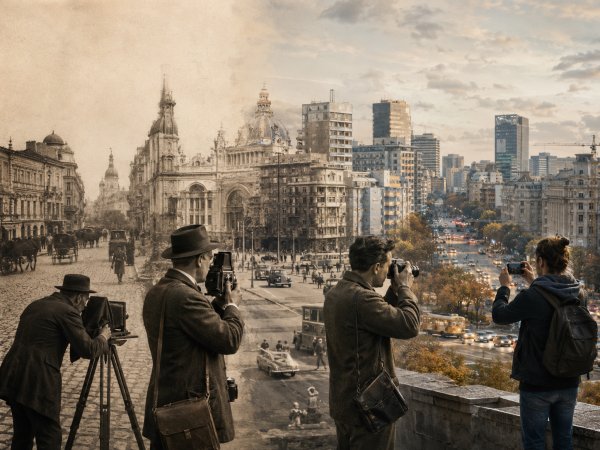
Photographs of Bucharest that captured the city before many things disappeared
By Eddie Țone
- Articles
- 05 JUN 26
Whether we like to admit it or not, Bucharest has a major weakness for disappearances. It loses its houses, gardens, cinemas, old signs, shop windows, taverns, markets, passageways, trams, and sometimes even its hills, then seems genuinely surprised when someone asks where they all went. The capital has always had a yo-yo relationship with memory: it preserves a marble staircase in a peeling apartment block, a superb awning above an ordinary shop, a church moved like an overly heavy piece of furniture, and, a few streets away, a vacant lot that looks as if it is hiding an entire autobiography.
This is why Bucharest photography carries a particular stake. It becomes a kind of civil status record for condemned buildings, razed neighborhoods, renamed streets, and people removed from the scenery by history. From Carol Popp de Szathmári to Andrei Pandele, from Franz Duschek to Iosif Berman, from Nicolae Ionescu to contemporary photo communities, Bucharest has been documented by people who pressed the shutter with the intuition that the city in front of them was changing faster than its own memory.
Carol Popp de Szathmári, the man who captured Bucharest when photography still smelled of the laboratory
The story naturally begins with Carol Popp de Szathmári, born in Cluj in 1812 and settled in Bucharest, where he became one of the decisive figures in the beginnings of Romanian photography. Specialized sources present him as a painter, graphic artist, watercolorist, and photographer, and the Bucharest Municipality Museum has dedicated exhibitions and research to his work. In the visual history of the capital, Szathmári remains linked to some of the most valuable images of nineteenth-century Bucharest.
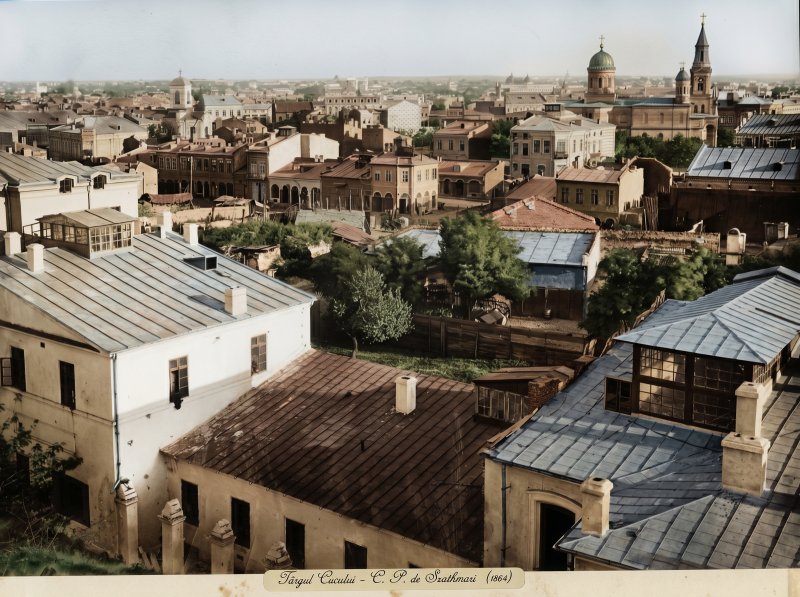
Târgul Cucului, București 1864 / Photo by Carol Popp de Szatmari / Image restored and colorized using artificial intelligence, preserving the original details.
Szathmári was also the stuff of novels: an artist trained in the age of drawing, who later entered early photography, with cumbersome equipment, temperamental chemical processes, and exposure times that demanded monastic patience from his subjects. He is considered one of the pioneers of war photography thanks to the images he made in the context of the Crimean War, when he photographed soldiers and scenes connected to the clashes in the Danube region.
In Bucharest, his importance lies in another form of confrontation, slower and more insidious: the transformation of the city. The images attributed to him preserve a Bucharest suspended between Oriental and European, between carriage and urban project, between wide courtyards and representative buildings. Without such photographs, many landmarks of the nineteenth century would have remained mere descriptions in books — a beautiful memory, yes, but one quite easily overturned by the first hurried bulldozer.
Franz Duschek and the Bucharest that was learning to pose
After Szathmári, Franz Duschek brought another stage in Bucharest’s urban photography. A Czech photographer, born in 1820 and deceased in 1884, he lived in Bucharest between 1862 and 1883. He worked in a city that had begun to groom itself, build institutions, refine its elites, and discover an increasingly serious pleasure in representation.
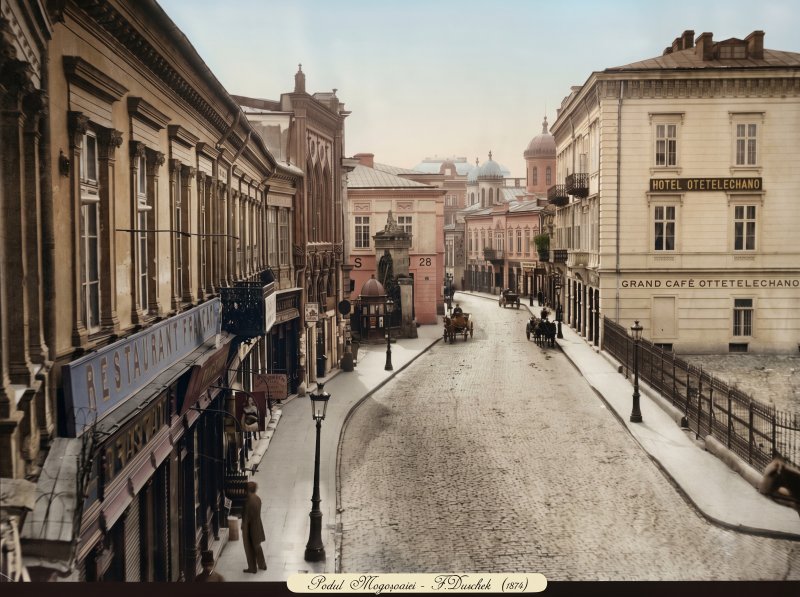
Podul Mogoșoaiei (Calea Victoriei), 1874 / Foto: Franz Duschek / Image restored and colorized using artificial intelligence, preserving the original details.
Duschek had a studio on Strada Nouă, today Edgar Quinet Street, according to research dedicated to nineteenth-century Bucharest photographers. His 1872 advertisement promised photographs “in any weather, clear or cloudy,” a delicious phrase for an era in which meteorology seemed to be co-owner of the camera.
Through Duschek, Bucharest gained a more social image. Studio portraits became small declarations of status. Ladies, gentlemen, soldiers, and solemnly dressed children entered a new visual ritual. The city photographed itself through the people who inhabited it. In the background, one can already sense the modern capital, with its ambitions, uniforms, hats, frock coats, and an almost comic confidence in its own seriousness.
Franz Mandy, the royal photographer and the refined theatre of prestige
Franz Mandy completes this gallery of Bucharest pioneers. His birth date appears differently in sources, either 1846 or 1848, while Budapest is indicated as his birthplace. Mandy was a photographer of the Royal House and one of the important figures of Bucharest photography at the end of the nineteenth century.
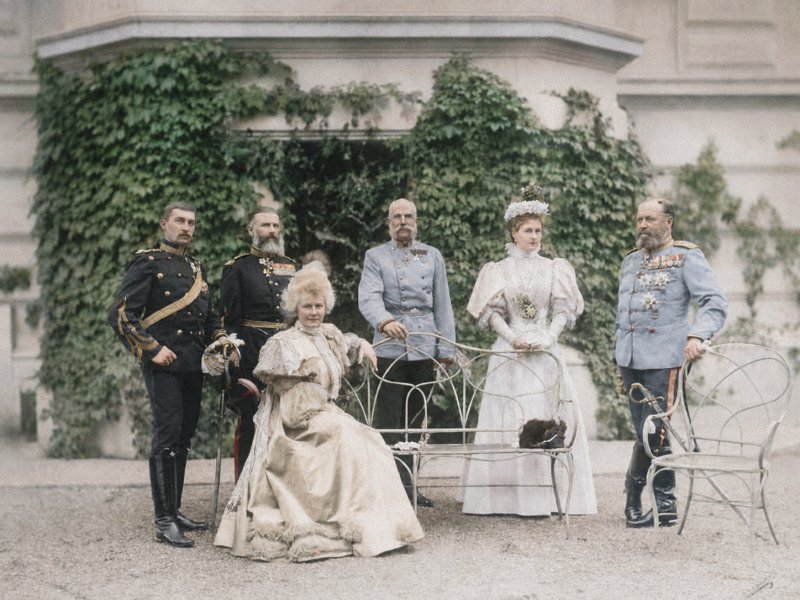
1910 - King Carol I, Queen Elisabeth of Romania and Franz Joseph I of Austria,Ferdinand , Duke Alfred , Queen Mary / Photo: Franz Mandy / Image restored and colorized using artificial intelligence, preserving the original details.
Mandy belongs to an era in which photography was becoming an instrument of public prestige. The portrait carried social weight, the studio functioned as an antechamber of posterity, and the pose chosen for the photograph could say, with theatrical discretion, that the sitter had already entered the ranks of respectable society. In the case of Bucharest, such photographs are essential for understanding a capital that was inventing its bourgeois image.
For several years, Mandy had a studio at 21 Calea Victoriei, after which he moved his studio into his own house on Știrbey Vodă Street, later Câmpineanu Street, from 1890 onward. According to Photo Historia, in 1878 Mandy received the title of “Photographer of the Princely Court,” followed by that of “Photographer of Her Majesty the Lady,” more precisely Queen Elisabeth’s private photographer.
What is interesting about Mandy is his position between art, document, and official representation. He belongs to the generation that moved photography from the realm of technical miracle into that of urban profession. Bucharest was beginning to have photographers just as it had doctors, lawyers, merchants, and good confectioners: necessary people in a city that wanted to leave elegant traces behind.
Nicolae Ionescu, the sidewalk chronicler of interwar Bucharest
With Nicolae Ionescu, we enter a Bucharest much closer to our imagination: the interwar city, with cars, trams, shop windows, elegant ladies, street vendors, stubborn vacant lots, and modernity advancing with polished shoes through dust. The Bucharest Municipality Museum presents Nicolae Ionescu, 1903–1975, as a true chronicler of the interwar period.
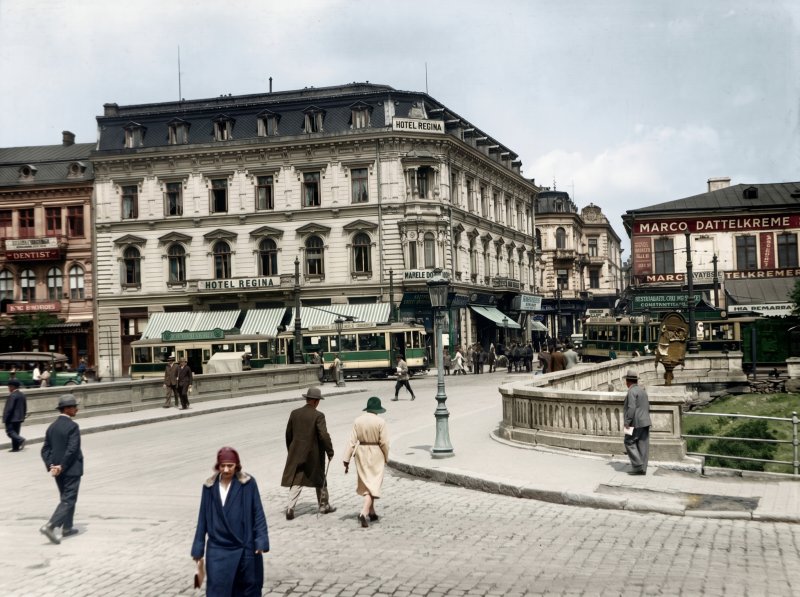
Photo: Nicolae Ionescu / Image restored and colorized using artificial intelligence, preserving the original details.
Nicolae Ionescu began as a photographer for the Photographic Service of the Royal Army, with a passion for photographs taken both in the capital and across the country. He then worked for a time in Paris, returned to Romania, and took a job at the National Printing House, where he included in his contract a clause stating that during the summer he would be allowed two months to photograph. He went through turbulent periods in the 1940s, and after the communists came to power, he continued his work as a photographer with difficulty.
Nicolae Ionescu’s photographs are valuable because of their attention to the natural flow of life. He captured Bucharest before the interwar period became a perfumed backdrop in nostalgic albums. His city has nerve, contradictions, mud, advertising, commerce, crowds, coquettishness, and improvisation. It is the capital that wanted to be Paris, while still preserving enough mahalaua reflexes, and that combination gives the photographs extraordinary vitality.
Through Ionescu, urban photography becomes almost visual sociology. A street photographed in 1922 or 1935 tells you who had money, who walked, who sold, who watched, what signs hung on façades, and what the daily rhythm looked like. In a city that has demolished, badly renovated, renamed, and covered much of its own memory in double-glazed windows, such frames function as evidence in the case file of urban identity.
Iosif Berman, the photojournalist who made the city breathe in images
Iosif Berman deserves a special place, because his photography has movement, street life, and journalistic instinct. He was born in Burdujeni, according to sources either in 1890 or 1892, and died in Bucharest in 1941. He worked for important interwar publications, photographed Bucharest, the rural world, the Royal House, and the sociological campaigns coordinated by Dimitrie Gusti.
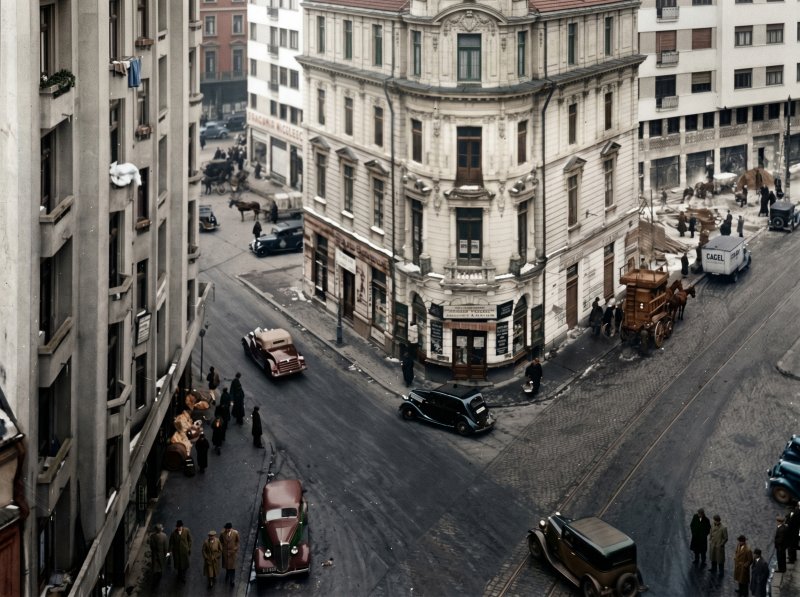
Photo: Iosif Berman / Image restored and colorized using artificial intelligence, preserving the original details.
The Bukovina Museum presents him as a photojournalist for Adevărul and Dimineața, official photographer of the Royal House, and collaborator of Dimitrie Gusti’s Sociological School. His photographs also appeared in National Geographic, which shows Berman’s range: he could photograph the institution, the street, the village, royal childhood, prison, ceremony, the outskirts. Anything. He had an eye for the event, but also for the small person caught in the corner of the frame, where history suddenly becomes more credible.
His fate has a brutal cut. According to accounts preserved around the family and later echoed by the Romanian Peasant Museum, because of his Jewish origin he was forbidden to continue photographing, and this rupture was connected in family memory to his death in 1941. For Bucharest, Berman remains the photographer who took the city out of the stillness of the portrait and set it in motion — voting, celebrating, protesting, selling, living.
Aurel Bauh and modernist Bucharest, seen through avant-garde eyes
Aurel Bauh, 1900–1964, belongs to another sensibility. The Bucharest Municipality Museum presents him as a photographer trained in France, later active in Bucharest, where he opened a studio. Sources dedicated to the history of photography connect him to a modern way of seeing the city, attentive to form, light, architecture, and composition.
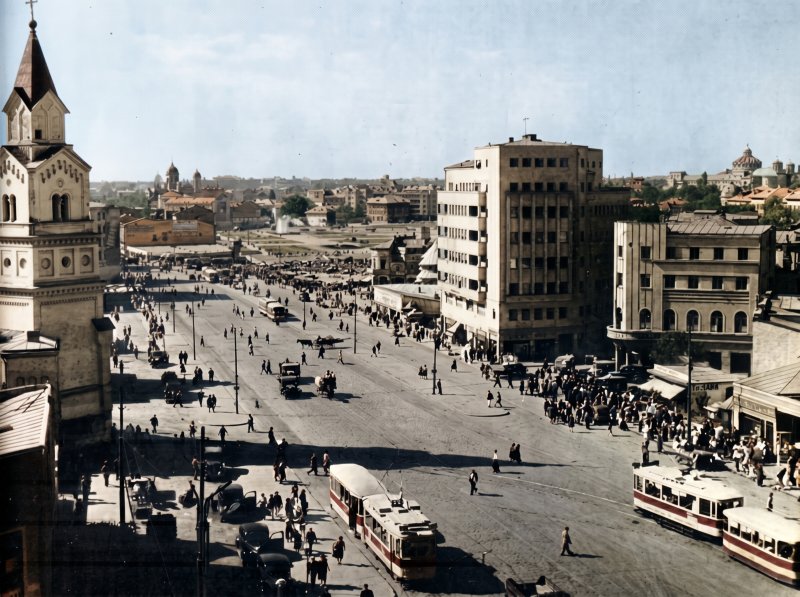
Photo: Aurel Bauh / Image restored and colorized using artificial intelligence, preserving the original details.
Bauh matters because his Bucharest begins to be photographed somewhat differently: with interest in volume, rhythm, urban geometry, and the expressiveness of the building. In 1957, the album “București” appeared, with photographs by Aurel Bauh, published by the State Publishing House for Literature and Art, with a preface by Tudor Arghezi.
Where Ionescu and Berman bring the street to life, Bauh brings in a more composed city, more attentive to architecture, to the image of a modern capital. In photographs of this kind, Bucharest sometimes appears more disciplined than it actually was, which says a great deal about the aspirations of the era. The city was already photographing itself in order to present itself, and presentation, like any good suit, concealed quite a few seams.
Andrei Pandele, the witness of Bucharest brought to the ground
In the 1980s, Bucharest urban photography acquired an almost judicial gravity. Andrei Pandele, born in 1945, architect and photographer, is one of the best-known figures in the photographic documentation of communist demolitions. Humanitas presents him as an architect who taught courses on photography and architecture at the “Ion Mincu” University of Architecture and Urbanism, while Scena9 recalls that, before 1989, he slipped photographs of urban destruction among his frames, printed only after the Revolution.
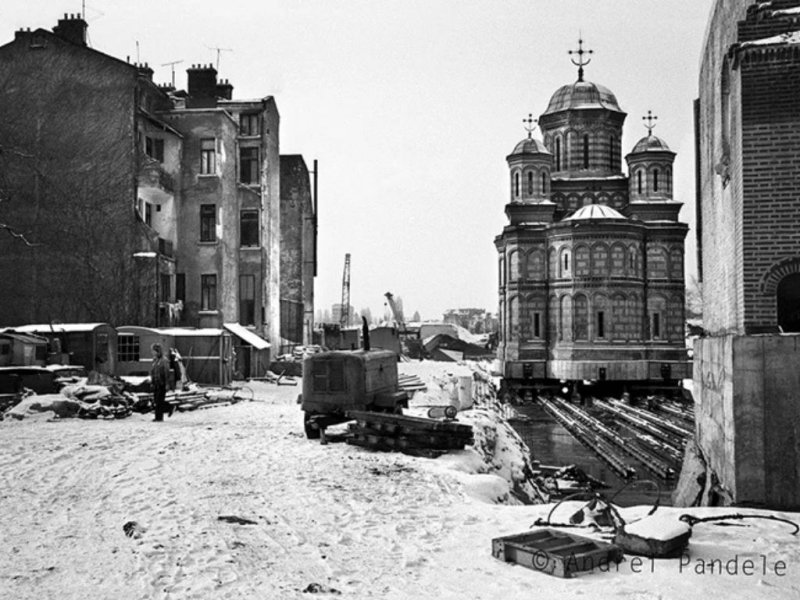
Photo: Andrei Pandele
Pandele photographed a city wounded in real time. The houses, streets, churches, and people from the areas condemned by the Civic Centre project enter his images with a force that the official urban planning of the era would have preferred buried under concrete. His work is linked to the documentation of Bucharest destroyed by communist systematization, including the Uranus area and the demolition of landmarks such as Brâncovenesc Hospital.
What was lost gains precise contours here. The Uranus neighborhood and the Izvor–Mihai Vodă areas, with extensions toward Antim and Rahova, were affected by the systematization that prepared the Civic Centre. Radio Romania International describes old Uranus as a hilly area with the army Arsenal, the Republicii Stadium, churches, monasteries, private homes, parks, and public monuments, transformed in the early 1980s into the present ensemble dominated by the Palace of Parliament.
Văcărești Monastery represents another major wound. RRI presents it as the largest Christian Orthodox monastic ensemble in Southeastern Europe. The demolition was carried out in stages, beginning in December 1986, with the ensemble completely destroyed by 1987. In such cases, photography remains the witness that refuses convenient amnesia.
Andrei Bîrsan, Bucureștiul meu drag, and the city photographed like a family member
After 1989, urban photography became democratized. Personal projects, communities, tours, exhibitions, and online archives appeared. Andrei Bîrsan and the “Bucureștiul meu drag” Association hold an important place in this new stage. The project describes itself as a family album of Bucharest, built from images of the city in the present and in the past, and the association mentions activity begun in December 2007.
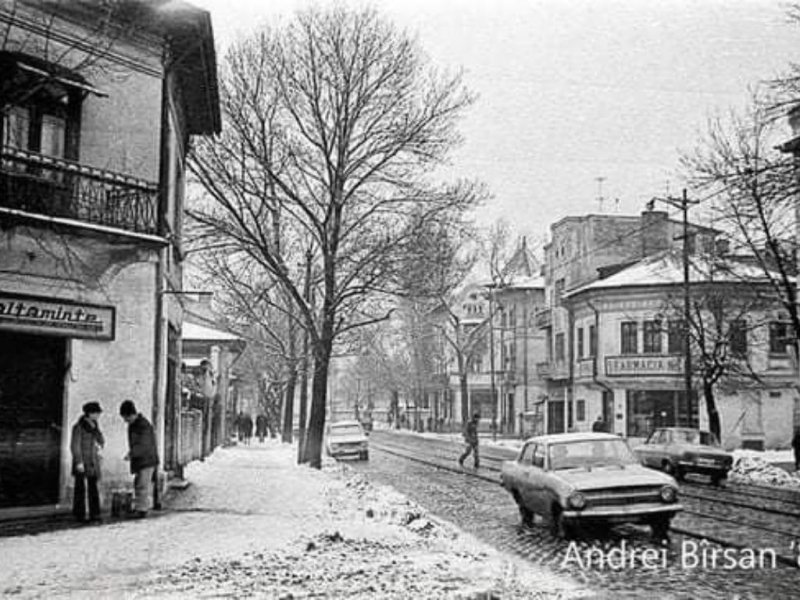
Photo: Andrei Bîrsan
Bîrsan has the advantage of a long-term gaze. The website orasul.ro, associated with the project, though long unupdated, displayed at the time of consultation more than 173,000 published photographs, a volume that turns passion into a visual infrastructure of urban memory.
The importance of this type of archive lies in accumulation. A photograph of a house may seem ordinary today. In ten years, when the house becomes an apartment block, a metal fence, or a café with purple neon, the image gains documentary value. Bucharest changes its scenery at a speed that turns any attentive photographer into an emergency archivist.
Cristian Vasile and optimistic Bucharest
Cristian Vasile, known through the “București Optimist” project, brings a complementary perspective. Red Bull Romania presented “București Optimist” as one of the most loved photo projects in Romania, built on the idea of showing the bright side of the city. The project’s page defines it simply: “About the full half of the city.”
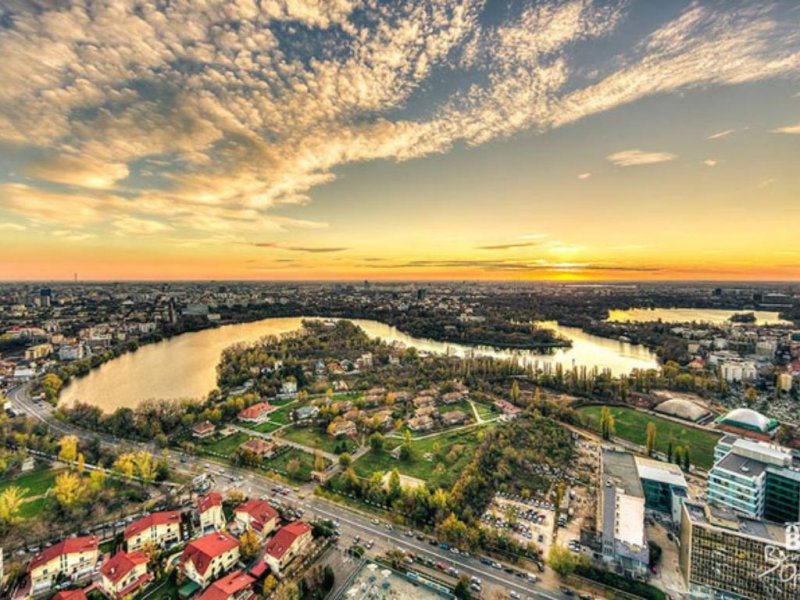
Photo: Cristian Vasile
In a city often photographed through ruins, cables, potholes, and frayed tempers, this approach has a useful role. Visual optimism, when it remains honest, can save ignored details: light on an old façade, a still-living neighborhood corner, a staircase, a garden, a café, a tram at sunset, an intersection that seems ordinary until it disappears. Documenting the city requires both indignation and tenderness. Bucharest needs both, administered in careful doses.
What we have already lost and what can still be saved
Bucharest has lost entire neighborhoods, monuments, historic hospitals, monasteries, cinemas, workshops, gardens, façades, and streets with names that today sound lifted from a novel. Uranus, Izvor–Mihai Vodă, parts of Antim and Rahova, Văcărești Monastery, Brâncovenesc Hospital, old commercial routes, and outskirts with their own identities form a map of absences. UAUIM records the existence of documentation dedicated to demolished areas and buildings, including the volume “București demolat: arhive neoficiale de imagine: 1985.”
What can be saved depends on an apparently simple practice: consistently photographing the city. Red-dot houses, closed cinemas, former factories, markets, passageways, apartment-block staircases, old shop windows, painted signs, courtyard entrances, garages, trams, kiosks, urban furniture — all deserve to be documented with the same seriousness granted to palaces. The history of the city often lives in the small detail, in the corner of the frame, in the thing a hurried urban planner files under “degraded built fabric.”
Bucharest’s photographers have always had a larger role than it seemed at the moment the shutter was pressed. Szathmári captured the visual beginnings of the modern capital. Duschek and Mandy fixed the elites and rituals of the nineteenth century. Nicolae Ionescu and Iosif Berman gave the interwar street a face, rhythm, and human density. Aurel Bauh brought the city into the modernist register. Andrei Pandele documented the trauma of demolitions. Andrei Bîrsan, Cristian Vasile, and today’s communities continue the affective inventory of a city that changes without always leaving minutes behind.
Bucharest finds it difficult to look in the mirror, but photography forces the city into moments of pause. And for a city so skilled at disappearances, a few seconds can mean the difference between memory and vacant land.
You may also like: The story of “Bucharest around 1900” in color: who took the city’s first color photographs