The story of “Bucharest around 1900” in color: who took the city’s first color photographs
By Eddie Țone
- Articles
- 10 MAY 26
In most cases, Bucharest around 1900 reaches us dressed in sepia. It has horses, carriages, stiff-brimmed hats, serious mustaches, and ladies with salon-ready gazes, all caught in a world that seems to have lived exclusively in shades of tea left forgotten on the table. Color, however, appears more rarely. A façade takes on a creamy hue, a garden catches a little green, a folk costume emerges from the fog of history and, suddenly, Bucharest’s urban great-grandfather seems less decorative and much more alive. Color does something almost cheeky to the past, taking it out of the display case and placing it beside us, on the pavement.
The story of Bucharest’s first color images, however, requires caution. In old photography, the term “first” must be handled like a porcelain cup on an unstable table. There are images colorized later, there are reproductions, there are lost plates, there are autochromes preserved in public collections or recently surfaced in private archives.
What can be documented today is that the first solid traces of color photography made in Bucharest are connected to the Autochrome Lumière process, to the work of professional photographers such as Franz Duschek Jr., and to the spectacular archive of architect Victor G. Ștefănescu, rediscovered after more than a century. And somewhere in the background, the Lumière brothers slipped potatoes, glass, and chemistry into history, a combination that sounds like a rural recipe and produced one of the most elegant visual revolutions of the twentieth century.
How color ended up on a glass plate
Autochrome Lumière was the first truly viable industrial process for color photography. The brothers Auguste and Louis Lumière patented it in 1903, and its commercialization began in 1907, which explains the rarity of color images made before the First World War. It was a modern, expensive, fragile, and demanding technology — in other words, exactly the sort of thing that instantly attracted educated elites and people patient enough to believe that photography could become a small operation in domestic alchemy.
The technical secret seems, at first glance, taken from a laboratory joke. A layer made of millions of microscopic potato starch grains, dyed in shades of orange, green, and violet, was applied to a glass plate. Carbon powder was inserted between them, followed by the black-and-white photographic emulsion. Light passed through these colored grains, and the result was a positive image on glass, viewed like a slide. A photograph, but also an object in itself, with weight, fragility, and the aura of a jeweler’s piece.
For this reason, autochromes have a distinctive texture. Their color seems slightly dotted, soft, sometimes a little dreamy, as if reality had been passed through a filter of luminous dust. At the same time, the process required long exposures, stable cameras, and well-behaved subjects. Restless Bucharest, with trams, mud, hats, and hurried gentlemen on Calea Victoriei, had to be persuaded to stand still. But this is where the charm begins: the modern city entered color through a technology that forced it, at least for a few seconds, to behave civilly.
Photographic Bucharest before color
Before Bucharest gained natural tones on glass, the city had already built a remarkable photographic culture. The Museum of the Municipality of Bucharest notes that daguerreotype photography had been announced in the Romanian space as early as 1839, and the first camera of this type was purchased by Saint Sava College in 1840. The same museum identifies the first photographic studio in Bucharest as belonging to a woman, Wilhelmine Priz, who made daguerreotype portraits at a “decent” price — a phrase so Bucharest-like that one can almost hear the negotiation going on in the background.
Then came the major names of early Romanian photography. Carol Popp de Szathmari is credited with one of the earliest images of Bucharest, the calotype known as “Câmpul Procopoaiei.” Ludwig Angerer, Franz Mandy, Franz Duschek, and others fixed the capital of the nineteenth and early twentieth centuries into an enormous visual heritage. The photography collection of the Museum of the Municipality of Bucharest preserves images of Bucharest from the nineteenth and twentieth centuries: portraits, interiors, squares, fairs, and events, with works signed by names such as Carol Popp de Szathmari, Ludwig Angerer, Franz Mandy, and Franz Duschek.
Color came over this tradition like a luxury apparition. Black-and-white photography was already an urban, social, commercial, and memorial instrument. Autochrome added a new layer: color as document, color as proof that the past wore fabrics, wood, paint, plants, ceramics, and leather in precise tones. For the historian of the city, this difference matters enormously. A black-and-white photograph tells the shape of a world. A color photograph begins to speak about the temperature of that world.
Franz Duschek Jr. and the autochrome commissioned by Tzigara-Samurcaș
One of the most important documented episodes in early color photography in Bucharest is connected to the Museum of National Art and Ethnography, an institution led by Alexandru Tzigara-Samurcaș, art historian, ethnographer, journalist, and photographer. According to research presented by Theodor Ulieriu-Rostás, museographer and archivist at the National Museum of the Romanian Peasant, in 1910 the museum commissioned Bucharest photographer Franz Duschek Jr. to make “four color plates using the Lumière system,” with images from the museum.
The image preserved today in the Image Archive of the National Museum of the Romanian Peasant, and which can be seen here, is considered one of the oldest color photographs made in Romania. It captures an interior of the first exhibition of the Museum of National Art, housed between 1907 and 1912 in the buildings of the old Mint on Șosea, on the site now associated with the Museum of the Romanian Peasant and Monetăriei Street. Here, color preserves the interior of a Bucharest museum at a moment when public institutions of this kind were still in a formative stage.
Franz Duschek Jr. deserves to be taken out of the footnotes. He came from a family of photographers and was active in Bucharest from the 1890s until before the First World War, according to the same Theodor Ulieriu-Rostás. The fact that a Bucharest cultural institution commissioned him, in 1910, to produce color plates using the Lumière system shows that Bucharest was rapidly connected to European photographic innovation. Of course, this connection had the air of a cultural elite that read catalogues, wrote official orders, and treated photography as a tool of prestige. Bucharest always modernized in its own way: with ambition, with occasional administrative delay, but also with real surprises.
Victor G. Ștefănescu, the architect who photographed the city in color
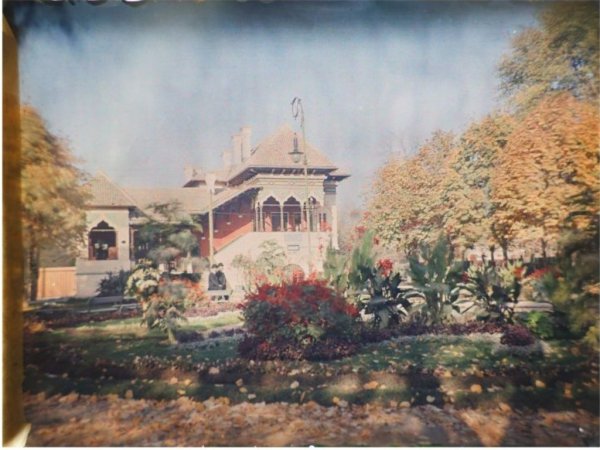
Another major piece of the story has recently entered public attention through the archive of architect Victor G. Ștefănescu, rediscovered after more than 100 years. The archive contains images made through autochrome photography, including buildings in Bucharest, among them the Bufetul de la Șosea, alongside images from Constanța and Alba Iulia. Sources published in 2024 indicate plates dated 1907, 1908, and 1910, placing these images very close to the commercial beginnings of the Lumière process.
Victor G. Ștefănescu, sometimes written Stephanescu or Stephanesco, was born in 1877 and was one of the important architects of the first half of the twentieth century. He designed or worked on buildings such as the Geological Institute, the Anglican Church in Bucharest, the Carol I Mosque in Constanța, Cotroceni Station, and the extension of the North Railway Station. He studied in Paris, at the École spéciale d’Architecture, between 1896 and 1901, where he received a gold medal and a first-place diploma, according to the presentation of the Ștefănescu-Arephy family.
The importance of his archive comes from a double position. Ștefănescu looked at the city as an architect, so he saw volumes, façades, construction sites, perspectives, and building details. At the same time, he used an extremely new photographic process, with Lumière plates, to capture these elements in color. This changes the way the images are read. The Bufetul de la Șosea, for example, gains through autochrome the air of a Bucharest rehearsing its European speech in front of the mirror, with enough confidence and enough décor.
Of course, the status of these images requires careful wording. Public sources present them as among the first color images of buildings in Bucharest and among the earliest color photographs made in Romania. Until a full museum catalogue and extensive academic research are completed, they function as a spectacular chapter in local autochrome pioneering, with obvious heritage value and a charm that is hard to match. A glass plate with dyed starch and an architect educated in Paris can, together, make a small breach in time.
Albert Kahn and the great global fever of autochromes
The story of Bucharest colored through autochromes is better understood in an international context. The most famous project of this type was “Archives de la Planète,” initiated by French banker Albert Kahn. Between 1909 and 1932, the project gathered the largest collection of autochromes in the world, alongside one of the largest preserved collections of documentary film. UNESCO describes the archive as a project created by Kahn, a philanthropist and pacifist, under the scientific direction of geographer Jean Brunhes starting in 1912.
The aim was ambitious, almost unbelievable by our standards: to document a world in transformation. Photographers, camera operators, and researchers traveled through dozens of countries, collecting autochromes, films, and stereoscopic images. Kahn believed in the archive as an instrument of knowledge and closeness between peoples, which sounds very beautiful and very French, in that way in which idealism sits down at the table with technology and orders another coffee.
For Bucharest, Albert Kahn matters through context, even where the direct connection must be verified image by image in the museum database. In the years 1910–1930, autochrome photography was a visual language of global documentation. Cities, costumes, markets, monuments, villages, rituals, portraits — all entered the same great attempt to preserve the world before modernity changed it irreversibly. Bucharest participated in this era through professional photographers, architects, museums, and private collections, using the same technology that colored Japan, the Balkans, the Near East, or rural France.
National Geographic, Wilhelm Tobien, and Bucharest in the 1930s
After the pioneering period of 1907–1910, autochrome photography continued to circulate in the international press. National Geographic used the process extensively and preserves a major collection of autochrome plates. Its archives also include images taken in Bucharest by photographer Wilhelm Tobien. A photograph published in the National Geographic Found archive shows two young women in bathing suits, photographed in Bucharest in November 1930, with the credit given to Wilhelm Tobien.
Another example, mentioned by National Geographic France, shows a woman in Bucharest sitting on a bench, wearing a red hat and red bathing suit, in an autochrome made by Tobien in January 1936. The same source states that National Geographic preserved more than 15,000 autochrome plates and that such images were part of a way of showing the world in color before modern films, such as Kodachrome, radically changed field photography.
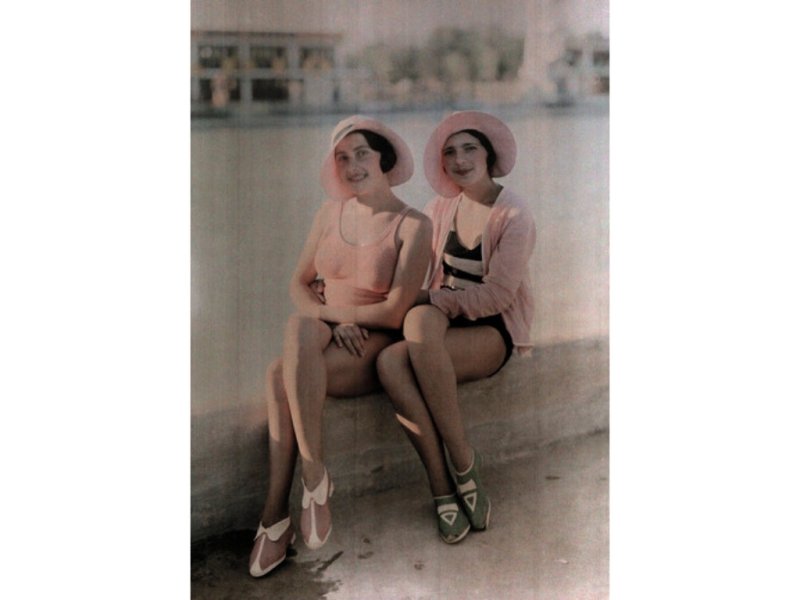
These images of interwar Bucharest have a different tone from those around the 1910s. Here appears a more relaxed city, more physical, more modern in gestures and fashion. The Bucharest of late autochromes can sit on a bench in a bathing suit, without the solemnity of the museum and without the gravity of the façade. It is already a city that has learned to pose for magazines, with a cosmopolitan air and a touch of seaside theatricality, even when the setting remains the capital.
Why these images matter for Bucharest
The first color photographs of Bucharest have historical value because of their rarity, but also because of the way they change our perception of the city. Bucharest around 1900 was for a long time visually consumed in black and white, and that gave it a convenient distance. It seemed solemn, dusty, almost literary. Color makes it more concrete. A wall has pigment, a shop window has reflection, a coat has fabric, a museum hall has wood, a face has presence.
The autochromes connected to Franz Duschek Jr., to the Museum of National Art and Ethnography, to Alexandru Tzigara-Samurcaș, and to the archive of Victor G. Ștefănescu open a story still in the process of being clarified. They show a Bucharest photographing itself with very new instruments, shortly after the commercial appearance of the Lumière process. This says something about the cultural ambition of the city, about its institutions, and about the people who understood the image as document, prestige, and memory.
And here lies the real beauty of the subject, because early twentieth-century Bucharest in color appears through a few fragile plates, a few museum commissions, a few rediscovered archives, and a few names worth remembering: Franz Duschek Jr., Alexandru Tzigara-Samurcaș, Victor G. Ștefănescu, Wilhelm Tobien. Behind them stand the Lumière brothers, with their potato starch transformed into cutting-edge technology. History has a sense of humor, when it feels like it. Sometimes it preserves an entire city on a glass plate and colors it with something that, in another life, could have ended up as mashed potatoes.