No Man’s Land at the National Theatre, a ticket to the trenches of Balkan absurdity
By Eddie Țone
- Articles
- 03 JUN 26
A Bucharest resident, exhausted after a week spent navigating the capital’s infernal traffic, often seeks refuge at the National Theatre, hoping for a comfortable escape from everyday life. Instead, he finds a one-way ticket to a muddy trench in Bosnia in 1993, a deeply unfriendly space where logic surrendered long ago to the instinct for survival. The transition from the theatre foyer to the churned-up earth of a conflict zone is brutal, handled with a directorial mastery capable of pinning the audience to their seats from the very first scenes. The urban audience, accustomed to corporate dramas and phone alerts, is suddenly thrown into a universe where survival hangs by a thread, and decisions of life and death are made by people who can barely agree on the weather outside.
We are talking about the production No Man’s Land at the National Theatre. The premise of Danis Tanović’s text, brought to the stage in Andrei Marinescu’s translation and Alexander Morfov’s adaptation, works like a clinical study of armed human stupidity.
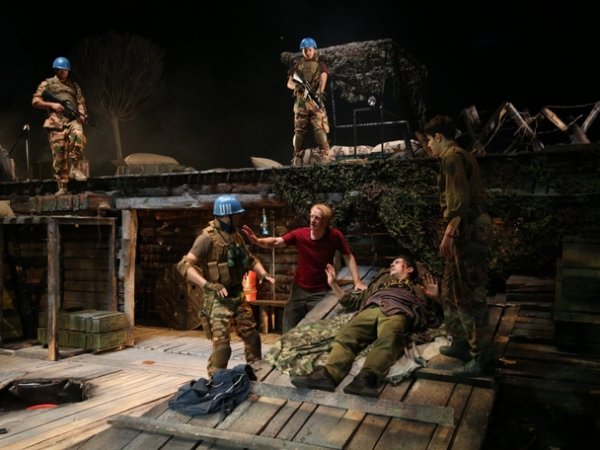
Two enemy soldiers find themselves trapped in an abandoned trench somewhere between the front lines, a neutral territory generically called “no man’s land.” The situation takes on shades of black humour with the introduction of a third character, Cera, lying on top of an anti-personnel bouncing mine, which would explode if the pressure of his body were released. Every movement promises a violent redecoration of the entire landscape, and this constant threat turns the ordinary ditch into a waiting room for death, seasoned with nervous laughter and historical arguments shouted at artillery volume.
How to turn tragedy into a demonstration of black humour
Originally written for film, the story quickly entered the international circuit of major awards. No Man’s Land won the Oscar for Best Foreign Language Film at the 2002 ceremony, in a category that also included the famous French production Amélie. It also won the Golden Globe for Best Foreign Language Film in 2001. The film received the screenplay award at Cannes, while the TNB presentation mentions a track record of more than 40 international awards. One might call it a splendid irony: a story about mud, fear and administrative absurdity ending up on the red carpet of cinema’s grand ceremonies.
Danis Tanović knows the anatomy of conflict from an intimate perspective: during the siege of Sarajevo in the 1990s, he spent roughly two years on the front line, filming for the Bosnian army. That raw experience, filtered through the lens of time, was later refined into a text of sharp intelligence, translated and adapted for the stage in a production that preserves the absurd tension of the original situation.
The move from film to theatre intensifies the feeling of claustrophobia. On screen, the director can shift the camera angle at any moment, offering the viewer a visual pause, a moment to breathe. On the TNB stage, the man lying on the mine remains there, in front of you, a physical presence impossible to ignore. The acidic dialogues between the enemy camps resemble an epic quarrel between apartment-block neighbours over a parking space, transferred to a geopolitical level and equipped with heavy weaponry.
The architecture of chaos on the Bucharest stage
Bulgarian director Alexander Morfov, known to the TNB audience through productions such as The Tempest and The Visit of the Old Lady, orchestrates this chaos with a taste for stage energy, movement and physical tension. Morfov uses the theatrical space like a pressure mechanism: the actors sweat, crawl, shout, approach one another and betray one another with a fluidity that turns the stage into a living organism, pulsing with adrenaline.
Nikola Toromanov’s set design physically and psychologically reconstructs the purgatory of “no man’s land”, an isolating, filthy, suffocating space. The earthen walls seem to close in around the characters as time passes, forming an almost impenetrable natural barrier. The visual contrast between the muddy trench and the bureaucratic spaces of the international officials supports the production’s satire: on one side, exhausted bodies and impossible decisions; on the other, uniforms, procedures and institutional concern expressed in regulatory language.
The lighting design by Chris Jaeger supports this scenic opposition, alternating the atmosphere of the front with the cold zones of the administrative mechanism in a theatrical geometry of helplessness: every area looks different, but all lead to the same bitter conclusion — when a human being is trapped between sides, systems move slowly, solemnly and often uselessly.
Bureaucracy in a blue helmet and the media circus
The production reaches its most acidic satirical territory with the appearance of the peacekeeping forces, represented by UNPROFOR. In the story, Sergeant Marchand tries to intervene despite his initial orders, while the mission of neutrality collides with the muddy reality of the Bosnian front. From this collision emerges a black comedy of procedures, recognisable to anyone who has ever stood in line at a counter where the file still needed one more stamp, two copies and a great deal of patience.
When a man is lying on an explosive device, the institutional response is divided between orders, approvals, communications and the attempt to preserve the appearance of control. The satire becomes fierce because the concrete situation demands action, while the system produces language, hierarchy and hesitation. War, in Tanović and Morfov’s reading, looks like a tragedy administered through memos.
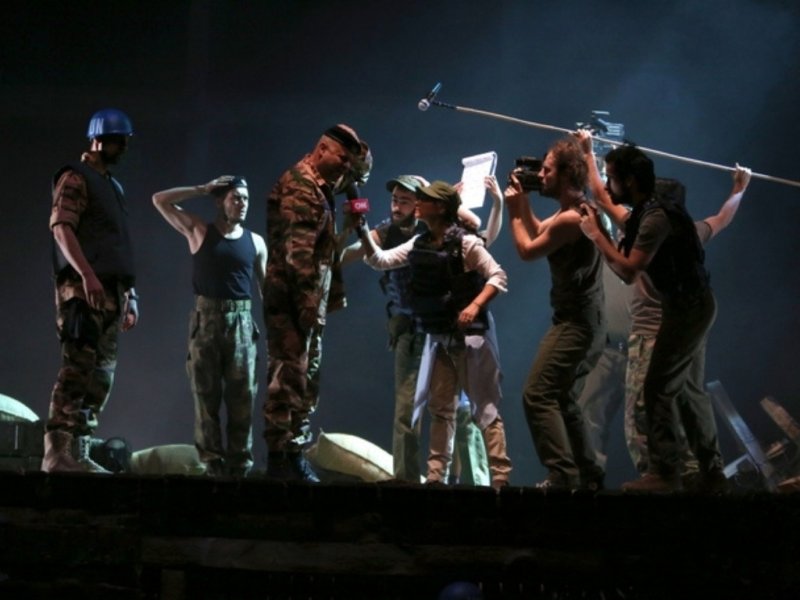
Into this volatile mixture steps the international press, represented by journalists interested in the media power of the incident. The arrival of the television crew instantly changes the power dynamics inside the trench. The officials begin speaking for the cameras, the soldiers realise they have become characters in a global story, and the tragedy suddenly gains breaking-news value. The satire exposes an uncomfortable mechanism: human suffering becomes more visible when it can be broadcast, commented on and packaged for an audience.
The acting dynamic supports the entire scaffolding of this absurd universe. Richard Bovnoczki and Ciprian Nicula build the antagonistic axis of the production, moving from visceral hatred to awkward moments of closeness, in which the two soldiers seem to remember for a few seconds that they belong to the same species. Mihai Călin, as Cera, becomes the physical and moral centre of the extreme situation: his body, immobilised on the mine, holds the entire stage world in an almost unbearable tension.
The physical effort of the actor lying on the mine deserves a separate mention. Terror, resignation, sarcasm and panic must be conveyed from an almost static position, which requires severe bodily discipline and careful economy of expression. The secondary characters, from soldiers to journalists and officials, complete the social portrait of a conflict in which everyone wants to appear useful, while reality continues to sit, literally, on a bomb.
The production may leave the spectator with the echo of laughter mixed with a lump in the throat. Tanović’s observation, brought to life by Morfov’s staging, works like a mirror placed in front of a society that complicates simple things and misses the essential with a perseverance worthy of better causes. The performance remains a robust theatrical experience, with recent history, sarcasm, cynicism and an impressive quantity of stage earth. People laugh, sweat, and go home with an unexpected gratitude for the safety of Bucharest’s pavements, even with all their familiar potholes.
Administrative details for the curious spectator
No Man’s Land
“I.L. Caragiale” National Theatre Bucharest — TNB
Text by: Danis Tanović
Stage adaptation and direction: Alexander Morfov
Set design: Nikola Toromanov
Cast: Mihai Călin, Richard Bovnoczki, Ciprian Nicula, Lari Giorgescu, Marcelo-S. Cobzariu, Vitalie Bichir, Eduard Adam, Ionuț Toader, Aylin Cadîr, Fulvia Folosea, and an extended team of talented actors from the TNB company.
Photo credit: TNB
You may also like: The National Theatre of Bucharest, from its beginnings to the present: a boyar legacy turned into the cultural heart of the Capital