Bucharest City Hall prepares the rehabilitation of part of the Uranus neighborhood through a partnership between key state institutions
By Bucharest Team
- Articles
- 30 JAN 26
A significant area in central Bucharest, overlapping the former footprint of the historic Uranus neighborhood, is set to be included in a large-scale urban regeneration project. The initiative comes from Bucharest City Hall and is based on a cooperation protocol bringing together several central and local public institutions.
The project aims to transform an extensive area located near some of the city’s most symbolic landmarks into a more accessible, coherent urban space that is better integrated into the current structure of the capital.
What the protocol approved by the General Council provides for
The document adopted by the Bucharest General Council establishes a framework for cooperation between the Municipality of Bucharest and several state institutions, including the Government of Romania, the Chamber of Deputies, the Senate, the Romanian Academy, the Romanian Patriarchate, and Metrorex.
The purpose of this partnership is to prepare and implement the strategic project entitled “Urban Regeneration of Dealul Arsenalului – Uranus.” At this stage, the protocol does not set a total budget or a clear implementation timeline, but defines the responsibilities of each party involved during the preparatory phases.
Where the area to be redeveloped is located
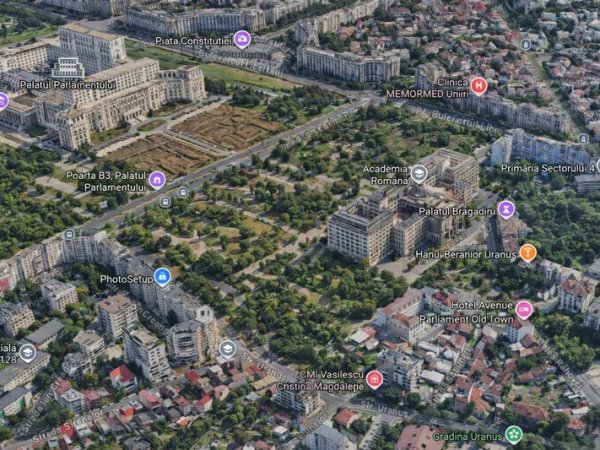
The targeted perimeter lies in a central part of Bucharest, bounded by the Romanian Academy, the National Cathedral, the Palace of Parliament, Constitution Square, and Izvor Park. The total area under consideration covers approximately 30 hectares.
According to urban planning documentation, the area is currently characterized by:
- functional fragmentation;
- underused public spaces;
- heavy car traffic;
- limited pedestrian connections between the northern and southern parts of the city.
Despite its proximity to major administrative and cultural landmarks, the area currently functions more as an urban barrier than as a connective space.
Objectives pursued through the regeneration project
Local authorities have outlined several general directions that will guide the upcoming urban design competition. The stated objectives include:
- improving the quality of public spaces;
- enhancing connectivity with neighboring districts;
- developing pedestrian, promenade, and leisure areas;
- capitalizing on the cultural and tourism potential of the Palace of Parliament area;
- integrating the historical memory of the Uranus neighborhood into new urban interventions;
- increasing accessibility for pedestrians, cyclists, and public transport.
Official documents emphasize the importance of the site’s memorial dimension, noting that proposed solutions should avoid uniform, imposed interventions and should respect the area’s historical sensitivity.
The role of the institutions involved
Bucharest City Hall will coordinate the organization of the design competition and integrate the winning project into urban planning documentation. Partner institutions will have advisory and approval roles, in line with their respective competencies.
Metrorex’s involvement is required due to the overlap between the project area and metro infrastructure and safety zones. The company will take part in approving technical and economic documentation to ensure compatibility with the existing underground network.
The costs of organizing the design competition are expected to be covered by the local budget of the Municipality of Bucharest or other legally established sources, including European funds. Expenses related to expropriations and construction works will be determined at a later stage.
The Uranus neighborhood, between lost history and symbolic recovery
The Uranus area represents one of the most difficult chapters in Bucharest’s urban history. Beginning in 1982, the neighborhood was largely demolished to make way for the Palace of the People and Victory of Socialism Boulevard, a process that erased a complex urban fabric.
As a result of the demolitions, numerous buildings of historical and social value were lost, including churches and medical institutions, and entire communities were relocated. The regeneration project announced now is presented by authorities as an attempt to reconnect this area with the city and to bring the memory of a vanished neighborhood back into public discussion.
In its current form, the initiative does not aim to reconstruct the Uranus neighborhood, but rather to reinterpret the urban space, focusing on functionality, accessibility, and acknowledgment of the past.