Who was Georges Clemenceau and why does a street in central Bucharest bear his name
- Articles
- 12 MAR 26
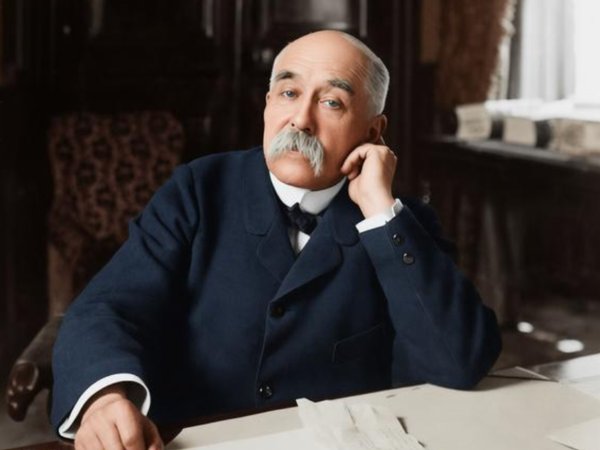
Georges Clemenceau, one of the most influential political personalities of modern France, was born on September 28, 1841 in the locality of Mouilleron-en-Pareds, in the Vendée region, in western France. The future political leader was to become a dominant figure of the Third French Republic, being known for his strong character, for his incisive speeches and for the decisive role he played at the end of the First World War. Because of his energetic style and the uncompromising way in which he defended his ideas, his contemporaries gave him the nickname “The Tiger.”
The origins and formation of a republican spirit
Clemenceau’s childhood took place in a rural environment, among the peasants of Vendée. Although he came from a modest family, the influence of his father, Benjamin Clemenceau, was decisive in his intellectual and political formation. Benjamin was an admirer of the philosopher Voltaire and a fervent supporter of the ideas of the French Revolution of 1789. He instilled in his son values such as freedom, critical thinking and opposition to authoritarianism.
In the Clemenceau family home, radical political ideas for that time were often discussed. Through his father, Georges came into contact with people who opposed the regime of Napoleon III and even planned a coup against the emperor. It was also then that he met the historian Jules Michelet, a famous intellectual who was pursued by the imperial police for his republican opinions.
His father’s political activity did not remain without consequences. In 1858 Benjamin Clemenceau was arrested by the authorities. This episode had a strong impact on the young Georges, strengthening his political convictions and determining him to become actively involved, later on, in the struggle for democracy.
The student years and the first confrontations with the authorities
In November 1861 Georges Clemenceau left for Paris to study medicine. The capital of France was at that time an effervescent intellectual center, and the Latin Quarter had become the meeting place of students and young people who challenged the imperial regime.
In this environment full of political debates, Clemenceau drew closer to young radical republicans. Together with them he founded an avant-garde association called “Agis Comme Tu Penses,” which in translation means “Act as you think.” The organization promoted the idea that every individual must follow his convictions and fight for changing society.
During the same period Clemenceau and several friends launched a magazine titled “Le Travail” (“Work”). The publication presented radical political ideas and defined four principles that were to characterize his entire career: freedom, social justice, civic responsibility and opposition to authoritarianism.
The imperial authorities reacted quickly. The magazine was closed by the police, and Clemenceau was arrested after he published an announcement inviting workers to come to Paris to commemorate fourteen years since the Revolution of 1848. Because of this, the young student spent 73 days in prison.
After his release he did not give up his activism. He founded another newspaper, “Le Matin” (“Morning”), but it too was closed by the authorities. These experiences strengthened Clemenceau’s reputation as a republican militant and an opponent of the imperial regime.
The American experience and the influence of democracy
After completing his medical studies, Clemenceau decided to leave France for a period. Between 1865 and 1869 he lived in the United States, an experience that was to profoundly influence his political vision.
He arrived in New York at a dramatic moment in American history: the Civil War was still at its peak. Clemenceau was impressed by the energy of American society and, especially, by the freedom of expression enjoyed by citizens. Compared with France dominated by the authoritarian regime of Napoleon III, America seemed to him a model of democracy.
During this period he had to support himself, because his father had stopped helping him financially. Thus Clemenceau became a teacher at a girls’ school in Stamford, Connecticut.
There he met Mary Plummer, one of his students. Despite the opposition of the young woman’s guardian, the two married in 1869. Their marriage produced three children, but the relationship did not last, and after about seven years the two separated.
Shortly after the wedding, Clemenceau returned to France. Initially he settled in Vendée and practiced medicine, but political events were soon to draw him toward public life.
Entry into politics and rise in French public life
In July 1870 Emperor Napoleon III declared war on Germany. The conflict ended quickly with a catastrophe for France. After the defeat at the Battle of Sedan, the empire collapsed and the republic was proclaimed.
Clemenceau was among those who participated in the demonstrations of September 4, 1870, when the crowd invaded the Bourbon Palace and acclaimed the republican leader Léon Gambetta.
Soon afterward Clemenceau was appointed mayor of the 18th arrondissement of Paris, the Montmartre area. On February 8, 1871 he was elected radical republican deputy in the National Assembly, representing the department of the Seine.
He firmly opposed the harsh peace conditions imposed on France by Germany after the war. He considered the treaty a national humiliation and promised that France would regain its dignity.
During the same period the revolt known as the Paris Commune broke out. Clemenceau attempted to mediate negotiations between the leaders of the revolt and the government installed at Versailles. His attempt failed, and in March 1871 he resigned from his public offices.
However, his political career did not end there. In 1876 he was elected again as deputy for the 18th arrondissement of Paris and joined the radical wing of French politics. His energy, powerful speeches and ability to mobilize supporters quickly turned him into a leader of the republican far left.
Clemenceau – journalist, intellectual and supporter of culture
Alongside his political activity, Georges Clemenceau had an important career in journalism. In 1880 he founded the newspaper “La Justice,” which became one of the most influential publications of the radicals in Paris.
Through his articles Clemenceau criticized both conservatives and republican governments that he considered too moderate. This combative attitude earned him the reputation of a “destroyer of governments,” because numerous political cabinets fell after press campaigns supported by him.
Besides political and journalistic activity, Clemenceau was a man of culture. He was a friend of many writers and artists of the era and showed a special interest in art. He was a fervent supporter of Impressionism and especially admired the works of the painter Claude Monet.
After the First World War Clemenceau contributed to organizing Monet’s monumental exhibition at the Orangerie in the Tuileries Gardens in Paris, where the famous “Water Lilies” were displayed.
Clemenceau also wrote several books, especially works of a political or sociological nature. Among them was the volume “At the Foot of Mount Sinai,” illustrated by the artist Henri de Toulouse-Lautrec, which presents episodes from the history of the Jewish people.
An important moment of his journalistic activity was his involvement in the famous “Dreyfus Affair.” At first Clemenceau believed that the officer Alfred Dreyfus was guilty of spying for Germany. Later, convinced of his innocence, he conducted an eight-year press campaign for his rehabilitation.
“Father of Victory” and the role in the First World War
Clemenceau’s political career reached its peak during the First World War. After serving as minister of the interior and prime minister between 1906 and 1909, he returned to the head of the French government at a critical moment.
In 1917 France was in an extremely difficult situation. The morale of the army and the population was low, and the country’s resources were almost exhausted. Under these circumstances President Raymond Poincaré asked Clemenceau to take over the leadership of the government.
His determination became legendary. Clemenceau was convinced that the only solution was total victory over Germany. For those he considered traitors or pessimists he had no tolerance.
He supported the idea of a unified military command for the Allied armies. In 1918 Marshal Ferdinand Foch was appointed supreme commander of the Allied forces, a decision that contributed to coordinating the military effort.
Clemenceau’s strategy was one of total resistance. His famous declaration remained that France would continue the fight “until the last moment, and the last moment will be ours.” After the Allied victory he was nicknamed the “Father of Victory.”
At the Peace Conference of Versailles in 1919, Clemenceau played a major role in establishing the new borders of Europe. His influence was decisive in shaping the treaty that officially ended the war.
Withdrawal from politics and the last years of life
After withdrawing from political life in 1920, Clemenceau returned to his native region of Vendée, to Bel-Ebat, in a modest house located on a dune overlooking the Atlantic Ocean. Although he was almost 80 years old, he remained an active spirit.
He traveled extensively and even made a long maritime expedition to India between 1920 and 1921, accompanied by his friend Nicolas Piétri. During this journey he even participated in tiger hunts and impressed his hosts with his energy and his immeasurable intellectual curiosity.
In the following years he continued to write. Among his works are “Demosthenes” (1926), a study about the famous Greek orator, and “The Evening of My Thoughts” (1927), considered a kind of philosophical testament.
Georges Clemenceau died in 1929 in his apartment in Paris on Franklin Street. In his will he requested to be buried simply, next to his father, without official or religious ceremonies.
Georges Clemenceau Street in Bucharest
In Bucharest there is a street that bears the name of Georges Clemenceau, as a tribute to his role in the history of Europe and in the victory of the Entente in the First World War, a conflict in which Romania was on the side of the Allies.
Georges Clemenceau Street is located in the center of the Romanian capital, in Sector 1, in the area known as the Dorobanți – Piața Romană neighborhood, very close to Calea Victoriei and other important arteries of the city. The area is one of the oldest and most elegant parts of Bucharest, where numerous historic buildings, cultural institutions and embassies can be found.
The choice of the name of this street reflects the international recognition that Clemenceau enjoyed. The French politician was perceived in many European countries as one of the leaders who decisively contributed to the victory of the Allies and to the reorganization of the continent after the war.
Clemenceau’s legacy in the history of Europe
Georges Clemenceau remains one of the defining figures of European politics at the beginning of the twentieth century. His career combined journalism, political activism and state leadership at a crucial moment in history.
His combative spirit, belief in democracy and determination during the First World War earned him an important place in the collective memory of France and of Europe.
The fact that a street in central Bucharest bears his name shows the influence he had beyond the borders of France. For Romanians, Clemenceau was one of the Allied leaders who contributed to the victory of 1918 and to the reorganization of Europe after the war.
Thus his name remains linked not only to the history of France, but also to the destiny of the entire continent in the modern period.
We also recommend: General Ioan Emanoil Florescu, founder of the Romanian Army, has a street bearing his name in the center of Bucharest