The Story of Barbu Ștefănescu Delavrancea: The Child from the Delea Nouă Slum, Caragiale’s Lawyer, the Mayor Who Gave Us Drinking Water in Bucharest
- Articles
- 17 MAR 26
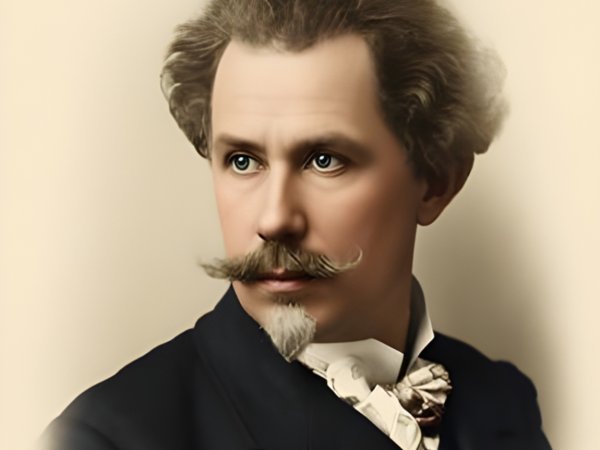
Barbu Ștefănescu Delavrancea remains one of the most complex and fascinating personalities of modern Romania — writer, lawyer, brilliant orator, influential politician, and visionary city leader. His life is the story of a spectacular rise: from the child of a poor family in a Bucharest slum to the man who modernized the capital and defended in court the honor of Ion Luca Caragiale. His destiny concentrates the spirit of an era in which Romania was seeking its identity, modernity, and unity. Delavrancea was not only a cabinet intellectual, but a man deeply involved in social realities, driven by a special sensitivity toward those coming from the same modest environments as his own.
Childhood in the Delea Nouă Slum
Barbu Ștefănescu Delavrancea was born on April 11, 1858, in the Delea-Nouă slum, near the Vergului barrier — one of the peripheral areas of Bucharest at that time. He came from a large and poor family, being one of the many children of the carter Ștefan Tudorică Albu, known in the neighborhood by the nickname “empty-cart.” His father came from a family of shepherds from Vrancea and earned his living transporting grain on the Bucharest–Giurgiu route, eventually becoming the “foreman of the carriers” in the area.
His mother, Iana (Ioana or Ana), was the daughter of a widow from the village of Postrăvari, a community of serfs on the Filipescu family estate. The modest origin was never hidden by Delavrancea; on the contrary, he wore it as a mark of his identity. He remembered with lucidity that he descended from a world of serfs and hardships, stating that he could not forget he was “the child of the serf peasant who received land.”
He spent his early years on Vergului Street, in a modest house, alongside an already elderly father. Childhood memories are imbued with tenderness and nostalgia: the image of the child clinging to his father’s fur-lined coat, begging to be taken in the cart, or the evenings spent by the stove listening to stories until sleep gently overtook him. These experiences nourished the sensitivity and imagination of the future writer.
The Path Toward Education and Affirmation
His first contact with literacy came through the deacon Ion Pestreanu, from Saint George the New Church. In 1866 he enrolled at Boys’ School No. 4, then at the Princely School. He began high school at “Gheorghe Lazăr” and continued at the prestigious “Sfântul Sava,” where he graduated as a scholarship student — a notable achievement for a child from a poor slum.
Between 1877 and 1882 he attended the Faculty of Law in Bucharest. The year 1877 also marks his literary debut, with a poem published in the newspaper “România liberă.” Soon afterward appeared his first volume, “Poiana Lungă – Memories,” signed simply Barbu.
In 1882 he left for Paris for doctoral studies, which he did not complete. However, the French capital offered him a decisive cultural experience: he frequented museums, libraries, and intellectual circles, coming into contact with world literature. The works of Balzac, Hugo, and Zola fascinated him, as did Shakespeare, Tolstoy, and Dostoevsky. This period refined his artistic taste and broadened his intellectual horizon.
The Lawyer, Journalist, and Writer
Returning to the country, Delavrancea enrolled in the Ilfov Bar and began a remarkable legal career. At the same time, he carried out intense journalistic and literary activity. He collaborated with numerous important publications — “România liberă,” “Epoca,” “Lupta,” “Familia,” “Vieața,” “Românul,” and many others — where he stood out through his polemical style, democratic spirit, and pamphleteering talent.
His literary work is varied: prose, drama, folktale-inspired fairy tales, lectures, and speeches. Among the well-known writings are “Sultănica,” “Liniște,” “Paraziții,” and the novella “Hagi Tudose.” In theater, the historical trilogy “Sunset,” “The Storm,” and “The Morning Star” occupies a central place, evoking the figure of Stephen the Great and his successors.
Delavrancea was also a passionate defender of Romanian cultural values, constantly supporting the importance of art and national talents for collective identity.
The Famous Plea in Defense of Caragiale
His oratorical talent reached its peak in the courtroom. A memorable moment is the plea “Innocent,” delivered in 1902 in defense of Ion Luca Caragiale, accused of plagiarism for the play “Năpasta.” Delavrancea’s speech was considered a masterpiece of legal rhetoric, demonstrating not only erudition but also profound empathy for the wronged artist.
His intervention contributed decisively to saving the playwright’s reputation and remained a classic example of advocacy in Romanian legal history.
Political Career and National Ideals
Initially politically unaffiliated, Delavrancea later joined the Liberal Party, becoming a deputy for Prahova in 1894. Later he moved to the Conservative Party and continued to be elected to various public offices. He served as Vice President of the Chamber of Deputies, Minister of Public Works, Minister of Industry and Commerce, and temporarily Minister of Religious Affairs and Public Instruction.
His political speeches addressed social problems, especially the situation of peasants, but also national issues. He advocated for the rights of Romanians in Transylvania and for the unification of all Romanians into a single state, becoming a symbol of active patriotism.
The Mayor Who Modernized Bucharest
Delavrancea served as mayor of the capital twice, and his mandate was marked by ambitious modernization projects. One of the most important achievements was improving the water supply system.
He initiated the construction of a water intake station at Bragadiru, on an area of about seven kilometers, equipped with twenty concrete wells. The water was transported through an aqueduct over nine kilometers long to the reservoir at Cotroceni, with a capacity of about 7,000 cubic meters. This system ensured a safe source of drinking water for Bucharest residents, contributing to the reduction of diseases and the increase of hygiene standards.
At the same time, Delavrancea ordered the relocation of the power plant from Ciurel to Grozăvești and its modernization by installing new generators, strengthening the city’s energy infrastructure.
Sanitation and Transformation of Poor Neighborhoods
Another essential aspect of his municipal activity was improving conditions in marginal districts. The Tei neighborhood, considered one of the most unsanitary at the time, benefited from extensive works: paving streets, arranging drainage, and general cleaning.
Delavrancea also introduced mandatory subscription for garbage collection, replacing the previous voluntary and inefficient system. At the same time, he established public slaughterhouses for animals, preventing their slaughter in household yards — a practice that favored the spread of diseases.
These measures significantly transformed urban life, contributing to the modernization of Bucharest and bringing it closer to Western standards.
The Man of Culture and Academician
Besides political and administrative activity, Delavrancea remained deeply involved in cultural life. He was a lecturer at the Romanian Athenaeum and a fervent supporter of artists. He even studied painting under the guidance of Nicolae Grigorescu, considering art a national necessity, not a luxury.
In 1908 he became a corresponding member of the Romanian Academy, and in 1912 a full member. Between 1915 and 1918 he served as Vice President of the institution. His reception speech, dedicated to the aesthetics of folk poetry, highlighted his attachment to Romanian traditions.
Family and Final Years
Delavrancea had two remarkable daughters: Cella Delavrancea, pianist and writer, and Henrieta Delavrancea-Gibory, one of the first female architects in Romania.
The final years of his life were marked by the First World War. He died on April 29, 1918, in Iași, where the Romanian authorities had taken refuge after the occupation of Bucharest. He passed away only a few months before the Great Union, the ideal for which he had fought his entire life.
The Legacy of an Exemplary Destiny
Barbu Ștefănescu Delavrancea remains the symbol of the intellectual fully engaged in society. He was at once the child of the slum, a brilliant lawyer, a talented writer, an electrifying orator, a politician, and a visionary city leader.
Through his infrastructure projects, he fundamentally changed the lives of Bucharest residents, bringing drinking water, hygiene, and modernity to a city in full transformation. Through his literary work and speeches, he contributed to strengthening national consciousness. And through his modest origin, he demonstrated that talent and will can overcome any social limitation.
Delavrancea’s story is, in essence, the story of modern Romania: a rise from the periphery to the center, from hardship to dignity, from dream to reality.
We also recommend: Stories of Bucharest: Henrieta Delavrancea knew she would become one of the greatest Romanian architects from the age of just 6