Cișmigiu Garden, Dura the Merchant’s pond and the favorite place of the Bucharest high society. The history of the Capital’s oldest park
- Articles
- 16 MAR 26
In the bustling heart of Bucharest, between historic buildings, heavily trafficked boulevards, and the fast rhythm of modern life, there is a place that seems to breathe a different time. Cișmigiu Garden is not just a park, but a true living memory of the city, an oasis of tranquility and romance that preserves something of old Bucharest’s charm. Considered the oldest public park in the Capital, Cișmigiu is a space where history, nature, and urban life intertwine in an almost poetic way. Few visitors know, however, that on the site of today’s park there was not always a landscaped garden, but a marshy area known in the 17th–18th centuries as Dura the Merchant’s Pond. From that wild landscape to the elegant park of today, the transformation was spectacular and reflects the evolution of the city itself.
From wild pond to princely hunting ground
In the distant past, the Cișmigiu area was part of the major floodplain of the Dâmbovița River, which periodically overflowed its banks across the surrounding plains. Dura the Merchant’s Pond constantly changed its appearance depending on the season: in spring and autumn, floods covered a large area, and after the waters receded, lakes and pools fed by natural springs remained.
The rich vegetation turned the area into an ideal habitat for numerous bird species, which led to the place being declared a hunting ground for the ruler. Hunting parties were organized here throughout the year, depending on the season and the abundance of game. The landscape was typical of a medieval city edge: wild, wet, and difficult to access.
As Bucharest expanded, the surface of the pond gradually decreased, and the surrounding lands began to be occupied by dwellings. The area, once peripheral, became increasingly integrated into the urban structure.
The emergence of the name “Cișmigiu” and the first interventions
The 19th century brought radical changes. After 1830, city authorities decided to drain the marsh, both for sanitary reasons and to secure sources of drinking water for the population. At that time, Bucharest’s water supply was provided through public fountains.
Their supervision was entrusted to an official called the “Great Cișmigiu,” responsible for maintaining the fountains and coordinating the water carriers who distributed water throughout the city. His residence was located in the area, and the name of the position gradually came to designate the place as well. Thus, the old name fell into disuse, and the area began to be known as Cișmigiu.
The initiative to build two fountains here belonged to Prince Alexandru Ipsilanti, around 1780. Around these water sources, the idea of arranging a public garden later took shape.
Transforming the marsh into a modern park
The decisive moment came during the reign of Prince Barbu Știrbei, who wished to offer Bucharest a park worthy of the great European capitals. For this project, the famous landscape architect Wilhelm Friedrich Carl Meyer, former director of the Imperial Gardens in Vienna, was brought from Vienna.
Meyer conceived a radical transformation: the marsh was to become an artificial lake, with drainage and sewer systems allowing the water to be emptied and cleaned. In the center of the lake, an artesian fountain was placed, and along the banks winding alleys were laid out, inspired by Western romantic gardens.
The architect pursued a clear objective: the park had to provide residents with refuge from the summer heat and the city dust. To create a pleasant microclimate, between 1850 and 1854 over 30,000 trees were planted, brought both from the surroundings of the Capital and from cities such as Brașov or Vienna.
Together with his assistant, Franz Horer, Meyer created artificial grottoes, romantic bridges, floral carpets, and numerous benches, elements that still give the park its charm today.
Unfortunately, the architect did not live to see the final result. He died of typhoid fever at only 38 years old, and the works were continued by the German landscape architect Friedrich Rebhuhn. The park was officially inaugurated in 1854.
A place of recreation in every season
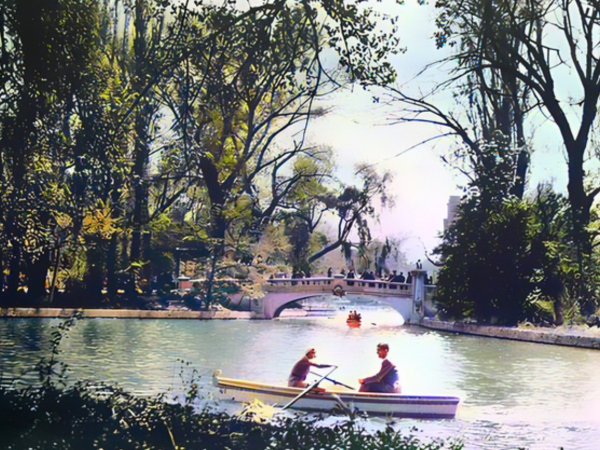
From the beginning, Cișmigiu was designed as a recreational space for all seasons. In summer, the lake offered coolness, and the shaded alleys attracted families, couples, and intellectuals seeking tranquility. In winter, the frozen surface of the lake turned into an extremely popular natural skating rink.
As early as 1852, authorities brought swans and pelicans to populate the lake, contributing to the park’s romantic atmosphere. Later, at the end of the 19th century, a small zoo also operated here, where bears, foxes, beavers, peacocks, and other wild animals could be seen. Over time, high maintenance costs led to its closure.
In 1851, the first buffet in the park was opened, where visitors could buy sweets and confectionery products, a detail that shows how modern the concept of public space was for that era.
Innovations and modernization in the 19th century
Cișmigiu was also a place of technological progress. In 1860, a “water jet” powered by a steam mill placed in the middle of the lake was installed, an impressive achievement for those times.
In 1892, the park was fully illuminated electrically, becoming one of the first public spaces in Bucharest with such a system. Around the same period, at the entrance from Regina Elisabeta Boulevard, the oldest newspaper kiosk in the city was installed, which still stands today in the same place.
Authorities even preserved administrative documents related to the park, such as the contract of August 1, 1855, by which fishing in the lake was concessioned for three years, proof that Cișmigiu also had an economic function.
“At the fortress” and underground mysteries
One of the most interesting historical points of the park is located in the area toward Schitul Măgureanu, known as “At the fortress.” Here lie the ruins of a monastery built in 1756 by the logothete Văcărescu.
Legend says that from this place started a secret tunnel linking Kretzulescu Palace to the bank of the Dâmbovița. Such underground passages were common in turbulent times, being used for refuge or for discreet movements of the elite.
The favorite place of Bucharest high society
During the interwar period, Cișmigiu became one of the most elegant promenading spaces in the Capital. Politicians, writers, artists, and members of high society met here — the Bucharest elite. Walks along the alleys, conversations on benches, or romantic encounters on bridges were part of the social ritual of the time.
In 1943, the Writers’ Rotunda was arranged, where busts of great Romanian authors are displayed, transforming the park also into a space of cultural memory.
The image of Cișmigiu in the winter of 1935, described by journalist Mircea Damian, captures the dramatic and poetic atmosphere of the snow-covered city: trams gliding silently, the blizzard emptying the streets, and the frozen lake like a white mirror. The park then became an almost unreal place, where the beauty of nature intertwined with urban melancholy.
Cișmigiu today — between nostalgia and present
Today, Cișmigiu remains one of the most beloved parks in Bucharest, even though the city has changed radically around it. It is a place where students, pensioners, tourists, and families meet without knowing that they are walking on land with a history of over two centuries.
Its charm lies precisely in this continuity. From wild pond to romantic garden, from hunting ground to modern public space, Cișmigiu reflects the evolution of Bucharest as a European city.
More than a park, it is a state of mind — an oasis of calm, a refuge from daily agitation, and a bridge between past and present. Rediscovering Cișmigiu Garden ultimately means rediscovering a Bucharest that still preserves the elegance and sensitivity of a vanished, yet never forgotten era.
We also recommend: Symbols of Bucharest: Kretzulescu Palace, the Fântâna Boului Suburb, and the Superb Castle near Cișmigiu