Symbols of Bucharest: Kretzulescu Palace, the Fântâna Boului Suburb, and the Superb Castle near Cișmigiu
- Articles
- 11 MAR 26
Old Bucharest was a city of contrasts, a place of great aristocratic residences and quiet suburbs that stretched around them. In the heart of this “Little Paris” stood one of the most elegant buildings of the capital: Kretzulescu Palace on Știrbei Vodă Street. Built at the beginning of the 20th century, in a place filled with history, the palace became over time one of the symbols of the city, not only through its architectural beauty but also through the stories that marked its existence.
The Fântâna Boului suburb and the beginnings of the estate
Its construction was the initiative of a remarkable woman, Elena Kretzulescu, a discreet yet ambitious personality who wished to offer Bucharest a building worthy of its heritage and of the name of the family she belonged to.
Located in one of the old neighborhoods of the city, in the Fântâna Boului suburb, close to Cișmigiu Garden, the palace dominated the area for a long time through its proportions and elegance. Over the decades it witnessed the transformations of the capital and went through numerous changes of destiny, from an aristocratic residence to a cultural institution.
Before the appearance of the palace, the area around Știrbei Vodă Street looked completely different. The Fântâna Boului suburb, also known as Schitu Măgureanu, was covered with gardens, vineyards and marshy lands. Here stretched a muddy pond that would later be arranged and transformed into Cișmigiu Garden, one of the most beloved public parks in Bucharest.
On this land stood the old houses of the Kretzulescu family, inherited by Elena from her father, Constantin C. Kretzulescu. The buildings had been raised in the time when the suburb was more a green outskirts than a central area of the city. Over time, however, the development of Bucharest transformed the place into an increasingly valuable district, and the family property became one of the best located in the capital.
Elena Kretzulescu was born in 1857 in Paris and was baptized by Count Emile Felix de Fleury, a close associate of Emperor Napoleon III. The daughter of Maria Filipescu and Constantin Kretzulescu, Elena – also known by the Catholic name Blanche – remained orphaned at a young age, inheriting a considerable fortune and the responsibility of managing the family properties.
Her life would be connected for more than fifty years to the house on Știrbei Vodă Street. There an important part of the family’s history unfolded and there the impressive palace that bears the name Kretzulescu would later come into being.
An Egyptian mummy and a fascinating story
A curious episode in the history of the place occurred in 1869, when the young Elena witnessed an event that caused sensation in Bucharest of that time. Her uncle, Doctor Kretzulescu, returned from Egypt bringing with him a real mummy.
The doctor, passionate about scientific and cultural research, had managed to obtain, with the support of the vice-regent of Egypt, the mummy of a priest of the god Amun from Thebes, dated approximately around the year 1600 BC. The sarcophagus was opened right in the house on Știrbei Vodă Street, in the presence of distinguished guests, among whom was Prince Carol I.
The event aroused great curiosity among the Bucharest elite. After the opening of the sarcophagus, the mummy was donated to the Museum of Antiquities in Bucharest, becoming one of the attraction pieces of the institution.
The same year also brought another important change in Elena’s life. The family houses were rented to Colonel Jacques Lahovary, who would later become her husband.
The discreet life of Elena Kretzulescu
The marriage with Colonel Lahovary lasted until 1880, a period during which the property on Știrbei Vodă continued to be modified and modernized. At one point the general called upon the architect Grigore Cerchez to transform the stables of the estate.
After the separation from Lahovary, Elena remarried General Panait Warthiadi, yet she chose to keep the name Kretzulescu, under which she was already known in Bucharest society.
Despite her fortune and social position, Elena Kretzulescu was not a constant presence in the fashionable life of the capital. She preferred a withdrawn existence, dividing her time between the residence on Știrbei Vodă Street, Paris, and her estate at Drajna.
This discretion contributed to her image as a cultivated intellectual, more concerned with personal projects and the administration of her properties than with the balls and receptions of Bucharest aristocracy.
The birth of Kretzulescu Palace
In 1902 Elena Kretzulescu made an important decision: the transformation of the old houses on Știrbei Vodă Street into an imposing palace. For this work she chose the architect Petre Antonescu, one of the most appreciated creators of the time.
Antonescu was already known for numerous projects in Bucharest, including representative buildings of the capital. Kretzulescu Palace was the first work designed by the architect in an eclectic style, combining elements inspired by Western architecture with the tradition of Romanian houses.
The plan of the building preserved the structure of the old Romanian dwelling: the entrance was through a vestibule that led into a central gallery, while rooms were placed on both sides. The central space, called the hall, was organized on different levels, and toward the garden opened an office with a library.
Toward the street were located the bedroom – larger than the dining room – and the boudoir. This organization of the space confirmed the fact that the owner was not a hostess inclined to organize frequent large receptions.
The architecture and the exterior charm of the palace
Kretzulescu Palace impressed not only through its interior plan but also through its exterior appearance. Placed on a slightly uneven terrain, it dominated the entire area of the suburb through its elegant proportions.
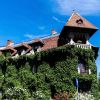
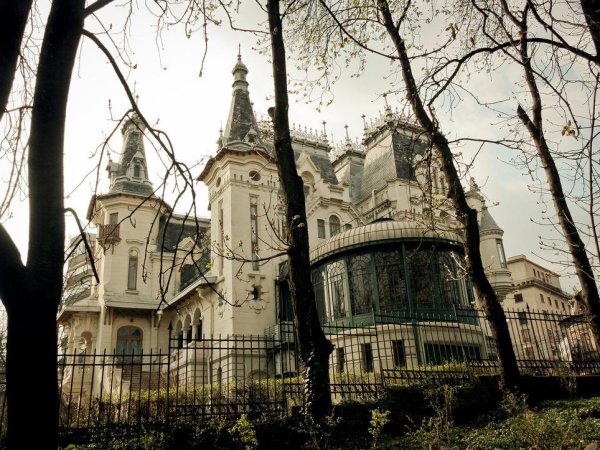
The façade was animated by a variety of architectural elements: loggias, balconies, stairs descending toward the garden and a massive arch through which the connection with the exterior was made. The small towers and the tall roof with varied volumes gave the building a romantic, almost castle-like appearance.
Behind the palace stretched an impressive garden arranged with terraces, alleys, flowers, fountains, basins and small bridges. A monumental staircase descended from the building toward the park, creating a direct connection with the green space.
Visitors who walked on the garden paths had the impression that they were entering a large aristocratic estate, although it was located right in the center of the city.
The sumptuous interiors of the palace
The interior of the palace was just as impressive as the exterior. The salons were decorated with huge tapestries covering the walls, and numerous carpets softened the footsteps of those who entered the rooms.
Silk wallpapers, heavy draperies and richly ornamented ceilings created a decor of great refinement. The gilded ornaments and inlays brought together Renaissance and Byzantine influences.
In the rooms there were numerous decorative objects: bibelots, statuettes, clocks of different sizes, from massive oak pendulums to delicate pieces of Saxon porcelain.
Silverware inspired by the art of the Levant and paintings representing bearded boyars with caftans or Phanariot characters completed the aristocratic atmosphere. A salon with stained glass windows, oriented toward two rows of tulips in the garden, was the place where the owner received guests in a spectacular setting.
A scandal and the decline of the fortune
After the death of General Warthiadi, in 1911, the name of Elena Kretzulescu appeared in an intensely publicized scandal. Newspapers announced the theft of a huge sum for that time: 700,000 lei together with several jewels.
To understand the value of this amount, it should be mentioned that building a comfortable house in those years cost around 200,000 lei. The owner immediately accused of theft the architect Sotiriu, a close acquaintance of the family and the designer of the palace on the Drajna estate.
The trial attracted the attention of the public, but the supposed culprit was eventually acquitted due to lack of evidence. In the following years Elena Kretzulescu’s fortune diminished considerably. In 1927, forced by circumstances, she decided to sell the palace on Știrbei Vodă Street.
From aristocratic residence to cultural institution
The Municipal Council of Bucharest analyzed the purchase of the building, considering that the property could become useful to the city. The garden was to be integrated into Cișmigiu Park, while the palace could host a cultural institution.
After the purchase, the place underwent radical transformations. The grille that isolated the estate was removed and the city gradually entered the space that had once been private. The alleys became neglected and the old aristocratic park entered a period of decline.
In the 1930s, however, the destiny of the palace changed again. The historian Nicolae Iorga, at that time Minister of Education and president of the Commission of Historical Monuments, decided to give it a cultural role.
The building became the headquarters of the Museum of Old Religious Art, and the interior was reorganized to host museum collections. The aristocratic furniture was replaced with desks and administrative spaces, and the palace entered a new stage of its existence.
The survival of a symbol of Bucharest
Kretzulescu Palace passed through many trials. It survived the earthquakes of 1940 and 1977, the bombings of the Second World War and the transformations brought by the communist period.
After 1989 the building was restored and returned to the cultural circuit. In 2003 the palace celebrated one hundred years since its construction, and this anniversary found it in excellent condition after restoration works carried out in 2001.
The interventions aimed to return the building to its original appearance. Some partitions added later were removed and the most spectacular spaces were highlighted again.
For example, the former dining room was united with the greenhouse by eliminating a wall, which revealed the elegant arches connecting the two rooms. Thus the palace once again became, for a time, one of the cultural symbols of Bucharest.
An urban castle in the heart of the capital
Through its romantic architecture, the palace near Cișmigiu was often compared to a small urban castle. The towers, the tall roofs and the vast garden gave it an almost fairy-tale presence in the landscape of the capital.
In the past, children who passed by the property grille imagined fantastic stories about the life inside. The pavilion hidden in ivy and the garden figurines placed among the flowers strengthened this impression of a fairy tale. Today the palace remains a testimony to the period when Bucharest was building its identity as a European capital.
The legacy of Kretzulescu Palace
Kretzulescu Palace represents more than a simple building. It is a part of the history of the city, connected to the evolution of Bucharest and to its social and cultural transformations.
From the suburb with vineyards and gardens to the modern metropolis, the place passed through numerous stages. At the center of this story stands the discreet figure of Elena Kretzulescu, the woman who wished to leave the capital a memorable construction.
Through its architectural elegance and its rich history, the palace remains one of the symbols of Bucharest, a landmark of the era when the city was proudly called “Little Paris.”
We also recommend: Kretzulescu Church, between past and present. Built by Safta Brâncoveanu, saved from ruin