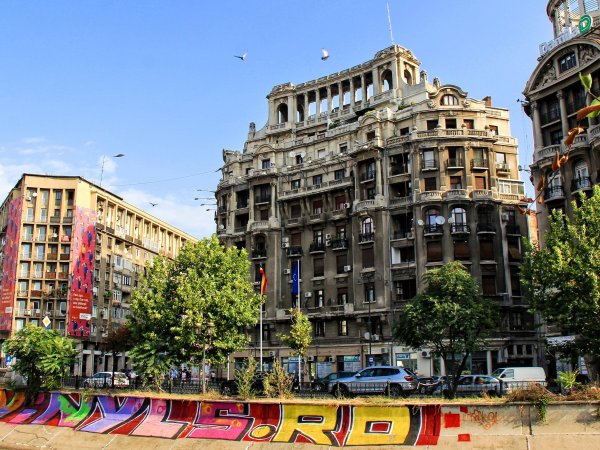
The Adriatica Building, from jewel to ruin. The story of the giant that has been watching over United Nations Square in Bucharest for a century
- Articles
- 16 MAR 26
In a Bucharest increasingly suffocated by traffic, modern buildings, and a frantic pace, there are places that seem suspended in time — constructions we pass by daily without noticing them, yet which preserve within their walls the memory of an era of elegance and urban ambition. One such place is the Adriatica Building, located in United Nations Square, at the entrance to Victory Avenue — one of the oldest, most prestigious, and symbolic arteries of the Capital.
A building born in the golden age of Bucharest
Built in 1926, in the midst of the interwar period, the building represents a true architectural jewel of a Bucharest that was then nicknamed “Little Paris.” Although today it appears discreet and sometimes neglected, the block impresses through its sober elegance and the decorative details that reveal the ambition of an era in which architecture was conceived not only as utilitarian, but also aesthetic. It is a silent witness to a century of transformations — from interwar prosperity to the convulsions of recent history.
The 1920s were, for Romania’s capital, a period of economic, cultural, and urban effervescence. After the First World War, the city developed rapidly, drawing inspiration from the great Western capitals. Wide boulevards, elegant cafés, luxurious hotels, and modern buildings shaped the image of a cosmopolitan city, optimistic and oriented toward the future.
In this context the Adriatica Building was constructed, as headquarters for an insurance company of Venetian origin — Adriatica, one of the most important companies in Central Europe at the time. The choice of location was not accidental: the area was one of the most dynamic from a commercial and administrative point of view, while Victory Avenue represented the center of social and economic life.
The building was designed to convey stability, prestige, and modernity — essential values for an insurance company. Thus, the structure was not merely an office space, but also an image instrument, meant to inspire confidence in clients and partners.
Eclectic style with neoclassical elegance
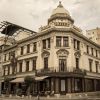
From an architectural point of view, the Adriatica Building stands out through an eclectic style with neoclassical influences, characteristic of the early 20th century. This approach combined traditional decorative elements with modern solutions for the period, resulting in an imposing yet harmonious structure.
The façade is decorated with vertical pilasters that confer rhythm and monumentality, but also with fine window frames, details that suggest refinement and attention to proportion. The ornamentation is not excessive, but discreet, emphasizing the sober-aristocratic elegance of the construction.
At the same time, the building conveys an air of interwar modernity. The simple volumetry and clear lines reflect the tendencies of urban architecture from that period, when European cities began to adopt more functional forms without completely renouncing ornament.
Viewed closely, the construction reveals a subtle duality: it is simultaneously classical and modern, robust and elegant, monumental and discreet.
Witness to a century of transformations
Over the decades, the Adriatica Building has witnessed some of the most dramatic changes in Bucharest’s history. It survived economic crises, the Second World War, the communist regime, and the post-1989 transition. Each era left its mark on the city, while the building remained, silent, in the same place.
The area of United Nations Square changed radically, especially during the communist period, when systematization projects massively transformed the center of the Capital. Nevertheless, the building endured, largely preserving its architectural identity.
Today, although it no longer shines as it once did, the structure continues to discreetly dominate the intersection. For many Bucharest residents, it is part of the everyday landscape, but few know its history or significance.
Interwar Bucharest — an architectural laboratory
The Adriatica Building is not an isolated case. Between the two world wars, Bucharest experienced an unprecedented architectural boom. The city transformed into a veritable laboratory of styles, in which Western influences met local traditions.
Among the dominant directions were Art Deco, modernism, and the Neo-Romanian style. These currents shaped the image of the Capital, generating buildings that still impress today through elegance and innovation.
An emblematic example is the Telephone Palace, completed in 1934. Considered the city’s first “skyscraper,” the edifice was designed in Art Deco style by a mixed team of American and Romanian architects and quickly became a symbol of modernity.
Nearby is also the ARO Building (today Hotel Cinema Patria), built in 1931. The modernist structure hosted one of the first cinemas with modern equipment in Bucharest, reflecting the era’s fascination with technology and entertainment.
Landmarks of interwar elegance
Other architectural monuments that define the city’s identity date from the same period. The ASE Palace, built between 1924 and 1926, is a remarkable example of Neo-Romanian style, inspired by traditional architecture but adapted for a modern educational institution.
Likewise, Casa Capșa and Hotel Lido evoke the cosmopolitan atmosphere of the time. These places were frequented by writers, politicians, artists, and diplomats, becoming centers of social and cultural life.
Together, these buildings outline the image of a sophisticated Bucharest, comparable to the great European capitals of the era.
From symbol of prosperity to ignored monument
Today, the Adriatica Building seems to have lost its original brilliance. The passage of time, the lack of major restorations, and urban changes have contributed to its degradation. From a prestigious headquarters of an international company, the building has become a discreet presence, sometimes ignored by passersby.
This transformation reflects, in a way, the evolution of the city itself. Modern Bucharest is dominated by office towers of glass and steel, shopping centers, and infrastructure oriented toward efficiency rather than aesthetics. In this context, interwar constructions appear as relics of a vanished world.
However, for connoisseurs and enthusiasts of urban history, they represent architectural treasures that deserve protection and rediscovery.
The importance of urban memory
Buildings such as the Adriatica are more than simple structures of concrete and brick. They are repositories of collective memory, witnesses to the social, economic, and cultural transformations of the city.
Rediscovering them means reconnecting with the authentic identity of Bucharest — a city that was once a center of elegance and modernity in Eastern Europe. By looking at these constructions, we can better understand the aspirations and values of the generations that built them.
At the same time, they invite us to reflect on how we manage urban heritage. Without conservation and restoration, the risk is that these symbols of the past will disappear or become mere decorations without meaning.
A silent giant that continues to watch over the city
Nearly a century after its inauguration, the Adriatica Building remains a landmark of United Nations Square. Although it is no longer in the spotlight, it continues to watch over one of the busiest areas of the Capital, like a guardian of urban memory.
Viewed carefully, the building reveals a discreet, almost melancholic beauty. It is a structure that does not shout for admiration, but quietly awaits it from those willing to lift their gaze from everyday haste.
Its story is, in essence, the story of Bucharest itself: a city of contrasts, where past and present often coexist without noticing one another. From architectural jewel to neglected construction, the Adriatica Building remains a testimony to an era in which beauty, ambition, and refinement defined the urban spirit. To rediscover it means to rediscover a part of the city’s soul.
We also recommend: Bucharest’s Calea Victoriei “breathes” history: the old Mogoșoaia Bridge was paved by Constantin Brâncoveanu with tree trunks