When the first traffic light appeared in Bucharest and what the Capital’s road traffic looked like during the interwar period
- Articles
- 12 MAR 26
After the end of the First World War, Romania entered a period of profound economic and social transformations. The country’s capital, Bucharest, became one of the main centers of modernization. During the 1920s and 1930s, the city experienced rapid development, and this was also reflected in the way the streets and urban traffic looked.
The transformation of Bucharest after the First World War
One of the most visible signs of modernization was the growth in the number of automobiles. If before the war cars were relatively rare and represented rather a luxury reserved for elites, after 1918 they began to appear more and more frequently on the streets of the Capital. Economic development, the emergence of new professions and the increase of urban mobility determined more and more people to use the automobile as a means of transportation.
This transformation, however, was neither sudden nor complete. The streets of interwar Bucharest were places where several types of transport coexisted. Automobiles circulated alongside elegant horse-drawn carriages, carts loaded with goods, electric trams and bicycles. This combination of modern and traditional means of transport created a picturesque image, but at the same time generated numerous difficulties for the organization of traffic.
As the number of vehicles increased, the city authorities were forced to take measures to organize circulation. Traffic rules were still in their early stages, and many of the instruments that today seem ordinary – traffic lights, pedestrian crossings, one-way streets or road signs – had not existed in Bucharest until then.
What Bucharest traffic looked like in the 1930s
Interesting information about Bucharest traffic during the interwar period appears in the magazine Urbanismul, which in 1934 published approximate statistics regarding the number of vehicles circulating on the main arteries of the city.
One of the busiest streets was Calea Victoriei, one of the symbolic avenues of Bucharest. According to the measurements carried out at that time, on Friday, August 24, 1934, between 11:30 and 13:30, no fewer than 1,143 vehicles passed in front of the Telephone Palace.
The composition of this traffic was extremely varied. Out of the total number of vehicles recorded, 907 were private automobiles – called “touring cars” in the documents of the time. In addition to these, there were 79 buses, 20 trucks, 117 horse-drawn carriages, one cart, 7 motorcycles and 12 bicycles. This diversity clearly shows the transition the city was going through: the modernity of the automobile coexisted with traditional means of transport.
If the afternoon interval between 17:30 and 19:30 is also taken into account, it results that on that day a total of 2,069 vehicles passed in front of the Telephone Palace. For a city still in the process of modernization, these figures were considered impressive.
Traffic was even more intense on Brătianu–Take Ionescu Boulevard, known today as Nicolae Bălcescu–Magheru Boulevard. During the same time interval, between 11:30 and 13:30, 1,447 vehicles were counted near the University of Bucharest.
Their distribution was different compared to that on Calea Victoriei. In total there were 648 private automobiles, 96 buses, 76 trucks, 338 tram cars, 186 horse-drawn carriages, 103 carts, 10 motorcycles, 80 bicycles and 6 vehicles classified as “miscellaneous”.
The presence of trams explained much of the difference between the two arteries. On Calea Victoriei trams did not run, while on Brătianu Boulevard they represented an essential means of transportation for the inhabitants of Bucharest.
The role of trams in the circulation of the Capital
The tram was one of the most important means of public transport in interwar Bucharest. According to information published in Gazeta municipală in 1940, the tram lines had a very efficient schedule, with waiting times of approximately two minutes during peak hours.
This detail explains the apparently surprising figure mentioned in the statistics of the magazine Urbanismul: 338 tram cars in only two hours on Brătianu Boulevard. The calculation shows that this figure was perfectly possible.
If 338 cars passed within a two-hour interval, this means that approximately 169 cars circulated on each direction. Since most trams consisted of two cars, this results in approximately 84 trams crossing the boulevard in 120 minutes.
Several tram lines circulated simultaneously on this boulevard, and their high frequency meant that the vehicles were present almost constantly on the street. The tram was therefore the backbone of urban transportation, carrying thousands of Bucharest residents every day between neighborhoods and the city center.
The appearance of the first traffic light in Bucharest
The rapid growth of traffic also generated serious problems. Road accidents had become increasingly frequent, some of them having severe or even fatal consequences. Under these circumstances, the authorities were forced to introduce new traffic regulations.
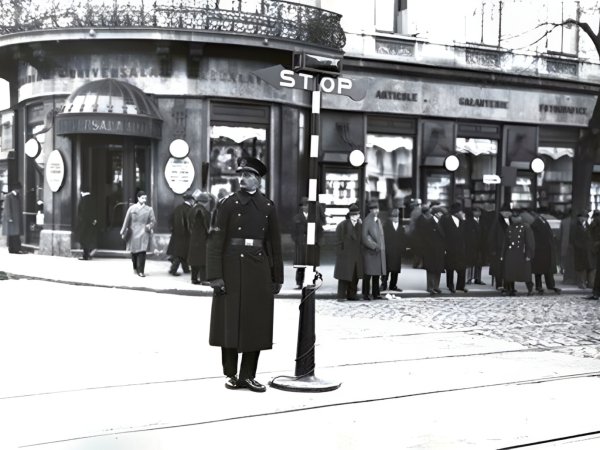
An important moment in the organization of Bucharest traffic took place in 1929, when the first electric traffic light in the city was installed. It was placed at the intersection between Calea Victoriei and Elisabeta Boulevard, one of the busiest areas of the Capital.
However, the traffic control system was different from the one used today. The traffic light was suspended above the intersection from the tram wires, and underneath there was a traffic officer supervising the flow of vehicles. In addition, at street level there was also a pole with an arrow bearing the word “Stop”.
This arrow was rotated manually depending on the direction in which traffic had to be stopped. In practice, the system combined electric technology with human intervention, being a transitional form between the old method of directing traffic and modern automated systems.
Over time, the role of the traffic officer became less important, and electric traffic lights began to be used more and more. Nevertheless, for many Bucharest drivers of the period these devices represented a novelty that was difficult to accept.
Drivers’ reaction to electric traffic lights
The changes introduced in the organization of traffic were not enthusiastically received by all participants in circulation. For drivers accustomed to less strict rules, traffic lights and road signs sometimes represented a real challenge.
Writer Mircea Damian described this situation in a text published in 1935, in which he related the difficulties encountered by drivers when they had to respect electric signaling.
He considered that the traffic light suspended from the tram wires was a “torture” for drivers. While the classic “Stop” sign was easier to understand, the electric signal required constant attention. Drivers had to watch the red or green light and ignore the traffic officer standing on the sidewalk, who operated the system with a handle.
This change of perspective – from direct contact with the policeman to observing an electric signal – represented an important step in the modernization of urban traffic.
Road education – a major problem in the interwar period
Although the authorities gradually introduced traffic lights, one-way streets and road signs, the problems in traffic did not completely disappear. One of the greatest difficulties was the lack of road education both among drivers and pedestrians.
Many inhabitants of Bucharest crossed the street wherever they wished or parked their vehicles without paying attention to rules. This attitude often created dangerous situations and contributed to the chaos in traffic.
Publications of the period began to draw attention to the necessity of road education. In the issue of February 19, 1936 of the magazine Realitatea ilustrată, an extensive article was published entitled “Traffic in a large city must be disciplined traffic”.
The author of the article emphasized that the simple application of penalties was not sufficient to solve the problem. In his opinion, it was necessary to organize special traffic schools where people could learn the basic rules of circulation.
He also proposed organizing conferences in schools and workshops, distributing explanatory brochures and producing informative posters. Authorities were even urged to organize “traffic weeks”, during which citizens would be educated about traffic rules.
The message was clear: Bucharest had become in recent years a modern city with increasingly intense traffic, and without road discipline chaos would inevitably become greater.
Interwar Bucharest – a city between tradition and modernity
Looking today at these data and testimonies, we can better understand what Bucharest traffic looked like during the interwar period. The city was in a stage of transition in which old means of transport coexisted with new technologies.
On the same street one could see modern automobiles, electric trams, elegant horse-drawn carriages and carts loaded with goods. This image reflected the transformation of Romanian society and the rapid rhythm of modernization.
The introduction of the first traffic light in 1929 was a symbol of this change. It marked the beginning of a new stage in the organization of urban traffic and in the adaptation of Bucharest to the standards of major European capitals.
In the decades that followed, the traffic light system expanded and traffic rules became increasingly clear and better respected. Nevertheless, the beginnings were marked by experiments, difficulties and gradual adaptations.
Thus, the history of the first traffic light in Bucharest is not only an urban curiosity, but also a story about the evolution of the city, about modernization and about the way its inhabitants learned to coexist in an increasingly crowded urban space.
We also recommend: “Cold Drunkennesses” and the Forbidden Pleasures in Interwar Bucharest: Morphine, Cocaine and Ether Were the Stars of the Parties