At Hotel Hugues, the Bucharest elite served caviar and truffles two centuries ago. The history of the first luxury hotel in the Capital
- Articles
- 16 MAR 26
Two centuries ago, the upper class of Bucharest came to savor select dishes at Hugues, the first hotel with a luxury restaurant in the Capital. The story of this establishment represents a symbol of the transformations that Bucharest has undergone over the past two centuries. From an exclusive establishment where truffles and caviar were served, to an anonymous building, marked by the passage of time, the former Hugues remains a fascinating chapter in the city’s history. Unfortunately, today, few still know this history.
The emergence of luxury hotels in Bucharest
At the beginning of the 19th century, Bucharest was a city at the crossroads between East and West. Ottoman influences were still strong, visible in gastronomy based on coffee, jams, Turkish delight, and various empire-specific dishes. However, a new wave of Western modernization was beginning to make its presence felt, noticeable in clothing, music, and especially in the lifestyle of the capital.
Among the essential changes of the time was the appearance of luxury hotels, a novelty for Bucharest. Until then, the city lacked such establishments, and travelers stayed in modest inns. In the 1842 city plan, only four inns were mentioned, far from the European standards of the time. In this context, the Belgian Donat Hugues was about to change everything.
Around 1835, Donat Hugues arrived in Bucharest, a consummate Belgian chef. The reasons for his settling in the city are not entirely clear, but it is assumed that he was brought either to work in a boyar household or at the princely court. At that time, wealthy families commonly employed elite chefs from the West. The passage of time showed that his presence would be revolutionary for Bucharestian gastronomy.
Hugues introduced French cuisine and popularized rare delicacies at the time, such as truffles. The Moldavian writer Dimitrie Ralet described them as “extinguished and black coals, yet burning, without cheeses, valued by some according to the degree of spoilage.” In the 1850s, Donat Hugues decided to build his own hotel, offering Bucharestians an elite lodging and dining experience.
The opening of Hotel Hugues
In 1860, Hotel Hugues opened its doors in one of the most vibrant areas of the city, the National Theater Square on Podul Mogoșoaiei (today Calea Victoriei). The hotel was located opposite the old National Theater, on the site where today stands Hotel Novotel.
The building had two floors and 40 luxurious rooms. Rates were high for the time: a package consisting of bedroom, lounge, and servant room cost 15 francs. Refinement extended beyond room comfort to the hotel restaurant. Hotel Hugues’ restaurant was a reference point of the era. Ulysse de Marsillac, a chronicler of the time, described the atmosphere as follows:
“In winter, one dines in a very beautiful hall, lit with gas, entirely overlooking the Theater Square. In summer, you dine in a small but very cool and pleasant garden. (…) You can order à la carte meals from 4-5 francs up to 20 francs and even more. At Hotel ‘Hugues,’ French, German, Russian, Italian, and Romanian cuisine is prepared according to the consumers’ preferences.”
The exclusive menu included refined dishes such as truffles, caviar, lobster, and other European delicacies, making it the preferred place for the aristocracy and foreign diplomats.
The culinary duel at Hugues
One of the most unusual events at Hugues took place in 1881: a culinary duel between two of Bucharest’s most influential figures — Constantin Isvoranu, the uncle of future Prime Minister Alexandru Marghiloman, and the Spanish ambassador, Juan Pedro Aladro Kastriota. The duel rule was simple: each had to eat more than the opponent. The duel consisted of two opulent lunches, and if each participant won one round, a third, decisive round was held.
The menu included only selected dishes — truffles, caviar, lobster, and other delicacies — and the two combatants were dressed in full formal attire, according to the etiquette code of the time.
Changes of ownership and the Riegler era
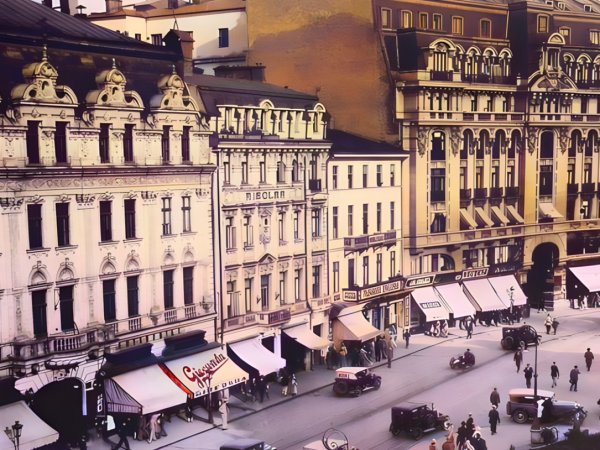
In 1890, Donat Hugues decided to sell his hotel to his rival, Iordache Ionescu, a renowned chef specializing in Romanian gastronomy. At the beginning of the 20th century, in 1900, the hotel was taken over by the confectioner Georges Riegler, who renamed it Hotel Riegler.
During the interwar period, the building’s façade was renovated in Belle Époque style, contrasting with the Art Deco trend gaining ground in Bucharest. The hotel was elevated with an additional floor and an attic, and the royal coat of arms of Romania was added to the frontispiece, as Riegler had become a supplier to the Royal House.
The impact of war and the communist period
During World War II, Bucharest was bombed, and Hotel Riegler, located opposite the Telephone Palace, was severely damaged. During the communist period, the building’s identity was practically erased. The hotel became an apartment block managed by IAL (Housing Administration Enterprise), and its façade was rebuilt austerely, without the decorative elements that had made it famous.
After 1990, the former Hotel Hugues was forgotten by authorities and investors, becoming a building marked by kitsch, PVC windows, and degradation.
Recent restoration and current state
In 2020, AMCCRS carried out a superficial restoration, painting the building yellow and leaving the façade covered with air conditioning units. Although the hotel has lost much of its original splendor, its story remains a symbol of Bucharest two centuries ago and a fascinating chapter in the history of the city’s gastronomy and luxury life.
Hotel Hugues thus remains a living testimony of Bucharest’s transformations: from the sophisticated center of the elite, with sumptuous dinners and European delicacies, to the anonymity and urban decay of today. It reminds us that every building preserves the imprint of time, as well as the stories of the people who helped transform the Capital into the cosmopolitan city we know today.
We also recommend: Grand Hotel du Boulevard, where an attempt was made to assassinate King Carol II on Easter Night