Aurel Vlaicu, the first pilot of the Romanian Army, inventor of the first Romanian airplane, has a street bearing his name in Bucharest
- Articles
- 03 MAR 26
The history of aeronautics has placed Aurel Vlaicu (1881–1913) among the pioneers who dared to believe that man could conquer the sky through his own strength. Born on November 19, 1882, in the village of Binținți in Transylvania, a locality that today bears his name, he came from a large and modest family. He was the eldest of the eight children of Dumitru and Ana Vlaicu, hardworking peasants who, despite material hardships, understood the importance of education.
Modest origins and the road to engineering
From childhood he showed a clear inclination toward mechanics and technology. His desire to build machines capable of lifting off the ground was not a simple romantic dream, but a serious concern, fueled by readings and careful observation of the technical progress of the time. He began his studies at the Technical University of Budapest, but dissatisfied with the conditions that did not allow him to experiment sufficiently in the field of aviation, he transferred to Ludwig Maximilians Universität München, which he graduated from in 1907, obtaining an engineering degree.
After completing his studies, he worked for a period at the Opel factories in Rüsselsheim, where he distinguished himself through his technical talent. Although he had promising prospects in an important industrial company, he chose to give up the security of a well-paid position in order to follow his calling: the design and construction of his own flying machines.
The first experiments and the glider from Binținți
Returning in 1908 to his native village, Vlaicu began working on a glider built almost entirely with rudimentary means. With this aircraft he carried out several experimental flights, demonstrating that his technical ideas had a solid foundation. A special episode from this period is the fact that he transported with his glider one of the first women who ever flew: his sister, Valeria, only eight years old.
In October 1909, on the 11th and 20th, he presented before an official commission a series of demonstrations with a model aircraft designed by him. Impressed by the results obtained, the officials decided to offer him the opportunity to continue his activity within an institutional framework. Thus, on November 2, 1909, he was employed as a day engineer at the Army Arsenal in Dealul Spirii, in Bucharest.
At the urging of the poet Octavian Goga, Vlaicu came to the capital, convinced that here he would find the necessary support to turn his dream into reality. After an exhibition of his scale models in Bucharest, the Minister of War approved the financing of a special workshop for the construction of an entirely Romanian airplane.
Vlaicu I and the beginning of Romanian military aviation
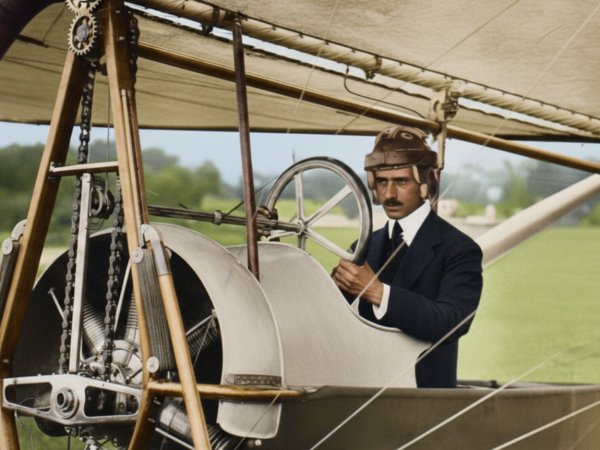
The construction of the first airplane, Vlaicu I, was carried out at the Army Arsenal. The aircraft, named “Vlaicu No. 1 model 1910,” represented a remarkable technical achievement for the era. On June 17, 1910, from the Cotroceni field, Aurel Vlaicu took off with his own aircraft, marking a historic moment for Romania.
Through this flight, Romania became the third country in the world on whose territory an original aircraft, conceived, built, and piloted by one of its citizens, rose into the air. Vlaicu demonstrated that his airplane could execute bold turns and reach impressive altitudes for that period, exceeding 450 feet, and in a military reconnaissance test he climbed to over 457 meters.
He thus became the first pilot of the Romanian Army and participated in the military maneuvers of 1910. On September 27 he flew over the route between Slatina and Piatra Olt, demonstrating the practical usefulness of the airplane for strategic purposes. Supported financially also by the future King Ferdinand I of Romania, he received funds to build a new, improved aircraft.
Technical innovations and international performances
The second airplane, Vlaicu II, completed in 1911, brought notable technical improvements. Aurel Vlaicu was the first inventor in the world to introduce the protective cooling ring around the engine. He also perfected the variable-profile wing, inspired by the solution imagined by Traian Vuia, and introduced a reducer between the engine and the propeller.
Among his avant-garde solutions were the use of two coaxial counter-rotating propellers, double steering, a landing gear with independent wheels, and wheel brakes—elements that were to become standard in the later evolution of aviation. These innovations demonstrated not only his practical talent, but also his ability to anticipate the future developments of aeronautical engineering.
In 1912, with Vlaicu II, he participated in the International Aeronautical Competition at Aspern-Vienna, held between June 23 and 30. In a competition attended by 40 pilots from seven countries, Vlaicu won five important prizes, distinguishing himself among the famous aviators of the time. His success brought Romania considerable prestige on the international stage.
Military missions and the last flight
In the summer of 1913, in the context of the Second Balkan War, Aurel Vlaicu participated with his airplane in military operations in Bulgaria, carrying out aerial reconnaissance missions in support of the Romanian army. It was clear proof that the airplane had become an essential strategic instrument.
On September 13, 1913, Vlaicu attempted to cross the Carpathian Mountains with Vlaicu II, in a symbolic gesture meant to unite the Romanian provinces. After a stop for refueling in Ploiești, the airplane crashed at Bănești, near Câmpina. The exact cause was not established, but it is presumed that a heart attack may have been fatal to him during the flight.
He was only 31 years old. His death was perceived as the disappearance of a national hero. He was buried at Bellu Cemetery in Bucharest, and his friends later completed the construction of the Vlaicu III airplane, piloted in 1915 by Petre Macavei.
The legacy and Aurel Vlaicu Street in Bucharest
Aurel Vlaicu’s legacy is deeply connected to the beginnings of Romanian military aviation and to the ideal of national unity. Romanian Aviation and Air Force Day is celebrated annually on July 20, as a tribute to the pioneers of flight.
In Bucharest, an important street in Sector 2 bears his name. Aurel Vlaicu Street is located near Șoseaua Ștefan cel Mare, opposite Dinamo Stadium. The area is heavily trafficked, situated in a neighborhood with historical and sporting resonance, which makes his name spoken daily by thousands of people. The presence of this street near such a well-known urban landmark strengthens the collective memory connected to the figure of the great aviator.
Through everything he accomplished in such a short life, Aurel Vlaicu remains a symbol of courage, technical intelligence, and devotion to the national ideal. From a modest Transylvanian village to the skies of Europe, his story continues to inspire entire generations.
We also recommend: The Genius of Romanian Aeronautics: Who Henri Coandă Was and Why Otopeni Airport Bears His Name