The First Taxis in Bucharest: From Horse-Drawn Carriages to Green-and-Red Automobiles
- Articles
- 20 MAY 26
Bucharest at the beginning of the twentieth century smelled of wet mud, horse manure, and chimney smoke. On the cobblestone pavement of Calea Victoriei, among Viennese carriages with colored lanterns and horse-drawn cabs, an automobile bearing a taxi sign appeared for the first time in 1911. It was painted green and red, rattled heavily over the uneven pavement, and smelled of gasoline, a smell entirely new to Bucharest nostrils, one that stirred equal measures of wonder and suspicion.
The story of these first taxis cannot be understood without looking back a little further, at a city where public transport was a concept still taking slow shape.
Until the middle of the nineteenth century, Bucharest knew nothing but animal propulsion. The boyars rarely stepped down from their carriages, brought from Vienna and adorned with family crests. Those of more modest means hired coaches by the hour or by the trip, driven by coachmen of Russian origin known as muscali, dressed in long cloaks and Russian fur hats, sitting rigid on the driver's box with the reins firmly in hand. Around 1857, the German traveler Ferdinand Lassalle wrote that at least four hundred carriages paraded along the Șosea, with gleaming equipages and footmen dressed in gold, a spectacle that left foreign guests speechless. The French writer Marc Girardin had noted even earlier, in 1836, that in Bucharest you do not walk, you ride in a carriage, legs are a luxury, and the carriage a necessity.
The main cab station stood in front of the National Theatre, on Calea Victoriei, the very spot where the first automobile taxis would park in 1911. The coachmen, known also as vizitii, did the work of today's taxi drivers, with the difference that behind them horses snorted rather than engines.
The first car to travel the streets of the capital belonged to Baron Barbu Bellu, remembered above all because on the land he donated to the Bucharest city administration in 1852 the Bellu Cemetery was founded. In the autumn of 1889, Bellu brought from Paris a Peugeot with four seats and four horsepower, capable of reaching eighteen kilometers per hour. The luggage compartment was essentially a bag mounted at the front, the transmission worked by chain as on a bicycle, and the machine made considerable noise. Passersby on the city's cobblestone streets jumped aside in fright or stopped to stare in astonishment, and the more devout among them crossed themselves. At the baron's death in 1900, the press of the day ran the headline: "Baron Bellu is gone, he with his automobile."
Yet this first car was a private curiosity, not a vehicle for public transport. The first automobile officially registered in the capital was an FN Herstal belonging to the explorer Bazil G. Assan, manufactured at an arms factory in Belgium in 1900, which received registration number 1. Only after that did the number of cars on Bucharest's streets begin to rise gradually, until their presence ceased to be a sensation and became an ordinary fact of city life.
Automobile taxis made their appearance in Bucharest in 1911, according to the field's reference work, Alexandru Cebuc's book "From the History of Passenger Transport in Bucharest," published in 1962. By regulation, these vehicles were painted obligatorily in green and red, a combination intended to make them recognizable in the city's motley traffic, which still included trams, carriages, carts, and the first buses. Their main station was again in the former square of the National Theatre, on Calea Victoriei, where the coachmen had stood before them. The long-term victory belonged to those with engines.
These first taxis did not come to abruptly replace a well-established system. They coexisted with cabs and carriages, and for several good decades the competition between the two worlds, one of horses and one of motors, gave Bucharest traffic a character all its own. Period images preserved in the Archive of the Bucharest Municipality Museum show a mix of vehicles on Calea Victoriei in the 1920s: carriages, open-top cars, trams, and pedestrians negotiating space through the same chaos that had been old for generations.
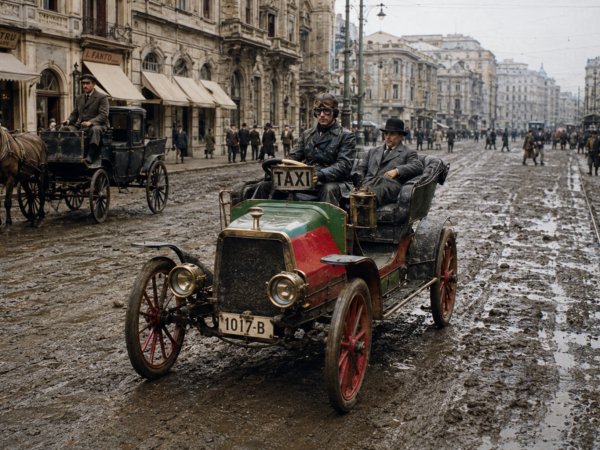
One taxi from that era, photographed around 1920, appears with registration number 1017-B: an open car with no enclosed bodywork, a young driver wearing protective goggles resembling those of an aviator, and a single passenger on the back seat. The mud on the street behind the car says more than any description about the conditions in which this first motorized public transport operated. Comfort was relative, speed modest, and the journey demanded a measure of courage and a tolerance for dust, cold, and vibration that today's passengers could barely imagine.
The arrival of automobiles did not immediately kill the coachman's guild. The transition was slow, unfolding over decades, with tensions and resistance along the way. In the 1930s, the magazine Realitatea Ilustrată published reports from the city center showing taxis parked on the wrong side of the street and blocking traffic, proof that urban chaos was nothing new and belonged to no particular era. The city had inherited it from the carriages and was passing it on intact, merely dressed in different noise.
A notable aside from this period: the first female taxi driver in Romania appeared in 1932. Her story was published in the 12 May 1932 issue of the weekly Realitatea Ilustrată, in an article signed by Margareta Nicolau. The wife of a doctor and a small landowner, she had decided to drive a taxi. Her name did not appear in the publication, most likely because the era would have found it too much. But her voice survived: "For now, until the idea catches on and people get used to it, there is still much to endure." She was, in her quiet way, a small revolution on the cobblestones of a city that was growing accustomed to change slowly.
The First World War, the interwar period, and the Second World War left deep marks on the capital's transport infrastructure. Private taxi service, which until then had operated sporadically and without uniform standards, was reorganized by the communist state in 1953 and 1954, when the foundations of an organized motorized taxi service were laid, with an initial fleet of around 100 vehicles and several garages belonging to the Bucharest Transport Enterprise. All taxi drivers were employed under work contracts and paid a fixed salary, supplemented by a percentage of their plan quota. Taxiing became a state monopoly, and the taxi drivers' guild, once free and as varied as the city itself, entered a different era.
But somewhere in the city's memory, that image from 1920 remains: the green-and-red car on the muddy cobblestones of Calea Victoriei, the driver with his aviator's goggles, the smell of gasoline mingling with the smell of horse manure, and a passenger on the back seat holding on tight and looking around with the air of someone who knows they are living something for the first time. Bucharest was changing. Slowly, with jolts, and always with more noise than anyone had planned.