Interview with Ciprian Sipoș, Green Designer: “Bucharest Needs More Than Green Concrete”
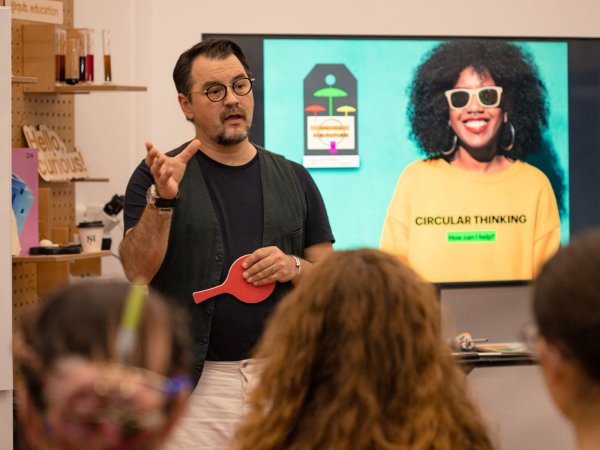
By Eddie Țone
- Articles
- 25 AUG 26
Bucharest is a city that changes every day, though not always in the direction we would like. Amid traffic, summer temperatures that are becoming increasingly difficult to bear, mounting pressure on green spaces, and neighborhoods built in haste, the question is no longer whether we need transformation, but how to achieve it while keeping the city livable for its people.
We spoke with Ciprian Sipoș, a green designer, circular thinking strategist, and climate educator who offers a different perspective on Romania's capital: one in which sustainability means more than bike lanes, planted trees, or new buildings carrying a green label. It means designing a city that helps us make better choices, day after day.
We discuss soil, shade, mobility, recycling, renovation, education, and the “awareness layer” that could turn Bucharest from a city we merely pass through into one we learn from.
Ciprian, first of all, tell the people of Bucharest a little about yourself. I know you are a green designer, a circular thinking strategist, and a climate educator, but tell us more. Help us understand what these things mean.
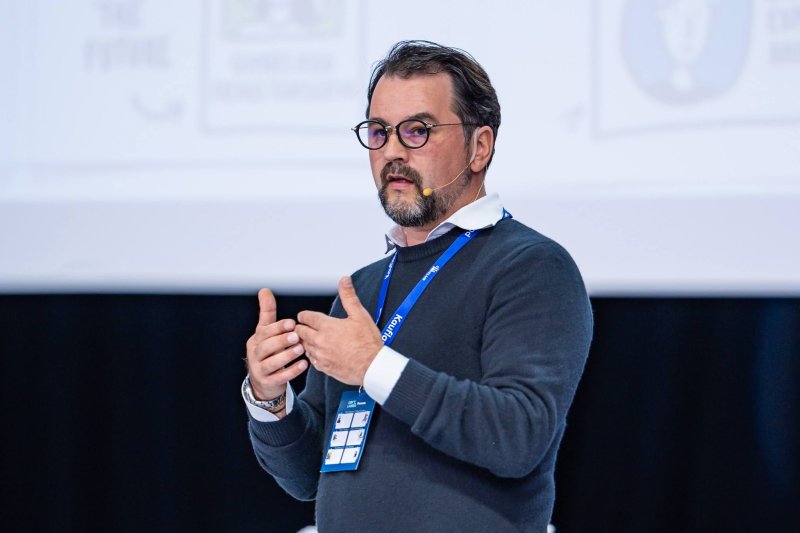
If I had to describe myself very simply, I would say that I am a kind of translator between worlds. I work at the intersection of design, the circular economy, education, and behavioral change. I am a social entrepreneur working in circular design and architecture, and I develop experiences and simulators, educational programs, and projects focused on sustainability, the future, and innovation. But I do not actually feel that I switch fields. I only change the context.
My tool is Design Thinking: I observe before I judge, ask questions before offering answers, and try to understand people before building solutions. For me, the most interesting ideas emerge precisely at the intersection of disciplines.
Perhaps that is why people have often described me as a “shawarma with everything.” I have come to believe that this is not necessarily a flaw. In a world where problems no longer respect boundaries between fields, perhaps we need more people who know how to connect the dots.
All right, let's see how this translates into the urban realm: if you were given the freedom to redesign Bucharest for the next 20 years, what would be the first three changes you would make?
I would start with three things: space for people, green infrastructure, and a city that helps us make better decisions.
I would gradually shift the city's center of gravity away from cars and toward pedestrians, public transport, and bicycles. Then I would treat vegetation and soil as critical infrastructure, not as urban decoration.
And I would add what I call an “awareness layer”: a layer of awareness over the existing infrastructure. A city that allows you to do something sustainable while also making that choice easier, more visible, and more natural.
I do not think Bucharest simply needs more “green” concrete. It needs a different way of functioning. A different kind of climate thinking and preparedness.
What does a genuinely sustainable European city look like in concrete terms? Do you have real examples? What indicators help us recognize one, beyond parks, bike lanes, and a few electric buses?
A sustainable city is not the one with the most solar panels or the most attractive bike lanes, but the one that reduces people's dependence on resources and infrastructure that consume unnecessarily.
I would look at indicators such as air quality, access to green spaces, neighborhood temperatures, time lost in traffic, the share of non-motorized journeys, building energy consumption, the amount of material recovered, and, very importantly, how easily people can meet their daily needs close to home.
In fact, a good city makes sustainable behavior the easiest behavior possible.
What are the three most serious urban development mistakes Bucharest is currently making?
The first is that we treat land as an infinite resource. We build to the limit and forget that soil, light, air, and vegetation are urban infrastructure.
The second is fragmentation. We build projects and solve problems individually without paying enough attention to the system as a whole: mobility, water, heat, public spaces, services, and community.
The third is that we develop infrastructure without sufficiently designing the behaviors that emerge around it.
We can build flawless infrastructure, but if people do not use it or use it incorrectly, the solution remains incomplete. That is why I say Bucharest also needs a “behavioral layer.”
You said in another interview that Bucharest also needs an “awareness layer” over its infrastructure. What would that mean in the daily life of someone living in Bucharest?
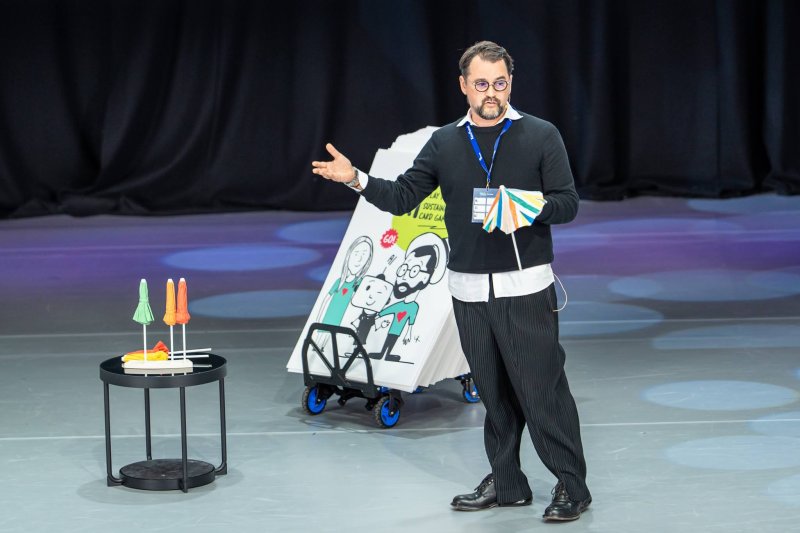
It means the city helping us become more aware of the consequences of our choices. Today, we have a great deal of information, but there is an enormous gap between “I know” and “I do.” We know that we waste food, energy, or time, but that does not automatically mean we change our behavior. An awareness layer could transform the city into a space for feedback: allowing you to see how much you consume, how much you save, what impact a choice has, or what alternative is available to you.
In practical terms, we would no longer simply learn about the city; we would learn in the city.
If Bucharest City Hall asked you for a plan that could begin tomorrow and produce visible results within a year, what would be the first five measures you would propose?
I would focus on very concrete measures.
I would launch a serious urban cooling program: trees, shade, permeable surfaces, and rapid interventions in high-temperature areas.
I would temporarily transform certain streets and parking areas into spaces for people, so that we could test solutions before building them permanently.
I would introduce clear rules for green space and permeable soil in new developments.
I would create a municipal system for recovering and reusing materials from demolitions and renovations. I would urgently design a water recovery system.
I would turn several neighborhoods into genuine urban laboratories where the circular economy, mobility, and sustainable behaviors could be tested together with the community.
I would rather test ten small solutions and see what works than wait ten years for a perfect solution.
Bucharest is losing green spaces, and in many neighborhoods construction extends almost to the edge of the sidewalk. What mandatory rules should every new real estate development follow?
First of all, development should not be allowed to eliminate living soil entirely. There must be a clearly defined proportion of permeable land and vegetation, not just planters placed on top of concrete. Light, natural ventilation, access to public spaces, and the building's relationship with the street must also be protected. And I would introduce a simple rule: every new development should leave the neighborhood better than it found it. The building's contribution to the urban ecosystem must also be effective.
Should a minimum percentage of permeable soil and vegetation be required for every developed plot? What threshold would be realistic for Bucharest?
Yes. Otherwise, soil remains one of those invisible resources that we consume until it disappears. As a starting point, I would suggest approximately 30% of each plot for permeable soil and vegetation, adapted to the type of development and the urban context. In certain areas, the percentage should be higher. What matters is that the requirement cannot be gamed through decorative solutions. A tree in a planter does not replace a living soil system capable of absorbing water, supporting biodiversity, and reducing temperatures.
How can we combat the urban heat island effect in neighborhoods overwhelmed by asphalt and concrete? What solutions can be implemented quickly?
We do not need to wait for ten-year projects to make the city cooler. We can begin with trees suited to their location, shade, permeable surfaces, rain gardens, the removal of unnecessary asphalt, and the conversion of certain parking areas or hardscaped spaces into green areas. But I would do something very important first: map temperatures at neighborhood level. We need to know where the problem is most severe and intervene there.
Mature trees are often planted as part of public campaigns, only to dry out a few months later. How should urban greening be managed professionally?
First of all, we must stop confusing planting with greening. A planted tree is not a grown tree. Greening must be approached as a system: selecting species according to the soil and microclimate, ensuring the quality of planting stock, providing sufficient space for roots, water and protection, and maintaining trees during their first years. I would also change the logic of public procurement: not only “How many trees are we planting?” but “How many healthy trees do we have after three or five years?” The result must be measured in living, healthy trees.
Many plane trees are planted in Bucharest. What is the truth about them: are they harmful to the population in the medium and long term? And if so, what should replace them?
I do not think the issue can be reduced to “plane trees are good” or “plane trees are bad.” The plane tree is a valuable urban species under certain conditions, but a problem emerges when the city relies too heavily on a single species. I would be more concerned about monoculture, biodiversity, and adapting species to the microclimate than about finding a single “perfect tree.” The city needs diversity: species adapted to drought and heat, with ecological value and enough room to grow. In practical terms, I would not replace one obsession with another. I would replace monoculture with biodiversity.
Bucharest has many old buildings and thousands of energy-inefficient apartments. Is it more sustainable to keep building new “green” buildings, or to recover and adapt what already exists?
Most of the time, the most sustainable building is the one you do not have to build again. When we demolish and rebuild, we disregard the energy, materials, infrastructure, and memory already embodied in the building. This does not mean that every building must be preserved at any cost, but the first question should be: what can we save, adapt, and improve?
We need more intelligent renovation, energy efficiency, reuse, and adaptation. Circularity often begins by not discarding what can still work.
You specialize in circular design and the use of recovered materials. How could City Hall apply these principles when renovating schools, markets, parks, or public buildings?
The first step would be to stop treating existing materials as waste before checking whether they are, in fact, resources. At the start of every project, there should be a kind of “materials audit”: what do we have, what can we keep, what can we repair, what can we transform, and what can we recover? In schools, for example, furniture can be repaired and adapted, materials can be reused, and demolition can be designed as disassembly. The circular economy begins with a very simple question: do we really need to buy something new?
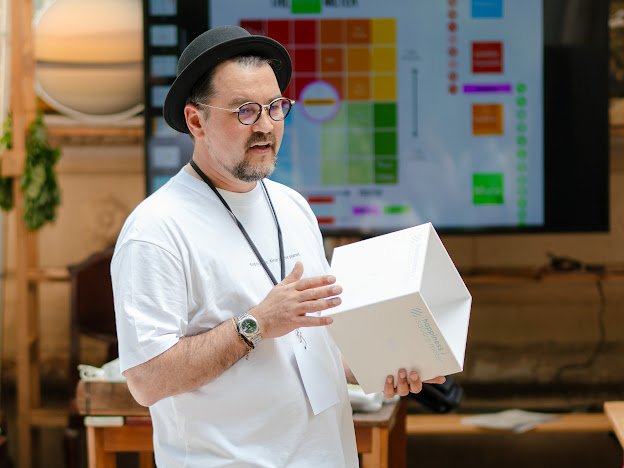
Could Bucharest establish municipal centers where furniture, construction materials, and other usable objects are repaired and returned to circulation?
Absolutely. And I think they would be among the most interesting forms of urban infrastructure we could create. I imagine them as municipal “material banks”: places where recovered materials are sorted, repaired, documented, and made available again. An office may no longer need its furniture, a school may need it, and a community project may be able to use materials that would otherwise end up in landfill. In practical terms, we would turn waste into a stock of resources. And we would also create jobs around it: repair, design, restoration, logistics, and upcycling.
What should happen to materials resulting from demolitions? Should developers be required to recover and reuse some of them?
Yes. Wherever possible, demolition should be rethought as a process of disassembly and recovery. Before demolishing, we should know what materials we have and how much value they can retain. Wood, brick, metal, stone, and finishing elements: many of them are not waste, but materials that have already gone through a production process and still have value. Developers should have clear recovery and traceability targets. If the linear economy says, “we build, we use, we throw away,” the circular economy asks, “what remains after we use it?”
Separate waste collection continues to operate in a fragmented and inefficient manner. Where does the real problem lie: infrastructure, public administration, the lack of penalties, or people's behavior?
It is a little of everything, but I think we make a mistake when we frame the issue solely in terms of “people are not educated.” Behavior emerges within a system. If the infrastructure is complicated, the information is unclear, containers are poorly located, and there is no feedback, we cannot demand perfect behavior. Individual responsibility certainly exists as well. But responsibility cannot be transferred entirely to citizens. We cannot ask people to solve problems created by entire systems through shopping bags and light bulbs.
I would begin by making the right behavior easier than the wrong one.
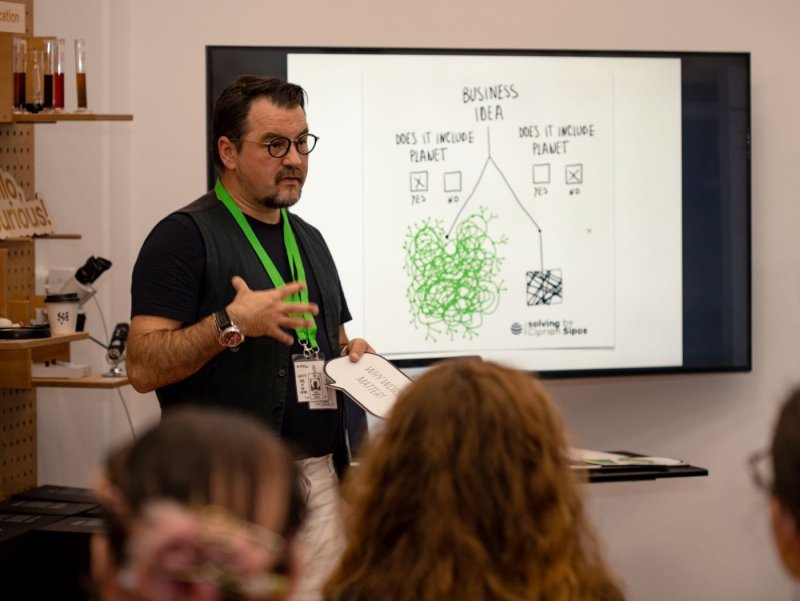
If we turned a single Bucharest neighborhood into a circular economy laboratory, what infrastructure and services should we introduce there?
I would turn the neighborhood into a living lab. It would have repair centers, reuse points, a material bank, smart collection, composting, libraries of things, exchange spaces, and community workshops. But the most important part would be the invisible infrastructure, made up of data, feedback, and learning through experience. I would want residents to see what happens to the neighborhood's resources and to be able to test alternatives. We should give people the infrastructure that allows them to “consume less.”
Mobility is one of the capital's major sources of pollution. What should be the correct order of priorities: public transport, walking, cycling, restricting cars, or charging vehicles to enter the city center?
My order would be simple: walking, cycling, public transport, and only then the private car. But we cannot ask people to give up their cars before offering them genuine alternatives. That is why mobility should not be treated as a war on drivers, but as a reconfiguration of the available options. If public transport is fast, predictable, and comfortable, and walking is pleasant and safe, people will change their behavior much more naturally. We need to design a system in which the good choice is also the convenient choice.
Bucharest is a city of long distances and dormitory neighborhoods. Can the “15-minute city” concept still be applied here?
Yes, but not as a formula copied from another city. For a neighborhood such as Militari, Titan, or Berceni, the 15-minute city does not mean that everyone must work within 15 minutes of home. It means that the essentials of everyday life must be accessible without permanent dependence on a car. Schools, shops, parks, medical services, sports, culture, community spaces, and jobs all need to reappear within neighborhoods. In practical terms, we need to make the city more complete.
We talk a great deal about citizens' responsibility. But do we not risk placing the burden of the shopping bag and the light bulb on their shoulders while major urban planning and economic decisions remain unchanged? Who, in fact, bears the primary responsibility?
Yes. And I think this is one of the greatest traps in the sustainability debate. Citizens have responsibilities, but they do not have the same decision-making power as public authorities, developers, producers, or large organizations. We cannot tell people to recycle perfectly while the system provides them with imperfect infrastructure. We cannot talk about sustainable mobility if the alternative to driving is slow and uncomfortable. Responsibility is distributed, but power is not distributed equally. Those with the greatest power to change the system also bear the greatest responsibility to do so. Citizens must participate, but they should not be blamed for a system they did not design.
Through your immersive education projects, you try to transform information into experience. How would you create a climate education program for children in Bucharest's schools that changes their behavior, not just their vocabulary?
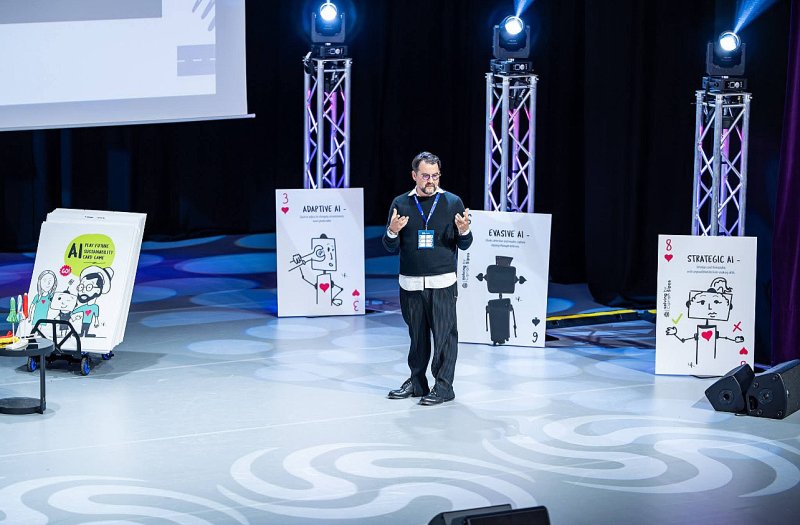
I would not start with definitions of climate change, but with an experiment. With a real problem in their school: how much energy do we consume, how much food do we throw away, how hot is the schoolyard, how much time do we spend getting there? Children should be able to make decisions, make mistakes, see the consequences, and try again. That is immersive education to me: you are not an observer; you are a participant. You do not simply learn about the future; you simulate it on a human scale. And perhaps the most important change would be for them to leave school with at least one question they had never asked before.
Let us suppose we meet again in 2035 and Bucharest has successfully transitioned to a sustainable city. What do we see when we step outside, and what things that seem normal today have disappeared in the meantime?
I think the first thing we notice is that the city is quieter. There are fewer cars, more shade, more people walking, and more services close to home. The spaces between buildings are no longer merely leftover areas, but places for people. We probably no longer talk as much about “sustainability,” because many behaviors we consider sustainable today have simply become normal. Perhaps there is no longer the same obsession with the new. We repair more, reuse more, buy more consciously, and design things so that they can have several lives. And I think the most important thing to have disappeared will be the feeling that the future is something that happens to us.
We will understand that the future is, in fact, the sum of the behaviors we repeat today.