When elevators were a luxury in Bucharest. How they changed the way people lived in the city
- Articles
- 06 OCT 26
Today, in an eight- or ten-storey apartment building, the elevator is so ordinary that we tend to notice it only when it stops working. In Bucharest a century ago, things were very different. The elevator was one of the technologies announcing the arrival of a new kind of city, with taller buildings, modern hotels and homes where comfort was increasingly defined by technological innovation.
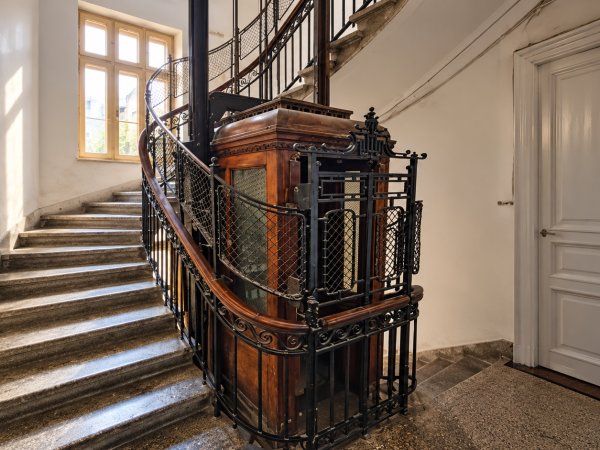
One of the most interesting chapters in this story can still be found on Dealul Mitropoliei. This is where Sacha Roman House, now known as Casa Madrigal, stands. It was here that the first elevator in a private residence in Bucharest was installed.
This does not mean, however, that it was the first elevator in the capital. Elevators had already appeared in hotels and other buildings, but identifying with certainty the very first one ever installed in Bucharest is considerably more difficult.
A private home with an elevator in 1920s Bucharest
Sacha Roman House stands at 11 Aleea Dealul Mitropoliei, close to the Romanian Patriarchate.
Built during the interwar period, the villa combined remarkable architecture with technological features that were unusual for a private residence at the time. The most interesting of these was its elevator.
Today, an elevator inside a house might simply seem like an expensive amenity. In 1920s Bucharest, however, it meant something quite different. The city had not yet entered the era of the large modernist apartment buildings that would transform its centre during the following decade, and elevators were more commonly associated with hotels and major buildings.
The house on Dealul Mitropoliei brought this technology into a private home, at a time when being able to move between the floors of your own residence without climbing the stairs was itself a sign of modernity.
When Bucharest residents were still getting used to elevators
Just how unusual elevators could seem to people at the time can even be seen in contemporary literature.
In 1927, Tudor Arghezi published the humorous piece “În ascensor” (“In the Elevator”) in Adevărul literar și artistic. The action takes place in a Bucharest hotel, and the elevator is still new and strange enough to become the focus of the story. The character regards the machine with suspicion, finds the vertical journey unsettling and eventually gets stuck inside, before being rescued by firefighters.
The episode says a great deal about how Bucharest residents related to the new technology. Elevators had become common enough for readers to immediately understand the situation, but they were still unusual enough to inspire fascination, fear and humour.
The experience was different for another reason as well. Elevators did not always work the way we use them today, by simply stepping inside and pressing a button. Hotels and other buildings could employ an elevator operator whose job was to control the lift and take passengers from one floor to another.
Bucharest begins to grow vertically
During the 1930s, the appearance of central Bucharest began to change rapidly. Multi-storey modernist apartment buildings, hotels and office buildings appeared, and the elevator gradually went from technological novelty to practical necessity.
One striking example is the Telephone Palace, built on Calea Victoriei in the early 1930s. With a silhouette unusually tall for Bucharest at the time, the building became one of the symbols of the city's modernisation. Its elevators could reportedly reach speeds of around 2.5 metres per second, an impressive performance for the period.
Elevators were also changing the way buildings could be designed and used. Once access to upper floors no longer depended entirely on staircases, the city could expand upwards much more easily.
This transformation became increasingly visible along Bucharest's main central boulevards, where taller buildings gradually began to alter the city's skyline.
When you needed a token to ride the elevator
An even harder detail to imagine today comes from the 1930s.
The Creditul Minier Palace, built on what is now Nicolae Bălcescu Boulevard, contained dozens of apartments and had an elevator. Tokens from the period have survived bearing the inscription “Bun pentru o deplasare cu ascensorul” — “Good for one elevator ride.”
In other words, an elevator ride could be treated as a separate service.
For today's Bucharest resident, accustomed to simply pressing a button after entering an apartment building, the idea seems almost unbelievable. At that point in the city's development, however, the elevator had not yet become the ordinary piece of infrastructure we now expect in a multi-storey building.
From a symbol of luxury to thousands of elevators
The spread of apartment buildings would permanently change Bucharest's relationship with elevators.
By 1950, when the Ascensorul enterprise was established, there were approximately 1,800 elevators in the capital, according to an account later published by Flacăra magazine. In just a few decades, a technology once regarded as a curiosity and associated with prestigious buildings had already found its way into thousands of properties.
The development of Bucharest's large residential districts during the communist period accelerated the process. In buildings with eight, ten or more floors, elevators were no longer a luxury but a necessity of everyday life.
Bucharest would also become the setting for another stage in this technological evolution in the 1980s, when an elevator controlled with the help of a microprocessor appeared, replacing older electromechanical systems.
It marked another step in the evolution of a technology that, only a few generations earlier, could still make people hesitate before stepping into the cabin.
From Sacha Roman House to the elevator we barely notice
Today, elevators are everywhere in Bucharest: in apartment blocks built before 1989, office towers, hotels, hospitals, shopping centres and new residential developments. In contemporary buildings, the question is no longer whether there is an elevator, but how many there are, how fast they travel or whether access requires a key card.
That is precisely why Sacha Roman House preserves such an interesting detail from the city's history. The first elevator installed in a private Bucharest residence belonged to an era when moving between the floors of your own home without climbing the stairs could itself be a demonstration of modernity.
A century later, we press the button and rarely think about how far this technology has travelled before becoming such an ordinary part of life in Bucharest.