How District Heating Became One of Bucharest’s Biggest Urban Headaches: The Story of Pipes That Have Aged Alongside the City
By Eddie Țone
- Articles
- 28 OCT 26
In Bucharest, the arrival of winter is announced by a few familiar signs. Leaves disappear from the pavements, shops put up their Christmas decorations, and hundreds of thousands of residents begin eyeing their hot-water taps with the kind of suspicion usually reserved for election promises. Will water come out? Will it be hot? Or will they have to leave it running for ten minutes, in an exercise in patience that really deserves a place on the school curriculum?
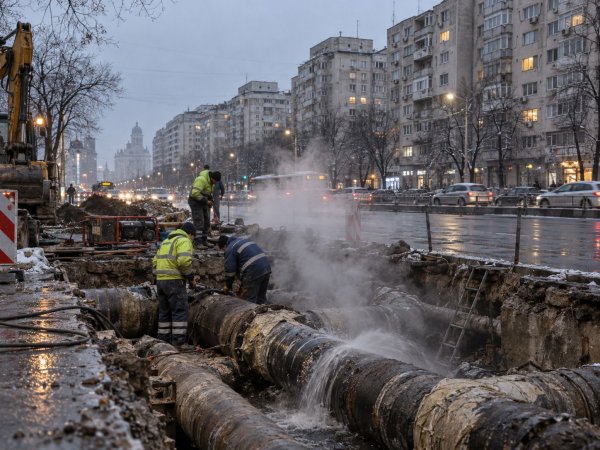
Over the past few decades, Bucharest’s district heating system has become one of the most visible examples of ageing urban infrastructure. Beneath the city’s busy boulevards stretches an enormous network of pipes, much of it built during the communist era, carrying heat to residential neighbourhoods. Some pipes have long exceeded their intended service life, others leak hot water underground, and repairs regularly turn major intersections into construction sites.
The paradox is that, when it was first introduced, the system represented considerable progress. District heating brought comfort to a growing urban population and made it possible to heat entire neighbourhoods simultaneously. It was one of the solutions through which Bucharest hoped to become a modern metropolis.
So how did the promise of collective comfort turn into apartments heated by portable electric heaters? The answer begins long before the first pipe failure made the evening news.
When Bucharest Relied on Stoves and Building-Level Heating Systems
At the beginning of the 20th century, heating a home in Bucharest largely meant using a stove. Ordinary households burned wood or coal, and stocking up on fuel was a serious annual concern. Wealthier homeowners enjoyed somewhat greater comfort, as some villas and modern apartment buildings had their own central heating installations.
During the interwar period, building-level heating systems became increasingly common in modern developments. Radiators and the distribution of heat through internal pipework offered an obvious advantage over stoves that constantly needed feeding and cleaning. Extending thermal comfort across an entire city, however, required a different kind of infrastructure, with large production facilities and underground distribution networks.
One precursor to the future system could be found at Grozăvești. In 1889, a hydroelectric plant began operating there, considered the first installation of its kind in Romania. In 1902, Grozăvești also became Bucharest’s first thermal power station to supply alternating current.
The connection between the history of electricity and that of district heating is essential. Generating electricity in thermal power stations produces substantial amounts of heat. If that heat is recovered and used to warm homes, the efficiency with which fuel is used can increase significantly.
The principle is known as cogeneration, or combined heat and power, and it would become the foundation for the development of Bucharest’s major district heating power plants.
The 1950s and 1960s: Bucharest Begins Building an Enormous Heating Network
The development of the centralised heating system accelerated after the Second World War, alongside industrialisation and the expansion of large residential neighbourhoods.
In 1953, Întreprinderea Electrocentrale București, the Bucharest Power Generation Enterprise, was established, incorporating the Grozăvești power station. By 1960, district heating production capacity had reached 78 gigacalories per hour, according to historical documents included in the municipality’s thermal energy supply strategy.
It was the beginning of a remarkable expansion. In 1962, to increase the available heat supply, the city even turned to the thermal power station belonging to the Grivița Works. Two years later, CET Titan was connected to the system, while construction of CET București Sud began in 1964.
The power station in the south of the city would become one of the main components of Bucharest’s energy infrastructure. Following the installation of its final generating units in 1975, CET București Sud was supplying more than half of the heat delivered to the capital.
CET București Vest began production in 1972, while CET Progresu entered service in 1987.
The expansion of power stations kept pace with residential construction. In Drumul Taberei, Titan and Berceni, the large numbers of apartment blocks being built required a shared heating solution. Every apartment had radiators supplied through the building’s heating system, freeing residents from the need to purchase and store fuel individually.
For families moving out of homes heated by stoves, the change was substantial. Hot running water and radiators connected to a centralised heat source had become standard features of modern urban living.
The price of that comfort, however, was enormous technical dependence. A problem at a power station or along a major pipeline could affect thousands of apartments simultaneously.
How Heat Travels from a Power Station to Your Radiator
Bucharest’s district heating system seems straightforward when viewed from inside an apartment. You turn on the tap and hot water appears. Behind that simple gesture, however, lies an infrastructure network running beneath streets and boulevards throughout the city.
Combined heat and power plants produce thermal energy, often simultaneously with electricity. The heat is transferred to water circulating through the primary network, which carries it through large-diameter pipes to local heating substations.
There, heat exchangers transfer the energy to secondary circuits. From these substations, water used for heating travels to building radiators, while domestic hot water is prepared and distributed separately.
The water in the primary circuit returns to the power stations to be heated again. It is a closed-loop system designed to recover and transport energy as efficiently as possible. At the heating substations, heat exchangers transfer thermal energy between the circuits.
The sheer scale of the system also explains why maintaining it is so difficult. The report The State of the Environment in Bucharest 2025 recorded approximately 987 kilometres of primary pipelines and 2,965 kilometres of secondary pipelines, along with more than a thousand heating substations and modules.
We are talking about thousands of kilometres of pipes buried beneath a city that continues to function, expand and build above them.
A failure along a major pipeline involves locating the defect, isolating the affected section, excavating, carrying out repairs and restoring operating conditions. Depending on the circumstances, supply may be resumed gradually.
And when the damaged pipe happens to run beneath a busy intersection, the technical problem immediately becomes a traffic problem as well.
Why the Pipes Started Failing
The main explanation lies in the age of the infrastructure and insufficient investment in its replacement. Metal pipes that remain in constant contact with water and are subjected to temperature fluctuations deteriorate over time. Corrosion weakens their walls, thermal insulation degrades, and the movement caused by expansion and contraction puts stress on joints.
Such processes are well understood in district heating systems and can be controlled through proper design, monitoring and periodic component replacement. Bucharest, however, has accumulated a substantial modernisation backlog.
According to the energy balance for 2024, publicly presented in June 2026, 61.77% of the pipes in the primary network were more than 25 years old. In the secondary network, the proportion exceeded 41%.
The age of the pipes is only part of the problem. The condition of the insulation, installation quality, the corrosiveness of the surrounding soil and the history of repairs also matter.
In a system that has operated for decades, localised repairs may extend the life of individual sections. But welding a new pipe between two severely worn sections leaves the neighbouring vulnerabilities intact.
There is also the issue of pressure and temperature fluctuations. Network operations must be performed carefully, as hydraulic and thermal stresses can damage installations, particularly at their weakest points.
In September 2026, Bucharest Mayor General Ciprian Ciucu announced that he was sending the municipal Control Body to investigate Termoenergetica, citing suspicions of improper operational procedures involving the pipelines. His statements concerned the way the system was being operated and the possibility that such practices had contributed to failures. Such allegations, however, must be distinguished from technical causes established through expert investigations.
What remains certain is that the age of the network and the large number of failures are documented in official reports.
How Much Heat Does Bucharest Lose Before It Reaches Apartments?
One of the figures that best illustrates the seriousness of the situation appears in the energy balance for 2024.
37.73% - Actual heat losses from the energy fed into the system in 2024
5,626 - Network failures recorded in 2024
Distribution of thermal energy in 2024:
Energy remaining: 62.27%
Losses: 37.73%
Figures from the system's 2024 energy balance. Losses include heat transfer losses and leaks of the circulating heating water.
In other words, for every 100 units of thermal energy fed into the transmission and distribution networks, approximately 38 were lost along the way. Total losses amounted to around 1.7 million MWh.
There is one essential technical clarification: every district heating network loses some of the energy it transports, even under good operating conditions. The difference lies between acceptable technical losses and actual losses, which are amplified by deteriorating infrastructure.
In Bucharest, the poor insulation of old pipelines contributes significantly to heat losses. Cracks and defective seals also allow water to escape from the circuit, requiring replacement water to be supplied and heated.
The costs are considerable. For 2024, the energy lost beyond reference technical loss levels represented an estimated economic value of approximately 390 million lei, divided between the primary and secondary networks.
That money reflects a problem that ultimately affects operators’ budgets, municipal finances and the overall cost of the service.
RADET: The Story of a Public Utility That Went Bankrupt
After 1990, the administration of Bucharest’s district heating system underwent several institutional reorganisations. RADET, the Autonomous Administration for Thermal Energy Distribution, became a name that generations of residents associated with the capital’s hot water and radiators.
The economic model, however, had a serious weakness. Thermal energy was produced mainly by ELCEN, a state-controlled company, while RADET managed distribution to consumers under municipal authority.
The price paid by residents was subsidised by Bucharest City Hall. The difference between the local tariff charged to consumers and the actual cost of the service was supposed to be covered through subsidy mechanisms.
When payments were delayed, debts accumulated throughout the financial chain. RADET owed money to the energy producer, while ELCEN, in turn, suffered the consequences of late payments.
Meanwhile, the pipes continued to age. RADET entered insolvency in 2016, and its bankruptcy was declared in 2019. In December 2019, operation of the system was taken over by Compania Municipală Termoenergetica București, the Bucharest Municipal District Heating Company.
The change of operator represented an administrative reorganisation, but the pipes themselves remained largely the same.
ELCEN also went through insolvency before eventually emerging from the procedure. The financial history of the two entities shows how vulnerable a public utility can become when investment depends on institutions with different budgets and responsibilities.
For a Bucharest resident waiting for hot water, the division of responsibilities matters very little. From an administrative perspective, however, it helps explain some of the difficulties that have accumulated over the years.
The Power Stations Have Problems of Their Own
Old pipelines are the most visible part of the crisis because ruptures produce construction sites and service interruptions. But thermal energy production also depends on equipment that requires modernisation.
ELCEN operates the București Sud, București Vest, Grozăvești and Progresu power stations. CET București Vest underwent an extensive modernisation programme between 2005 and 2009. The other three stations continued to rely, to a large extent, on technologies developed in the 1960s and 1970s.
In documents published in 2024 and 2025, ELCEN described the advanced deterioration of installations at București Sud, Grozăvești and Progresu, along with the need for major investment.
The problem is clear: the city depends on a system in which both production and distribution need to be modernised at the same time.
A recent example came in September 2026, when scheduled maintenance at CET București Sud affected the hot water supply of approximately 1,395 apartment blocks. The work was routine maintenance, but the number of homes affected demonstrates just how dependent entire neighbourhoods are on the major power stations.
Temporarily shutting down a combined heat and power plant for maintenance may also require transferring the load to other sources, within the limits of their capacity and the network configuration.
This is one reason why system flexibility and the interconnection of heat sources have become significant technical priorities.
Life in an Apartment Block: Postponed Showers and Electric Heaters
Energy statistics take on a much more immediate meaning inside an apartment where the radiators remain cold in January.
The discomfort caused by repeated interruptions goes well beyond missing a shower. A family with young children has to reorganise its mornings, an elderly person may find cold temperatures harder to tolerate, and people working from home spend entire days in inadequately heated rooms.
Individual solutions begin to appear. Portable electric heaters temporarily replace radiators, electric water heaters provide hot water, and some homeowners invest in independent heating systems wherever technical and legal conditions permit.
But every solution comes with additional costs. A 2,000 W electric heater used for five hours consumes 10 kWh of electricity. Repeated daily, that usage can produce a substantial increase in the electricity bill.
There are also consequences for the building itself. Low indoor temperatures, combined with humidity and insufficient ventilation, encourage condensation and mould growth.
For these reasons, failures in the district heating system affect both housing quality and household expenses. Over time, frequent interruptions also change how residents perceive public services. A city ends up being judged by very practical things, and the temperature of a radiator may carry more weight in assessments of the local administration than some spectacular urban development project.
Why Some Neighbourhoods Suffer More Than Others
The map of system failures shows that Bucharest’s district heating problems are unevenly distributed. Pipe conditions vary from one area to another, as does the distance from production facilities. Network configuration, heating substation capacity and the possibility of supplying heat through alternative routes all play a part.
Some neighbourhoods have benefited from substantial pipe replacement programmes, while others still depend on ageing sections. A failure along a major transmission pipeline can affect numerous heating substations, while a problem in the secondary network may be limited to a handful of buildings.
There are also situations in which heated water reaches a substation, but the available temperature or pressure is insufficient to provide adequate heating or domestic hot water.
Inside apartment buildings, their own plumbing and heating installations can create additional difficulties. Hydraulically unbalanced risers, deposits inside pipes or poor system adjustments can produce temperature differences between apartments.
As a result, two homes located only a few hundred metres apart may have completely different experiences on the same winter day.
Why Bucharest Digs Up Its Streets in Summer to Keep Homes Warm in Winter
Modernising district heating networks involves replacing old pipelines with new ones, generally pre-insulated and equipped with modern monitoring systems. Pre-insulated pipes reduce unwanted heat transfer into the ground and provide better protection against moisture. Moisture detection systems can help identify deterioration before it causes major failures.
The work, however, is complicated in a densely built city. Replacing a major pipeline requires opening up the underground route, installing the new pipes and connecting them to the existing network. Technical testing and recommissioning follow.
Temporary hot water interruptions during the summer are frequently the consequence of such work. And when projects run over schedule, residents’ patience wears out faster than the freshly laid asphalt over the trench.
In September 2026, Bucharest City Hall announced that 28 kilometres of main pipelines had recently been completed, while another 37 kilometres were at an advanced stage of modernisation. Work was also under way on additional sections.
The programme financed through European funds provides for the modernisation of 212 kilometres of pipelines, with a total value of approximately 1.76 billion lei, of which 1.3 billion lei represents non-repayable funding.
The deadline announced by the municipality for completing the investments financed through European programmes is December 2027. The pace of replacement remains decisive. Beyond the kilometres announced, what matters is the actual commissioning of the new pipelines and a measurable reduction in losses.
What Bucharest Residents Can Do When Their Radiators Stay Cold
Some of the problems experienced inside an apartment can be identified through a few simple checks. The first step is to consult the information published by Termoenergetica. The operator provides an outage map and the Termoalert app, available for Android and iOS. Users can monitor addresses of interest and receive notifications about failures in their area.
If an address appears in an affected area, the published information includes the reason for the intervention and an estimated time for restoring supply. That estimate may change depending on how the work progresses.
For reporting problems, Termoenergetica provides a free telephone number, 0800 820 002, available around the clock. Recorded messages about the state of the system can also be accessed by calling 031 9442.
When neighbours receive adequate heating but the problem persists in a single apartment or along one vertical riser, the building’s internal installation needs to be checked. The building administrator or the company responsible for maintenance may be able to identify local faults.
A distinction must also be made between a complete interruption of supply and insufficient hot water temperature. When complaints concern service quality, registering the complaint and checking the operating parameters can help establish the cause and apply the relevant contractual provisions.
Can Bucharest’s District Heating System Be Saved?
The answer depends on consistent investment, modernisation of the power stations and sound financial management.
District heating remains a solution used in numerous European cities. Its advantages come from efficient energy production and the ability to supply large numbers of buildings through shared infrastructure.
Bucharest already has an extensive network and a very large number of connected consumers. Replacing the entire system with individual heating solutions would require substantial investment in buildings and energy infrastructure. Modernisation, however, must move beyond emergency repairs. New pipes need efficient production facilities, properly maintained equipment and carefully monitored operation.
Predictable financial management is also necessary, allowing the energy produced to be paid for and investment to continue without endlessly accumulating historical debts.
In recent years, Bucharest has entered a phase of accelerated replacement of major pipelines, supported by European funding. The results will have to be judged by falling energy losses, fewer failures and greater service reliability.
Until then, the history of Bucharest’s district heating remains a chronology of postponed decisions. The system built for socialist-era residential neighbourhoods has survived the fall of communism, RADET’s bankruptcy and several generations of local administrations. The pipes stayed underground while the city continued to grow above them.
And for the capital’s residents, the true measure of modernisation will be surprisingly modest, considering the supposedly advanced age in which they will find themselves. On a freezing January morning, they will turn on the tap and find hot water. Without checking their phones first, without consulting the outage map and without keeping a kettle ready on the stove.
You may also like: How Bucharest Got Hot Water. Musiu Lagarde's Bathhouse and the Long Road to the Tap