Grigore Capșa’s Apprentice Became His Business Rival. The Story of the Man Who Founded the Nestor Confectionery in Bucharest
- Articles
- 01 OCT 26
In old Bucharest, confectioneries were not merely places where people bought cakes, sweets or ice cream. Some of them had become genuine institutions of urban life, spaces where businessmen, writers, artists, politicians and members of high society met. Among the best-known names were Capșa and Nestor, two confectioneries that came to be associated with refinement, quality products and a certain elegance of interwar Bucharest. Their story has, however, a spectacular detail. Jean Nestor, the man who would have his name associated with one of the best-known confectioneries in the capital, had been trained precisely in the environment of the Capșa House. Historians mention him among the confectioners who passed through the professional school of the famous company and later started businesses of their own. Thus, the man trained in the vicinity of Grigore Capșa eventually came to run a venue considered a rival of the famous establishment on Calea Victoriei.
From the Capșa school to his own confectionery
To understand the emergence of the Nestor confectionery, one must first look at the role that the Capșa House played in training Romanian confectioners. The Capșa family originated in Bucharest’s Aromanian community, and four of the family brothers – Vasile, Anton, Constantin and Grigore – were involved, at different stages, in the development of the famous business. Grigore Capșa and Constantin learned the trade in France, at the renowned Boissier House, and the experience they acquired there would decisively influence the style of the confectioners subsequently trained in the Bucharest workshop.
The Capșa House was important not only for the products it sold. It also became a place of professional training. Historians record that several young Romanians learned the art of confectionery there and, after gaining experience, opened their own businesses. Among the names mentioned are Niță Ionescu, Nae Drăghiceanu and Jean Nestor. Potra identifies Nestor as the owner of a confectionery on Calea Victoriei, considered one of the best-known in Bucharest until the 1977 earthquake.
The relationship between Capșa and Nestor was therefore a paradoxical one. The Capșa House contributed to the professional training of people who would later become its competitors. In Jean Nestor’s case, this evolution led to the emergence of an establishment that managed to build its own reputation in the center of the capital.
Jean Nestor’s professional path is not known in every detail, and the biographical information preserved about him is much more limited than that concerning Grigore Capșa. What emerges from the historical sources, however, is his connection with the Capșa House and the fact that, after his training, he built his own business in the confectionery field.
Nestor, the confectionery on the ground floor of the “Mica” building
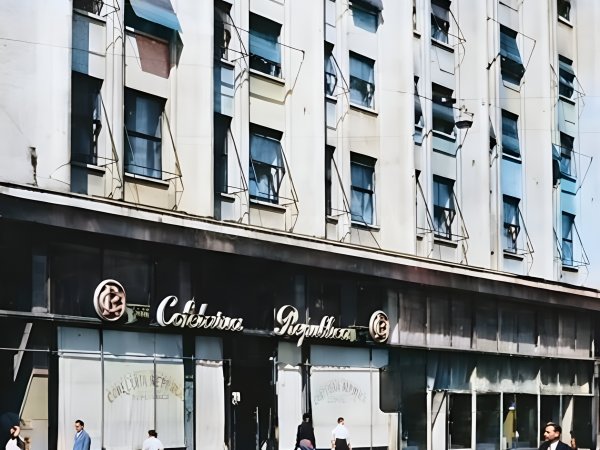
The Nestor confectionery eventually operated in the building of the Romanian “Mica” Anonymous Society, an important company in the interwar mining industry. Documentation from the Union of Architects of Romania identifies the “Mica” building at 61–63 Calea Victoriei as dating from 1932–1934 and attributes it to architect Duiliu Marcu. The document explicitly identifies it as the “Nestor Building,” mentioning the confectionery on the ground floor and the building’s disappearance following the 1977 earthquake.
Sources concerning old Bucharest also indicate that the building had several components and that the space occupied by Nestor was connected with the subsequent development of the complex. This is also the source of a certain confusion regarding the exact address. Some mention 77 Calea Victoriei, while other documents and guides place it at number 63. Architectural documentation and studies concerning the “Mica” building, however, identify the property at 61–63 Calea Victoriei as the one that housed the Nestor confectionery.
During the interwar period, the establishment built its reputation through a combination of elaborate products, elegant service and its location on one of the city’s most important avenues. Calea Victoriei was then one of Bucharest’s major commercial and fashionable arteries, while its proximity to major hotels, shops and other prestigious establishments provided the confectionery with a diverse clientele.
Nestor was not, however, a venue intended exclusively for a single social category. Memories of the confectionery describe a place where businessmen, intellectuals, writers and members of high society could be encountered. The atmosphere also varied depending on the area in which the customer sat.
A place with two atmospheres and a distinctive clientele
On the ground floor, the atmosphere was more relaxed. Customers could sit at tables, converse, and the confectionery had the character of a public place where spontaneous meetings and conversations were part of the establishment’s charm. It was not merely a place from which one could buy a box of sweets, but a space belonging to everyday Bucharest life.
The upper floor had a character closer to that of an elegant brasserie. Memories of interwar and postwar Bucharest describe a more sophisticated clientele here, including people who maintained the clothing style of earlier generations. Canes, hats and elegant accessories were part of the image of this world, at a time when certain social gestures and rituals were still surviving historical changes.
In such surroundings, drinks such as café-frappé or mazagran were ordered, together with cognac and other Western beverages. Mazagran, a coffee-based drink of North African origin, had become one of the specialties associated with the culture of cafés and modern confectioneries.
Nestor’s reputation was built, however, primarily around its products. The confectionery was known for its cakes, sweets and chocolate products, while the elegant packaging contributed to its prestige. Sweets bought there could become gifts for an important visit or a special occasion.
Cakes, sweets and the famous Joffre
The Nestor selection was sufficiently rich to turn its display window into a genuine spectacle. Among the products associated with the establishment were truffles, éclairs filled with cream, Carolines, kataifi, diplomat cake, almond biscuits, cookies, ice cream, cakes and various types of sweets.
At the time, some of these names were connected with Western gastronomic fashion and with the tradition of confectioners trained in French schools. Joffre was one of the best-known cakes, its name being associated with French Marshal Joseph Joffre, whose visit to Romania during the First World War contributed to the emergence of a genuine gastronomic legend surrounding the product.
Nestor also offered sweets with different flavors, candied fruit, fondant sweets and chocolate products. Among the specialties mentioned in recollections of the confectionery are also “cat’s tongues,” meaning thin chocolate products, as well as sweets containing orange.
Some products underwent name changes after the establishment of the new political regime. One example is the Bibescu cake, which, according to memoir sources, was renamed Tosca. Such changes in name did not necessarily mean that the products disappeared from consumers’ memories. In many cases, Bucharest residents continued to use the old names, contributing to their survival in collective memory.
Nestor during the communist years
After the establishment of the communist regime, many businesses and establishments associated with the old commercial society were renamed. The Nestor confectionery became Republic Confectionery, but its original name continued to be used in everyday speech and to appear in the memories of Bucharest residents.
This difference between the official name and the name used by people explains why Nestor remained so present in the city’s memory. The online photographic archive of the Institute for the Investigation of Communist Crimes and the Memory of the Romanian Exile even preserves an image taken on March 5, 1977, in which the building where the “Nestor” Confectionery was located is mentioned, only one day after the great earthquake.
During the 1960s and 1970s, the establishment continued to be associated with products considered more sophisticated than the ordinary offerings of state confectioneries. Memories of that period speak of sweets that were considered expensive but sought after precisely because of their quality and presentation. At a time when the commercial offering had become much more uniform, Nestor still retained something of the prestige of the old confectionery.
In this sense, Nestor was one of those interwar Bucharest businesses whose name survived even after the owners disappeared and the political regime changed. “Republic” was the official name, but for many Bucharest residents the place remained Nestor.
The 1977 earthquake and the end of an era
On March 4, 1977, the city of Bucharest was struck by one of the most devastating earthquakes in its modern history. Numerous buildings collapsed, including the building that housed the famous Nestor confectionery.
AGERPRES records that on Calea Victoriei, near its intersection with Știrbei Vodă, the building that had the Nestor confectionery on its ground floor collapsed during the earthquake. A new complex was subsequently built on the site, later associated with the Bucharest Hotel and, today, with the Radisson Hotel.
Technical studies concerning the building confirm the severity of the destruction. A report by the Technical University of Civil Engineering of Bucharest identifies the “Mica” building as the structure that housed the Nestor Confectionery and notes the total collapse of the section facing Calea Victoriei during the 1977 earthquake.
Thus ended the history of the establishment in the building that had made its name famous. The confectionery later continued to exist in another location, near the Athénée Palace Hotel, but it no longer had the same position or the same symbolic power. For the generations who had known the old Nestor, the move could not reproduce the atmosphere of the establishment on Calea Victoriei.
Today, Jean Nestor and his confectionery are remembered mainly through archival photographs, books on urban history and the memories of those who knew old Bucharest. His story is all the more interesting because it began inside the Capșa House itself: the apprentice of one of the city’s most important gastronomic institutions became, in turn, the owner of an establishment that entered Bucharest’s collective memory.
Nestor and Capșa were not merely two competing confectioneries. They also illustrate how a profession transmitted through apprenticeship could generate new businesses and new reputations. Grigore Capșa helped train a generation of confectioners, while Jean Nestor transformed the experience he gained into his own brand.
And if today names such as Nestor, Joffre, Bibescu, Tosca or mazagran seem to belong to a vanished world, they still preserve the image of a Bucharest in which confectionery was more than simply a stop for a cake. It was an urban ritual, a meeting place and, for some Bucharest residents, a form of everyday elegance. The disappearance of the Nestor building on the evening of March 4, 1977, meant not only the loss of a building, but also the disappearance of a landmark of that Bucharest.
We also recommend: Before Casa Capșa, there was Kübler. The story of the most famous café in 19th-century Bucharest