How Bucharest Got Hot Water. Musiu Lagarde's Bathhouse and the Long Road to the Tap
- Articles
- 08 SEP 26
On Monday, September 7, thousands of Bucharest schoolchildren got ready for the first day of school with water heated on the stove and poured into a basin. According to Termoenergetica, 1,666 buildings across the city, apartment blocks, schools, kindergartens, mostly in districts 2, 3, 4 and 5 had their hot water cut off or running below normal parameters, because of the summer maintenance shutdown at CET Sud and a handful of other plants offline.
The same districts, the same plants, almost the same numbers come back every cold season, year after year. What the Termoenergetica lists don't show is that Bucharest has been fighting over hot water for close to two centuries. The fight has just gone by different names over time: hamam, taps, gas boilers, CET.
Musiu Lagarde's bathhouse
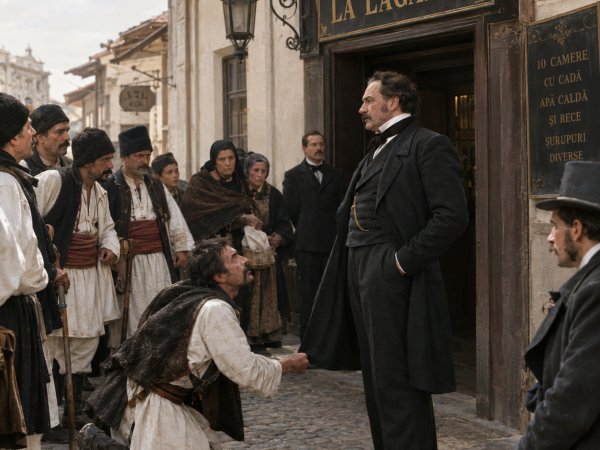
In March 1825, Kir Stanciu walks out onto Ulița cea Mare with all his bath attendants and two old women who bathed the ladies. He's come to protest. A Frenchman named Lagarde had just gotten approval from Prince Grigore Ghica to open a bathhouse "in the Viennese style," with ten rooms, each with a tub and taps that let a customer choose, to taste, hot water or cold. Until then, the city's only baths ran on the Turkish model, steam, not plumbing.
Stanciu's own bathhouse stood at Casa Beilicului, on what's now Șerban Vodă street, leased from the monastery for 1,800 talers a year. Bath attending was a trade passed down like any other guild craft, with its own rules, rates, even a guild master. Constantin C. Giurescu writes in Istoria Bucureștilor that at the start of the nineteenth century the city had only two public baths of any size: one belonging to Plumbuita Monastery, the other near the princely court. Ordinary Bucharesters didn't go there. They washed in the Dâmbovița river, or at home in a wooden tub, with water heated over a fire.
Lagarde's petition set off what historian V. A. Urechia calls, in an account later picked up by Realitatea Ilustrată magazine in 1937, a genuine uprising. Stanciu threw himself at the prince's feet, kissing the hem of his coat, and begged for protection for his trade: if the Frenchman opens his bath, he and his attendants will be reduced to begging bread. The prince wrote on the petition that Lagarde's bath would serve only the sick, and that the city's other baths would go untouched. It didn't matter much in the end. Fashionable Bucharest went straight to Lagarde, and Stanciu was left with the customers who, as the old account puts it, washed "once in a blue moon."
From the public bath to the apartment bathroom
The 1825 episode is the first documented moment Bucharest has a hot-water tap. But for a long time that stays a public-bath luxury, not something that reaches people's homes. Realitatea Ilustrată noted in 1937 that Romania then had one bath per 2,000 residents, and that "until about fifteen years ago" a house in Bucharest with its own bathroom was rare. The magazine credits the shift to the so-called apartment blocks: the first interwar buildings brought the bathroom, with hot and cold water on tap, straight into every unit, however small.
That solved the problem only for whoever lived in one of the new blocks, with a private boiler or water heater. The rest of the city kept its wood and coal stoves, and hot water still meant a pot on the fire.
1943: gas, then district heating
The moment that actually changes the scale of the problem comes with the introduction of natural gas to Bucharest, in 1943. From then on, centralized heat supply starts to develop. By 1950 around 1,000 gas boilers were already installed, but still one at a time, boiler by boiler, block by block.
The first step toward a centralized system in today's sense comes in 1957, at the Grozăvești plant. Engineers build an experimental district-heating installation there, meant to supply heat to the Grozăvești apartment blocks, the ICECHIM building, student dormitory 303, and a kindergarten. It's effectively the first Bucharest neighborhood connected to a shared heat and hot-water source, rather than individual boilers. By 1960 the installation's capacity reaches 78 Gcal/h, and Grozăvești officially becomes the city's first CET — combined heat and power plant. The Grozăvești plant itself had run since 1889, as a hydro-electric works, but its role as a supplier of hot water to homes only starts now.
From there, the expansion moves fast, tied directly to the pace of construction. Bucharest goes from 11,000 new apartments a year in 1961–1965 to 25,000 a year in 1971–1975. Every new block of flats gets wired into the district-heating network from the start: CET Griro (the former Grivița plant) takes on the load in 1962, CET Titan connects in 1964, and that same year construction begins on CET București Sud, which would become the city's largest heat source, followed by CET București Vest, commissioned in 1972. Starting in 1958, smaller neighborhood heating plants also begin appearing, one for each cluster of blocks, many of them tucked into basements.
In just two decades, the city moves from stoves and individual taps to a system that today sends hot water to over half a million apartments, through the second-largest district-heating network in the world after Moscow's.
What's left of the story
The network built back then, across the 1960s and '80s, is the same one that breaks down today at every summer maintenance shutdown or cold snap, with failures at CET Sud, CET Vest, or CET Grivița — the very plants named in the September 7 news. The last plant built from scratch in Bucharest, CET Titan, dates to 1979; only now is a new one going up, also called Titan, in District 3. Musiu Lagarde's bathhouse is long gone, but its principle — hot or cold water, at the tap, "to taste" — remains exactly what the City Hall, Termoenergetica, and the more than a million Bucharesters still connected to th