How Cinemas Emerged in Bucharest and the First Scandals Related to Morality
By Eddie Țone
- Articles
- 14 APR 26
If you had been strolling down Calea Victoriei on the afternoon of May 27, 1896, you would have noticed an unusual commotion in front of the building housing the editorial offices of the newspaper L'Indépendance Roumaine. It wasn't a government crisis or a duel between proud boyars, but something far more bizarre: a Frenchman named Paul Menu had installed a device that promised to show photographs coming to life.
Bucharest residents, accustomed to the slow pace of horse-drawn carriages and classical theater performances, suddenly found themselves before a window into a world where trains drove directly into walls and workers left factories without ever tiring. This first screening marked the beginning of a love-hate relationship between the Capital and the "seventh art"—one that would severely test the nerves of purists and the patience of the police.
The Miracle in the Window and the First Heartbeats of the Big Screen
The first cinematic experiences in Bucharest were far from the comfort of today's plush armchairs. It all began in a quasi-improvised setting, where curiosity overcame the fear of the unknown. Paul Menu, the official representative of the Lumière brothers, quickly realized that Bucharesters had an immense appetite for novelty, even if it came with the hellish noise of a hand crank and a pungent smell of sulfide.
The first frames shown featured mundane scenes, such as marching troops or people leaving a church service; however, for the audience of that time, the simple movement of leaves on a tree projected onto a white wall seemed like a form of black magic.
The success was so explosive that locations diversified rapidly. From the aforementioned newspaper headquarters, screenings moved to summer gardens and hastily arranged wooden shacks. People paid considerable sums to watch a few minutes of jerky images. In practice, this new entertainment began to compete directly with theater and variety shows, sparking the first waves of discontent among the cultural elite, who considered "animated photography" to be merely a toy for the uneducated masses. This vision proved wrong, as screenings quickly became a meeting point for all social classes, from coachmen to government ministers.
Darkness in the Hall and Moral Panic in Bourgeois Society
As cinema moved from open spaces to dedicated halls, a problem arose that no one had correctly anticipated: the necessity of total darkness. In late 19th-century Bucharest, the idea of men and women sitting together for an hour in a pitch-black room triggered a storm of moralizing warnings.
The press of the time began publishing worried editorials about the "dangers lurking in the shadows of the cinema," suggesting these spaces were covers for far less artistic activities. Authorities felt obliged to intervene. There are accounts of police officers patrolling the halls with flashlights, checking if spectators were keeping their hands in plain sight or if young couples were taking advantage of moments of suspense to steal kisses forbidden by etiquette.
This was an era where a visible ankle could cause a major scandal, so one can imagine the impact of "collective intimacy" in a projection hall. This constant surveillance turned the viewing experience into an exercise in forced discretion, where the audience had to constantly prove they were there solely for the film's educational value.
Censorship and the Pursuit of Forbidden Scenes
If darkness was a spatial issue, film content quickly became a state issue. The first films brought from Paris or Vienna were not always about mountain landscapes or royal visits.
Certain films, often screened after midnight under the title "evenings for men," featured scenes considered revoltingly bold at the time. Even ordinary films that included moments of tenderness or energetic dances, such as the can-can, were viewed with suspicion by the newly established censorship committees.
Regulations became increasingly strict, and cinema owners had to submit their film lists to the prefecture days before the screening. Archives reveal a fascinating duality in the Bucharest citizen: on one hand, there was public condemnation of immorality; on the other, shows "forbidden to minors and ladies" were always sold out. This tension led to the emergence of neighborhood cinemas, less visible to the eyes of the law, where censorship was applied with much more indulgence in exchange for sums of money slipped to law enforcement agents.
Elite Resistance and the Acceptance of Progress
Not everyone saw the cinema as a threat to the purity of the soul. A portion of the intelligentsia embraced the technology as a tool for modernizing Romania. However, prominent voices lamented the "death of theater and reading," arguing that moving images "make the mind lazy." The natural comparison at the time was the emergence of pocket novels: it was believed that easy access to entertainment would destroy people's ability to appreciate high-level art.
In reality, cinema forced cultural institutions to adapt. Theater actors, initially reluctant to appear on the "white canvas" for fear of losing their prestige, began to understand the potential for stardom offered by the screen. The first Romanian productions, such as The Independence of Romania (1912), demonstrated that the new medium could serve noble national causes, partially calming conservative spirits. Cinema ceased to be seen merely as a place of perdition and began to be accepted as an essential component of modern urban life.
The Palaces of Elisabeta Boulevard and Their Legendary Aura
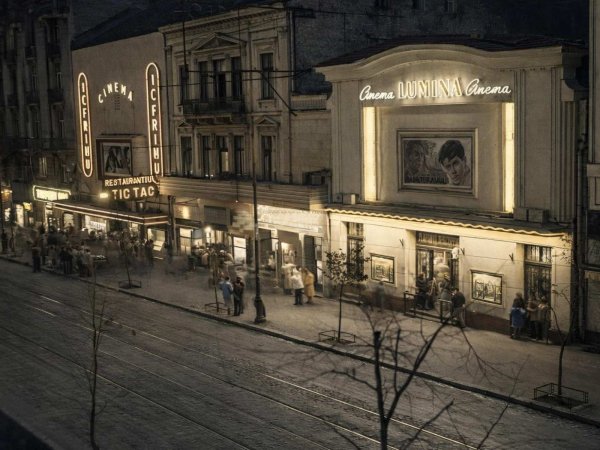
While Calea Victoriei was the cradle of cinema, Elisabeta Boulevard quickly became the backbone for cinephiles. During the interwar period, this thoroughfare transformed into a local "Broadway," where the light from neon signs was so bright that night felt like an extension of the day. You came to Elisabeta Boulevard to see movies but also to be seen, to show off a new hat, or to discuss the latest political gossip in marble-clad foyers.
- Cinema Bulevard: The Aristocracy of the Screen Located on the ground floor of the hotel of the same name, Cinema Bulevard was the definition of old-fashioned elegance. It was the preferred spot for those seeking a select experience, away from the noise of the youth. It is said that screenings here were so esteemed that Romanian army officers had traditionally reserved seats, and evening dress was almost mandatory, even for afternoon shows.
- Cinema Capitol: The Garden of Stars With a history beginning as the Alhambra Summer Theater, Capitol remained in the memory of Bucharesters for its eclectic facade and adjacent summer garden. It was a space where the barrier between indoors and outdoors vanished, and films played under the open sky on warm July nights. The statues decorating the facade are the work of sculptor Spiridon Georgescu, the same man who worked on the Arch of Triumph.
- Cinema Scala: Modernism and Luxury Scala represented the leap toward modernist architecture, integrated into a spectacular building designed by Rudolf Fränkel. It was the cinema for gala premieres, equipped with cutting-edge technology for the time, including a ventilation system that was the pride of the city. Scala was among the first halls in Bucharest to introduce a rudimentary "air conditioning" concept, using large blocks of ice and giant fans to cool the audience during heatwaves.
- Cinema Trianon (later București) Trianon was where luxury met absolute comfort. With an impressive capacity and a balcony offering perfect visibility, the Trianon often hosted charitable events patronized by the Royal House. During World War II, the cinema miraculously survived the bombings that affected the central area, becoming a symbol of the city's cultural resilience.
Interpreting the History of Bucharest Cinemas
Regarding the beginnings of cinematography in Bucharest, it is easy to fall into the trap of myths. There are nuances that deserve closer attention to avoid a superficial understanding:
- Confusing the first screening location: Many believe the first film played in an actual cinema. In practice, the first screenings took place in newspaper halls, hotels, or cafes, as dedicated buildings appeared much later.
- The idea that audiences were scared to death by trains: Although the anecdote about spectators fleeing the hall at the sight of a train coming toward them is famous, it is often exaggerated. Bucharesters in 1896 were urban and sophisticated; they understood the difference between reality and a light projection, even if the effect was impressive.
- The view that films were just cheap entertainment: Many early films were of an extremely serious documentary or informative nature, serving as "visual news" in an age without television.
- The assumption that censorship was purely political: In the early years, censorship was almost exclusively moral and religious; political intervention came much later with the radicalization of social movements.
A Stop Before the Screen of Yesteryear
This journey into the world of early screenings demonstrates that Bucharest has always been a city of contrasts, ready to adopt top-tier technology while desperately clinging to rigid social rules. Morality scandals only enhanced the charm of this new medium. Today, when we watch a film on a phone in the subway, we lose sight of the magic and danger felt by a spectator in 1900, for whom every light on the screen was a risky adventure.
If you find yourself in central Bucharest, take a look at the old buildings that still bear the signs of forgotten cinemas. Many are now mere facades, but they carry within their walls the echoes of the first collective "wonders."
Have you ever had the curiosity to enter an old cinema, with a balcony and boxes, just to try and feel what the atmosphere was like before the era of mall multiplexes?
You may also like: The history of the Romanian Hollywood. The Buftea Film Studios, built by Gheorghiu-Dej for his daughter, Lica