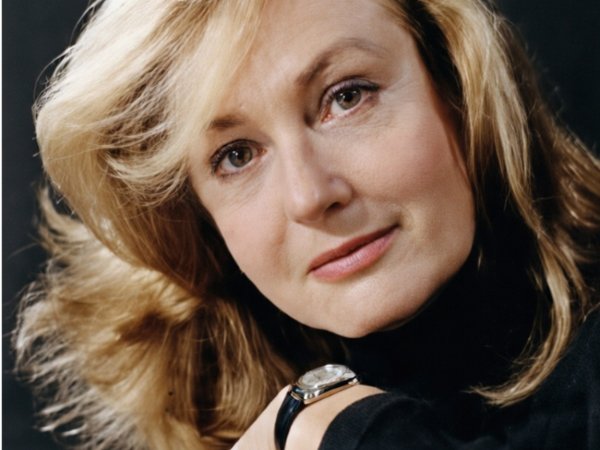
Dinu Lipatti’s sister-in-law, one of Romania’s great actresses. Who was the artist Aurelia Sorescu
- Articles
- 17 APR 26
Aurelia Sorescu was one of the representative actresses of Romanian theatre and film in the second half of the 20th century, a discreet yet remarkable presence through her talent and artistic refinement. She was born on November 23, 1929, in Bucharest, during a period when Romania’s capital was experiencing a phase of cultural effervescence, and the artistic scene was in continuous development.
Origin and training of a talented actress
Her childhood and adolescence were shaped by the influence of Bucharest’s urban environment, where theatre, music, and literature were part of the daily life of those passionate about culture. Choosing an artistic career was not accidental, but the result of an early inclination toward stage performance and artistic expression. In this sense, Aurelia Sorescu attended the Institute of Theatre and Film Arts, one of the most prestigious institutions of its kind in Romania.
Her formative years were essential for her professional development. Within the institute, she had the opportunity to study with important professors and to refine her acting technique. Rigorous education and exposure to great dramatic texts contributed to shaping an authentic interpretative style, characterized by naturalness and expressiveness.
Film debut and establishment on the big screen
Aurelia Sorescu’s film career began in 1952, with her appearance in the film “Mitrea Cocor.” This debut represented an important moment in her artistic journey, giving her the opportunity to stand out in a film industry in full development.
Her role in “Mitrea Cocor” highlighted the actress’s ability to adapt to the demands of film and to build credible characters. In a period when Romanian cinema was strongly influenced by the political and ideological context, Aurelia Sorescu managed to assert herself through professionalism and seriousness.
Later, she continued to act in other film productions, consolidating her position in the film world. Among her notable roles are those in “Și Ilie face sport” (1955) and “Nufărul roșu” (1956), films that offered her the opportunity to portray diverse characters and demonstrate her artistic versatility.
Although she did not have an extensive filmography, each of her appearances was appreciated for authenticity and sensitivity. Another important moment in her film career was her participation in the film “Emisia continuă” (1985), which marked a return to the screen in a different stage of her artistic life.
Theatrical activity and connection with the Bulandra stage
Alongside her film work, Aurelia Sorescu had a solid theatrical career, a field in which she fully expressed her talent. She was associated with the “Bulandra” Theatre, one of the most prestigious theatre institutions in Bucharest, known for its high artistic standards and quality repertoire.
On this theatre’s stage, the actress performed a wide variety of roles, demonstrating a remarkable ability to adapt to different dramatic styles. From classical plays to contemporary dramaturgy, Aurelia Sorescu succeeded in bringing complex, deep, and emotional characters to life on stage.
Theatre represented for her not only a workplace, but also a space for creation and artistic exploration. Direct contact with the audience, the energy of live performance, and the challenges of each role contributed to her development as an actress. In this environment, she built a solid reputation, being appreciated by colleagues and critics alike.
Personal life and connection with the Lipatti family
Aurelia Sorescu’s personal life was also marked by important connections with the artistic world. She was married to Dan Mizrahy, and later to Valentin Lipatti, the brother of the famous pianist Dinu Lipatti. Through this marriage, the actress became the sister-in-law of one of Romania’s greatest musicians, which brought her even closer to a complex artistic universe.
The Lipatti family is associated with musical excellence, and Aurelia Sorescu’s connection to this illustrious name further highlights her proximity to an elite cultural environment. Although there is not much public information about her private life, it is evident that she was part of a remarkable intellectual and artistic circle.
However, this connection did not define her entire identity, but rather complemented an already solid artistic career. Aurelia Sorescu was primarily appreciated for her own achievements, while her link to the Lipatti family represented only one aspect of her personal life.
Artistic style and contribution to Romanian culture
Aurelia Sorescu stood out through a balanced acting style, characterized by finesse, naturalness, and a profound understanding of the characters she portrayed. She was not an actress of exaggerated expression, but rather one who preferred subtlety and authenticity.
This approach allowed her to create memorable roles, even within less well-known productions. Her ability to convey sincere emotions and build credible characters was one of her defining qualities.
Her contribution to Romanian culture must be seen in the context of a generation of actors who worked during a difficult period marked by ideological constraints. Despite these limitations, Aurelia Sorescu managed to preserve her artistic integrity and offer audiences high-quality performances.
Her theatrical activity also had a significant impact on Bucharest audiences, contributing to maintaining a high standard for performances at the “Bulandra” stage. Through her roles, she participated in the development of a valuable theatrical tradition.
Last years and artistic legacy
Aurelia Sorescu remained active in the artistic field until the final decades of her life, even though her appearances became less frequent. The experience accumulated over the years and her artistic maturity turned her into a respected presence in the world of theatre and film.
She passed away on January 21, 1996, in Bucharest, leaving behind a dignified career and an important contribution to Romanian acting. Although she was not a highly publicized figure, her impact on those who knew her or watched her on stage remains significant.
Her artistic legacy consists of her roles, her professionalism, and her respect for the acting profession. Aurelia Sorescu remains an example of dedication and seriousness, representing an important part of the history of Romanian theatre and cinema.
In an era when fame was often fleeting, she chose to build a solid career based on work and talent. Thus, her name continues to be associated with an authentic artistic tradition and the fundamental values of Romanian theatre.
We also recommend: The other Lipatti. Valentin, essayist, translator and one of Romania’s greatest diplomats