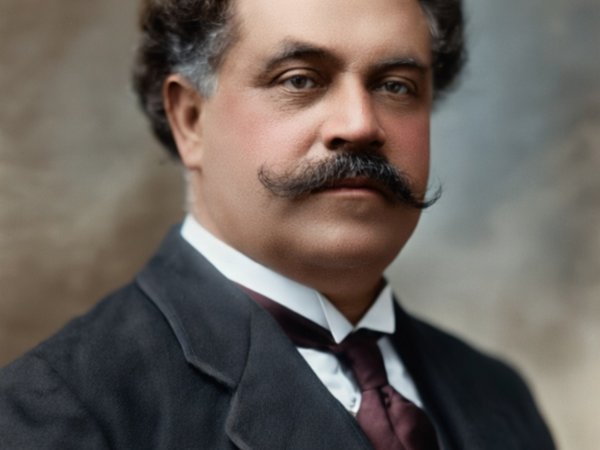
Censored by Prime Minister Dimitrie Sturdza, he laid the foundations of Romanian operetta. The story of tenor Constantin Grigoriu
- Articles
- 21 APR 26
In the second half of the 19th century, Iași was an important cultural center, a place where music and theatre were beginning to gain an increasingly clear identity. In this context, the destiny of a child was about to change radically due to a providential encounter. The conductor and composer Gavril Muzicescu, leading the Metropolitan Choir, noticed a boy of only 9 years old, gifted with a remarkable alto voice. Without hesitation, he included him in the choir, sensing his artistic potential. The name of this child was Constantin Grigoriu.
The discovery of a talent and the first steps in music
Under the guidance of important personalities such as Gheorghe Dima, Grigoriu continued his musical training and went on to study at the Conservatory. Graduating from this institution opened the path to a solid artistic career. He was hired as a tenor at the National Theatre in Bucharest, where he began with smaller roles, yet significant for his stage formation.
He appeared in various performances, from operetta to opera, interpreting parts from well-known works. The experience gained in these productions, as well as his participation in summer garden performances, helped him refine his style and understand the audience. In 1898, for example, he performed at the Cazino Garden alongside Nicu Poenaru’s troupe, sharing the stage with well-known actors of the time. This period was essential in shaping his artistic identity.
Between stage and pen: the playwright concerned with education
Alongside his activity as a tenor, Constantin Grigoriu showed a strong attraction toward writing. He did not limit himself to performance, but tried to contribute to the development of theatre through creation as well. Thus, he authored dramatic works such as the fairy play “The Fairy of the Carpathians” and the three-act comedy “Don’ Vagmistru,” which enjoyed success due to the performances of actors of the time.
At the same time, Grigoriu was concerned with the artistic education of children. He published the volume “Family Theatre,” a collection of short scenes intended for schoolchildren, through which he sought to bring young people closer to theatre and culture. This initiative clearly shows his vision regarding the role of art in shaping future generations.
A controversial moment in his activity was the allegorical play “The Dream of Romania,” created for the May 10 celebration organized at the Romanian Athenaeum. The work triggered a major scandal after being censored by the then prime minister, Dimitrie Sturdza. His intervention demonstrates the tensions between art and politics at that time, but also Grigoriu’s courage to approach sensitive topics.
A patriot dedicated to Romanian culture
Beyond his artistic career, Constantin Grigoriu was a true promoter of Romanian culture. His activity was extremely diverse: music teacher, inspector within the Ministry of Public Instruction, leader of church choirs, and organizer of artistic tours.
He was involved in important cultural initiatives, such as his activity within the Society “Tinerimea Română,” where he supported the development of the choral movement. He also contributed to promoting Romanian identity abroad, including participation in a Latin congress organized in Rome, where he recited the poem “The Sentinel at the Danube,” translated into Italian to highlight the Latin origin of the Romanian people.
Grigoriu did not limit himself to major cities. He also went to Chișinău, at a time when Bessarabia did not belong to Romania, contributing to the spread of Romanian culture. All these actions shape the portrait of an artist deeply involved in cultural and national life.
The birth of the Romanian Lyric Company
The most important achievement of Constantin Grigoriu remains the founding of a stable operetta ensemble in Bucharest. Until the beginning of the 20th century, this genre was dominated by foreign troupes, and attempts by Romanian artists to create a local company had not succeeded.
Grigoriu understood that operetta could not evolve without a professional and stable troupe. Thus, he gathered around him a group of artists and, in 1904, officially requested approval to organize performances. This is how the Romanian Lyric Company was born.
The debut took place at the Oteteleșanu Garden, with the performance “The Princess of the Canaries” by Charles Lecocq. Although the production impressed through its sets and costumes, it did not achieve the expected success. However, Grigoriu did not give up. The next premiere, “Spring Wind” by Joseph Strauss, brought the company the recognition it needed and confirmed its potential.
Tours – the key to the success of Romanian operetta
One of the biggest challenges for the Romanian Lyric Company was the lack of a permanent headquarters. During the cold season, Grigoriu could not afford to rent a hall, so the solution was to organize extensive tours throughout the country.
These journeys became true cultural events. The troupe, made up of over 100 people, arrived in cities such as Brăila, Galați, Iași, or Craiova, where it performed numerous shows. Audiences in the provinces received the same productions as those in Bucharest, with full sets and original casts.
Respect for the audience was a constant in Grigoriu’s activity. He believed that promoting operetta should not be limited to the capital, but must extend to all regions. These tours played a decisive role in popularizing the genre in Romania.
Talent scout and mentor of artists
Another important merit of Constantin Grigoriu was his ability to discover and support talent. Among the artists he promoted was Nae Leonard, who later became an emblematic figure of Romanian operetta.
Actors such as Velimir Maximilian and Gogu Carussy also had the opportunity to assert themselves within his company. Grigoriu not only offered opportunities, but also created excellent conditions for artists, including generous salaries.
An eloquent example is the case of Florica Florescu, whom he hired with an impressive salary for that time. Her testimonies outline the image of a dedicated, fair, and passionate director, who supported his artists both professionally and personally.
A generous man and a respected leader
Beyond his artistic achievements, Constantin Grigoriu was known for his character. He was a generous man, close to his colleagues and attentive to their needs. He owned a house in Albești, where members of the troupe could come during holidays, a sign of the close relationships he cultivated.
He never dismissed artists and constantly cared about their well-being. He was among the first directors who paid their employees throughout the entire year, contributing to the stability of the acting profession. This attitude earned him the respect and admiration of his contemporaries.
Memories of those who knew him, such as actress Natalița Pavelescu, describe him as a charismatic storyteller, full of humor and passion for theatre. For many, Grigoriu was not only a director, but a true mentor.
The legacy of a pioneer of Romanian operetta
Constantin Grigoriu remains an essential figure in the history of musical theatre in Romania. Through his efforts, operetta gained a stable place in the cultural landscape, and Romanian artists had the chance to assert themselves within a professional framework.
Although the beginnings were difficult, his perseverance and vision transformed a dream into a lasting reality. The Romanian Lyric Company paved the way for the further development of operetta, influencing entire generations of artists.
Grigoriu’s story is one of passion, courage, and devotion to culture. Despite obstacles, including political censorship, he managed to leave behind a valuable legacy that continues to inspire even today.
We also recommend: Velimir Maximilian, the best Jupân Dumitrache of the theatre, the sacred monster of operetta in Belle Époque Bucharest