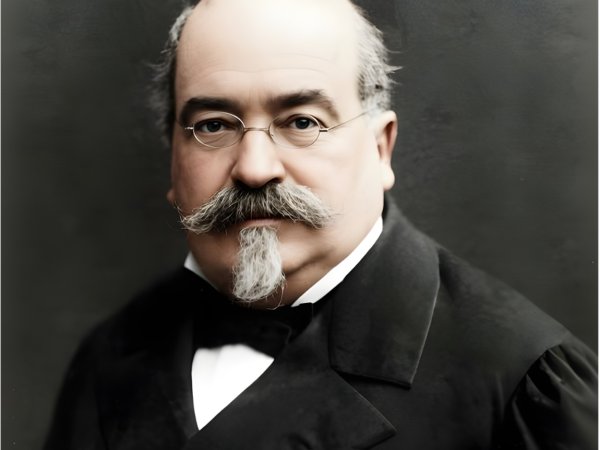
Famous boulevard names: Mihail Kogălniceanu, “the beginner of Romanian culture”, Cuza’s right hand who modernized the Romanian state
- Articles
- 02 APR 26
On 6 September 1817, Mihail Kogălniceanu was born, one of the most important political and cultural figures of the 19th-century Romanian world. His name is closely linked to the process of modernizing the Romanian Principalities and to the profound transformations that led to the formation of the modern Romanian state.
The birth of a personality who would change Romania
The historian Nicolae Iorga called him the “beginner of Romanian culture,” a phrase that perfectly captures his role as an initiator of essential directions in the intellectual and political life of the era. Throughout his life, Kogălniceanu became a landmark of reforms, a supporter of progress, and a promoter of modern ideas in a society still influenced by old social structures.
Intellectual formation and Western influences
Mihail Kogălniceanu’s youth was marked by studies carried out in France and Germany, two important centers of modern European thought. Here, he came into contact with liberal ideas, democratic principles, and new concepts regarding the organization of the state and the role of the citizen in society.
This formative period decisively influenced his political vision. Kogălniceanu became a supporter of profound modernization, social reforms, and national emancipation. Returning home, he quickly established himself as one of the most progressive voices of the era, actively engaging in debates regarding the future of the Romanian Principalities.
The 1848 Revolution and the affirmation of national ideas
An essential moment in his political career was the Revolution of 1848. During this period of social and political effervescence, Mihail Kogălniceanu was at the forefront of the nationalist movement in Moldavia. He firmly criticized the system imposed by the Organic Regulation, considered outdated and unjust.
During the Moldavian revolution, he drafted the famous manifesto “The Wishes of the National Party in Moldavia,” a programmatic document that summarized the reform aspirations of his generation. His text reflects the desire for modernization, equality, and political emancipation.
This stage marked the consolidation of his reputation as an intellectual and political leader capable of formulating clear directions for the future of the Romanian nation.
The fight for social justice and his role in the Ad hoc Divan
In the second half of the 19th century, Kogălniceanu continued his political activity within the National Party and as a member of the Ad hoc Divan in Moldavia. Here, he campaigned for the elimination of social inequalities between boyars and peasants, considering that true modernization of the state could not exist without social justice.
He himself stated with conviction: “At that time I swore, together with my generation, not to die until we had abolished beating and slavery, until we had made all people citizens in our country,” recalling the period when he served as aide-de-camp to Prince Mihail Sturdza.
This statement reflects his deep commitment to the idea of equality and social transformation, principles that guided his entire later political activity.
An architect of the Union of the Romanian Principalities
Mihail Kogălniceanu played an essential role in the process of the Union of the Romanian Principalities. As a strong supporter of the unionist cause, he contributed to the drafting of the resolutions of the Ad hoc Divan adopted on 7 October 1857, fundamental documents for achieving the union.
With the election of Alexandru Ioan Cuza as ruler of Moldavia and Wallachia in 1859, Kogălniceanu became one of his closest collaborators. Between 1859 and 1865, he repeatedly held the position of Prime Minister of the United Principalities, playing a decisive role in implementing the reforms that modernized the Romanian state.
The reforms that changed Romanian society
The period in which Kogălniceanu collaborated with Alexandru Ioan Cuza is one of the most important in modern Romanian history. During this stage, he contributed to the implementation of fundamental reforms aimed at deeply transforming the country’s social and political structure.
Among the most important reforms associated with his name are agrarian reform, the secularization of monastic estates, the public education law, and the amendment of electoral legislation. These measures had a major impact on society, contributing to the modernization of the state and the strengthening of democratic institutions.
Kogălniceanu often emphasized that he did not consider himself a “street revolutionary,” but rather a “man of government,” highlighting that the changes he supported were achieved through institutional political action rather than revolt.
Political career and state functions
Throughout his life, Mihail Kogălniceanu held numerous important positions in the Romanian state apparatus. He was Minister of Internal Affairs in four governments (1863–1865, 1868–1870, 1878, 1879–1880), Minister of Foreign Affairs in 1876 and 1877–1878, as well as President of the Council of Ministers between 1863 and 1865.
This intense activity demonstrates his central role in leading the modern Romanian state. Through his constant involvement, Kogălniceanu contributed to political stability and the consolidation of state institutions.
Romania’s independence and the moment of 9 May 1877
One of the most important moments in his political career is linked to the Romanian War of Independence. As Minister of Foreign Affairs, Mihail Kogălniceanu firmly supported the cause of independence before the great European powers.
His speech in the Assembly of Deputies on 9 May 1877 remained famous in history through the memorable phrase: “we are a sovereign nation!”. This declaration marked a turning point in Romanian history, confirming the Romanian state’s desire for independence.
After the war ended, Kogălniceanu was part of the Romanian delegation to the Congress of Peace in Berlin, where international recognition of independence was negotiated. Later, he became plenipotentiary envoy in Paris between 1879 and 1881, continuing to represent Romania’s interests abroad.
Cultural activity and contribution to Romanian press
Beyond his political career, Mihail Kogălniceanu also made a major contribution to cultural life. Mihai Eminescu described him as the “illustrious politician,” acknowledging his importance in the public life of the era.
He was editor and collaborator of important publications such as “Alăuta românească,” “Foaia sătească a Prințipatului Moldaviei,” “Dacia literară,” “Arhiva românească,” “Propășirea,” “Progresul,” and “Steaua Dunării.” These magazines played a key role in the development of modern Romanian culture and the spread of progressive ideas.
Historian, orator, and promoter of national culture
Kogălniceanu also distinguished himself as an exceptional historian and orator. He taught national history courses at the Mihăileană Academy and initiated the publication of fundamental works, such as the first volume of “The Chronicle of Moldavia” in 1846.
He also published important social studies, including “The Emancipation of the Gypsies” from 1844, contributing to debates on essential issues for Romanian society.
Through his activity, he laid the foundations of a modern perspective on national history and identity.
Final years and academic recognition
After retiring from active political life, Mihail Kogălniceanu remained a respected figure in intellectual circles. Between 1887 and 1889, he was elected President of the Romanian Academy, the highest cultural institution in the country.
This position represented recognition of his exceptional contribution to the development of Romanian culture, politics, and society. His legacy remains fundamental for understanding the modernization process of Romania.
The legacy of a reformer of the Romanian state
Mihail Kogălniceanu remains one of the defining figures of modern Romania. Through his political vision, implemented reforms, and cultural activity, he decisively contributed to the formation of the contemporary Romanian state.
Whether we speak about the Union of the Principalities, independence, or institutional modernization, his name is present in all essential moments of the 19th century. Today, the boulevards that bear his name are not just geographical landmarks, but also symbols of a profound historical legacy.
We also recommend: