Bucharest beneath the asphalt. The story of the underground passages that changed the capital
By Raluca Ogaru
- Articles
- 29 JUN 26
Bucharest is usually seen at boulevard level: traffic, busy intersections, old buildings, apartment blocks, squares and people in a hurry. But the city also has a life beneath the surface, less spectacular at first glance, yet essential to the way Romania’s capital functions. Underground passages, whether pedestrian, road-based or connected to metro stations, tell the story of a city that has always tried to adapt to congestion.
Some passages have become simple daily shortcuts, crossed without much thought. Others are urban nodes, places through which thousands of people pass every day. There are also road passages that have radically changed traffic in key areas of the city, as well as spaces now in need of serious repairs, because underground infrastructure ages along with the city.
Why Bucharest went underground
Bucharest began using underground solutions more and more as traffic, public transport and the number of pedestrians increased. The city’s major squares, such as University Square, Unirii, Victoriei, Obor or Eroii Revoluției, were not only administrative or commercial landmarks, but also pressure points. Boulevards, trams, buses and later the metro met there, while pedestrian crossings at surface level became increasingly difficult.
In this context, passages appeared as a way to separate flows: cars in one direction, pedestrians in another, public transport connected as directly as possible. The idea was simple: the city could gain space not only horizontally, but also vertically. Beneath the asphalt, it became possible to create links, crossings, platforms, metro exits, commercial spaces or passages through which people could avoid busy intersections.
With the development of the metro, this logic became even more visible. The first section of the Bucharest metro was inaugurated in 1979, and the network permanently changed the city’s relationship with the underground. From simple pedestrian crossings, Bucharest moved towards complex nodes in which passages, concourses and metro exits began to function together.
This is why underground passages should not be seen only as technical works. They show the way Bucharest has negotiated its public space over time: where pedestrians are sent underground, where cars are allowed to move faster, where public transport becomes a priority and where the city tries to repair, while still moving, decisions made decades ago.
Pedestrian passages, shortcuts and small urban worlds
For many Bucharest residents, a pedestrian passage is a place of transit, not a place to stay. You go down a few steps, cross, come back up and continue on your way. Yet these spaces have also had a larger urban role. The passages at University Square, Obor or those connected to major metro stations have functioned as link zones between transport, shops, markets and boulevards.
The passage at University Square is probably one of the best-known such spaces. It connects several corners of University Square with the metro station, in an area where surface traffic is constantly intense. For tourists, it may seem like nothing more than a practical crossing. For Bucharest residents, however, it is one of those pieces of infrastructure the city relies on every day, almost without noticing it anymore.
Obor, in turn, has a strong relationship with the underground. The area is one of Bucharest’s oldest and busiest commercial gateways, and pedestrian passages have the role of linking the market, public transport stops, boulevards and massive flows of people. Here, the passage is not just a crossing, but part of the commercial rhythm of the neighbourhood.
In recent years, some pedestrian passages have entered repair or modernisation works, a sign that the city is beginning to treat them again as public spaces, not just transit areas. A poorly lit, neglected or hard-to-access passage immediately changes the way people perceive it. A clean, well-lit passage, with good access and clear connections, can make an area safer and more welcoming.
Road passages, old solutions to endless traffic
Bucharest’s underground road passages appeared as a response to a problem that never disappeared: traffic. Obor, Muncii, Mărășești, Victoriei, Lujerului, Unirii, Băneasa, Piața Presei Libere or Piața Sudului are only some of the points where the city tried to move part of circulation below street level. Each passage says something about the period in which it was built and about the priorities of that time.
In many cases, these passages were designed to make car traffic flow more smoothly. The idea was for vehicles to cross complicated intersections faster, without successive stops at traffic lights. In practice, they became important for daily circulation, but also brought new problems: costly maintenance, water infiltration, difficult rehabilitation works, height restrictions and an impact on the city surface.
The Unirii Passage is one of the best-known examples. Located in an extremely important central area, it is not only a road passage, but one piece of a much more complicated urban system that includes the Dâmbovița River, the Unirii Square slab, surface traffic, the metro and pedestrian areas. This is why works and restrictions here have effects felt across the entire centre of the capital.
The Victoriei Passage is another relevant example. The area around Victoriei Square brings together road traffic, trams, pedestrians, public institutions and important links between neighbourhoods. The fact that such a passage ends up needing serious rehabilitation shows that underground infrastructure is not a solution that can be completed once and forgotten. It must be checked, maintained and permanently adapted.
What is happening today with Bucharest’s underground passages
Today’s Bucharest is at a point where underground passages are viewed from two directions. On the one hand, they are still necessary for mobility, especially in very busy areas. On the other hand, the city is beginning to understand that every passage must be considered together with pedestrians, public transport, accessibility, safety and the quality of public space.
A recent example is the Eroii Revoluției area, where the underground pedestrian passage was completed after years in which the project had been blocked. The area now functions as an intermodal node, with links between the metro, tram and pedestrian flows. For a city like Bucharest, such projects matter not only for traffic, but also for the way people move between different modes of transport.
In the eastern part of the city, the Republica - Hala Laminor area is another point where an underground pedestrian passage is being discussed. The project would connect the Republica metro station, Titan railway station and Hala Laminor, in an area where traffic and new urban developments are placing increasing pressure on infrastructure. Here, the passage is not just a crossing, but an attempt to better connect the metro, train, buses and surrounding points of interest.
At the same time, existing passages need repairs. Bucharest has many infrastructure works built decades ago, and their maintenance is becoming an increasingly important issue. It is not enough for a passage simply to exist. It must be safe, well-lit, accessible, clearly signposted and integrated into the city above ground.
This may be one of the great lessons of underground passages: they cannot be separated from the city above them. A poorly maintained passage can create discomfort or fear. A well-built one can shorten routes, save time and make an intersection easier to cross. The difference lies in how the administration manages them in the long term.
Lujerului Passage, the construction site that will test western Bucharest
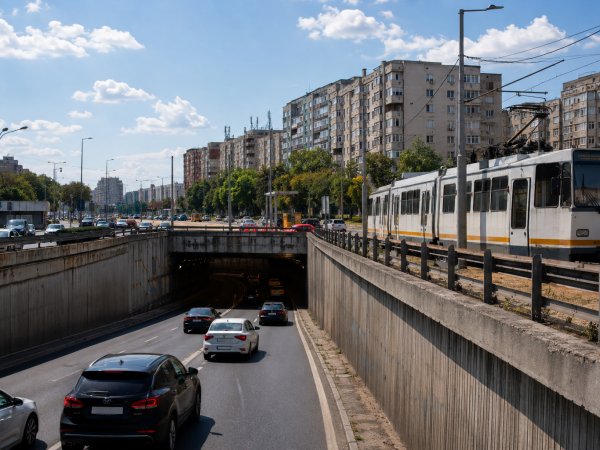
Lujerului Passage is one of the most important road junctions in the western part of the capital, used daily by thousands of drivers and passengers. It connects busy areas such as Militari, Drumul Taberei and Crângași, passes underneath Iuliu Maniu Boulevard and also serves tram line 41, one of the busiest public transport routes in Bucharest. Opened in 1987, the passage was designed as a solution to improve traffic flow in an area that was rapidly developing, but after almost four decades of heavy use, it now needs serious consolidation and rehabilitation works.
The contract for the works has been awarded, and the intervention is estimated to take 33 months, turning Lujerului Passage into one of the major construction sites of the coming period. The repairs are necessary because of structural degradation, water infiltration and problems that have appeared over time, while the works are expected to include infrastructure consolidation, road surface repairs, modernisation of lighting, traffic monitoring systems and signage. For western Bucharest, the construction site will be a major organisational test: alternative routes, protecting public transport and keeping drivers informed will matter almost as much as the rehabilitation itself.
Between utility, nostalgia and the real life of the city
Bucharest’s underground passages do not have the obvious charm of old houses, historic boulevards or large parks. They are rather silent pieces of infrastructure, places we use because we need them. Yet this very function makes them important. A city is not made only of beautiful places, but also of spaces that help it breathe.
For tourists, the passages may seem like technical details. For locals, they are part of the daily routine: the way to the metro, the crossing of a large intersection, the shortcut to the market, the link between tram and underground transport. In these short routes, one can actually see the real Bucharest, the city that is used, not just the city that is photographed.
READ ALSO:
The history of the Macca-Vilacrosse passage, a true time capsule in the center of Bucharest
There is also a certain nostalgia around the passages. Some preserve the feel of past decades, with old finishes, small shops, worn steps and signs that seem to belong to another time. Others have been modernised and try to look closer to the standards of a present-day European city. Between these two images lies today’s Bucharest: a city still repairing, improvising, updating and searching for solutions.
In the end, underground passages are a discreet map of the capital’s transformations. They speak about traffic, pedestrians, the metro, neighbourhoods and the way the city has tried to organise its congestion. They are not the most spectacular places in Bucharest, but without them, the capital would be much harder to cross.