The Globe on ASE Falls Only When a Virgin Graduates: The Legend of Piața Romană
- Articles
- 05 AUG 26
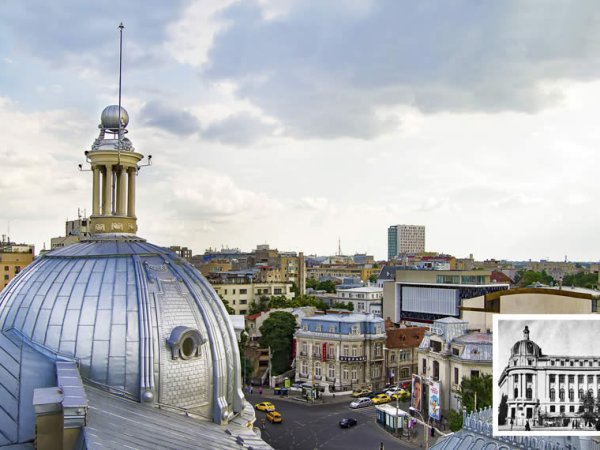
On the roof of the main building of the Bucharest University of Economic Studies, right above the entrance facing Piața Romană, a metal ball has sat atop a dome for nearly a century. Students who walk through the square every day, heading to the metro or to the terraces nearby, rarely look up. Those who do, and ask why it's there, almost always get the same answer: the ball will fall on the day a virgin student graduates.
It's the kind of legend that circulates around any city with old universities, but in Bucharest it has a twist. According to stories passed down among locals, the myth wasn't born on the ASE building at all, but on the University of Bucharest across town. The same thing was supposedly said about a ball on that building, and the story goes that its builders took it down just to put the myth to rest. The legend then migrated to ASE, where it took much deeper root, perhaps because the ball there actually exists and is clearly visible from the square.
No one has ever traced the exact origin of the story, and that's part of its charm. It circulates in slightly different versions from one student to another, with details that shift depending on who's telling it. What stays constant is the ball itself, the physical object the whole myth was built around.
A Building Raised for Commerce, Not Legends
The real story of the building is less colorful than the legend, but worth telling. The academy was founded on April 6, 1913, by royal decree, under the name Academy of High Commercial and Industrial Studies. The building in Piața Romană, the one with the ball, came much later, built between 1924 and 1926, in what was then called Piața Lascăr Catargiu. The plans were signed by architects Grigore Cerchez and Edmond van Saanen Algi.
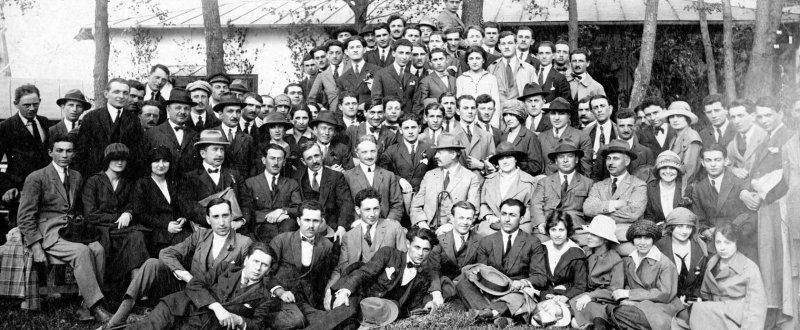
Photo: The class 1920. Copyrighted și Creator: www.cornelconstantin.ro
The complex grew in stages. Between 1932 and 1933, Cecilia Cuțescu-Storck painted the fresco "The History of Romanian Commerce" in the building's Aula Magna, still visible today to anyone who walks into the hall. In 1935, the library building went up next to the main structure, and in 1940 the commercial museum building was completed. What stands in Piața Romană today was essentially built over nearly two decades, piece by piece.
The communist period left its own mark on the name, one that still comes up in older Bucharest stories: the "V. I. Lenin" Institute of Economic Sciences and Planning. The 1948 education reform turned the former Academy of Commercial and Cooperative Sciences into this institute, modeled on Soviet higher education. Only starting in 1967-1968 did the institution return to a structure closer to its European roots and take the name it still carries, the Academy of Economic Studies.
The building also survived the 1977 earthquake, which destroyed a significant part of Piața Romană: the Palladio block, part of the Simu block, the building that once housed the Casata café. ASE held up, but lost a section of its dome, the very part the legendary ball now sits on.
The legend had one real moment of panic. In the summer of 2008, the ball was taken down during renovation work, and word spread fast among students. Romania's Ministry of Education stepped in through the press to clear up the mystery: the ball had only been removed temporarily to be cleaned and polished, not because the prophecy had come true. It went back up shortly after, to the relief of anyone still holding on to the myth.
What's Changed in Recent Years
Anyone who's walked through Piața Romană over the past decade has seen the area under near-constant construction. Casa Nanu-Muscel, the abandoned villa attached to ASE's main building, became university property in 2012 and sat empty for years, occupied at times by homeless people and pigeons, caught up in litigation between the academy and its construction contractor. The restoration is now complete, and the building houses the ASE Museum.
Behind it, a new seven-story structure went up, with a glass facade and copper inlays, designed by architect Remus Hârșan. The solution stirred controversy: representatives of the Pro Patrimonio foundation called it out of place for the square's circular layout, while the architect pointed to a project by David Chipperfield at the Des Moines Public Library as his inspiration.
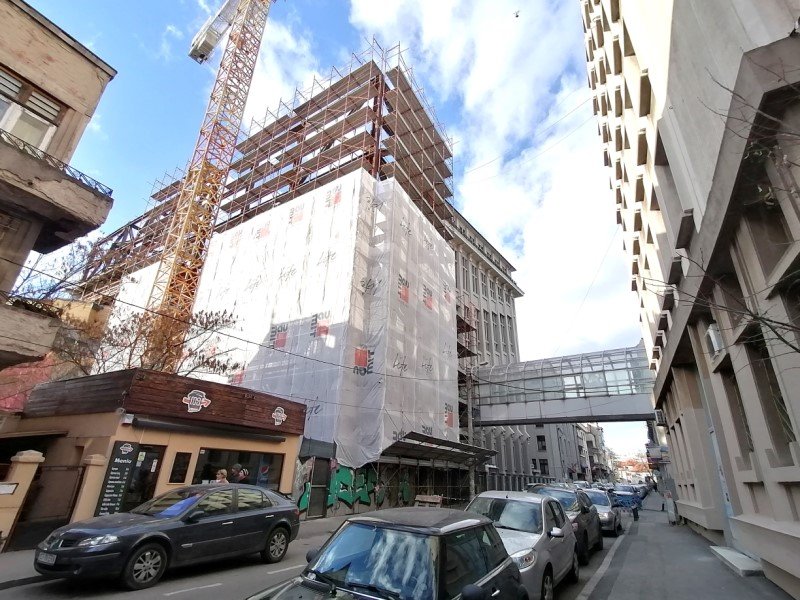
Photo: Cultura la dubă
The expansion has continued more recently. At the end of September 2025, ASE opened the "Mihai Eminescu" building on Bulevardul Dacia, following renovation, alongside the building at Piața Romană no. 7 and Casa Sabba Ștefănescu, both returned to the university community in previous years. The 2025-2026 academic year began with more than 10,100 new students enrolled across bachelor's, master's, and doctoral programs, in an academic community of over 25,000 members.
The ball, meanwhile, stays right where it is. No one has seen it budge.
Photo: Arhiva.ase.ro