Rose Island: the spot in Herăstrău Park where people have been proposing marriage for decades
- Articles
- 04 AUG 26
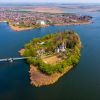
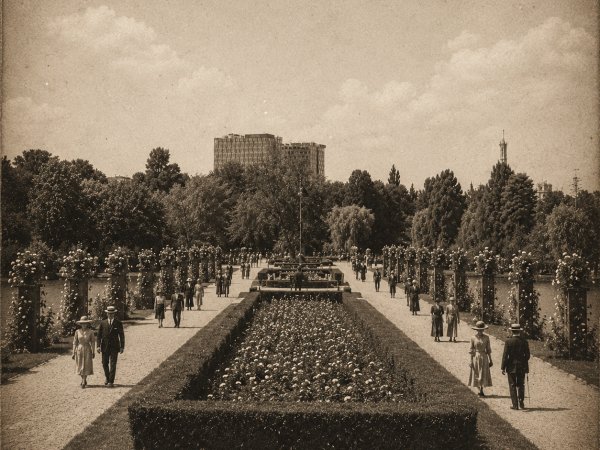
Some places don't need a plaque to tell their story. Rose Island, in Herăstrău Park, is one of them. You cross it in a hurry, on your way to the Village Museum or the boat dock, and it looks like just a nicer-kept stretch of park, roses climbing over trellises, water on both sides. In reality, this island carries almost a century of Bucharest's history — royal ambition, communist propaganda, a statue destroyed and rebuilt, a contested monument to the European Union.
The island grew alongside the park around it, in a rhythm that swung between careful upkeep and decades of neglect. It has witnessed royal promenades, ideological reconstructions and, more recently, countless marriage proposals. Its story begins in the interwar years and lands today in a public debate about how well — or how badly — it has aged.
From swamp to royal park
The island's history can't be separated from the park that holds it. The land north of Bucharest was, until 1930, a swamp. Drainage began that year, and the hydro-engineering works that formed Lake Herăstrău, along with Lake Băneasa and Lake Floreasca, ran from 1932 to 1937, under engineer Nicolae Caranfil. The park itself — its paths, its planting, the island's basic layout — was laid out between 1936 and 1939, under King Carol II, whose name the park carried until 1948.
In the same period, on the lake's shore, the Village Museum opened, inaugurated on May 10, 1936, with the king present. It's consistently described as one of the first open-air ethnographic museums in the world — the second, more precisely, after Skansen in Stockholm.
An island built for strolling, not for passing through
Rose Island sits close to the park's center of gravity. It's bordered by three bridges: two to the north, near the Herăstrău boat dock, and one to the south, near Elisabeta Palace, the official residence of the Romanian Royal Family. The two parallel promenade paths were laid out during the interwar amenajare and are still lined today with climbing roses trained over trellises, a visual contrast against the straight, vertical support posts.
The island's layout, paths included, dates from the interwar period and has survived intact. That makes it an exception: other parts of the park were reshaped repeatedly, first under the communist regime, then by the administrations that followed after 1990.
The communist years: a statue destroyed
Over the decades, the park saw a handful of major artistic interventions, and one of them has a rougher history than it first appears. In 1939, for the "Bucharest Month" festival, sculptor Constantin Baraschi raised the Caryatid Alley, at the park entrance facing today's Charles de Gaulle Square — a different location from Rose Island, though part of the same park.
The original monument didn't survive the communist regime. It was destroyed in the 1950s to make room for a statue of Stalin, erected in the same park, renamed at the time the I.V. Stalin Park. The alley stayed gone for decades, until, in the mid-2000s, sculptor Ionel Stoicescu rebuilt it, working from an original caryatid found in Bellu Cemetery.
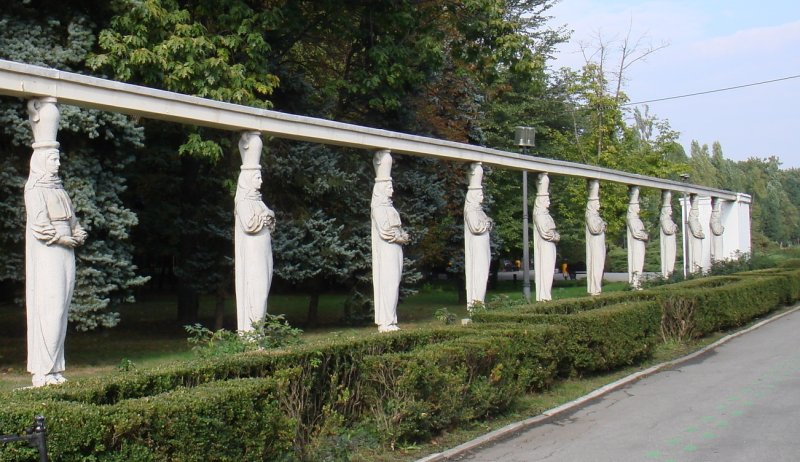
Credit Miehs at Romanian Wikipedia
The monument on the island, and the "wrong head"
That same Stoicescu is behind the piece actually standing on Rose Island: the Monument to the Founding Fathers of the European Union, twelve bronze busts arranged in a circle, representing the politicians credited with the European project. The concept belongs to architects Cătălin Cazacu and Paul Valentin, from Bucharest City Hall.
The monument was inaugurated on Europe Day, May 9, 2006, in a provisional version cast in plaster; the final bronze version, mounted on its plinths, wasn't finished until August 31 of that same year. Its story has an awkward footnote — one of the twelve identification plaques was engraved incorrectly for years, labeling Italian politician Altiero Spinelli as "Alterio," an error nobody at City Hall caught in time.
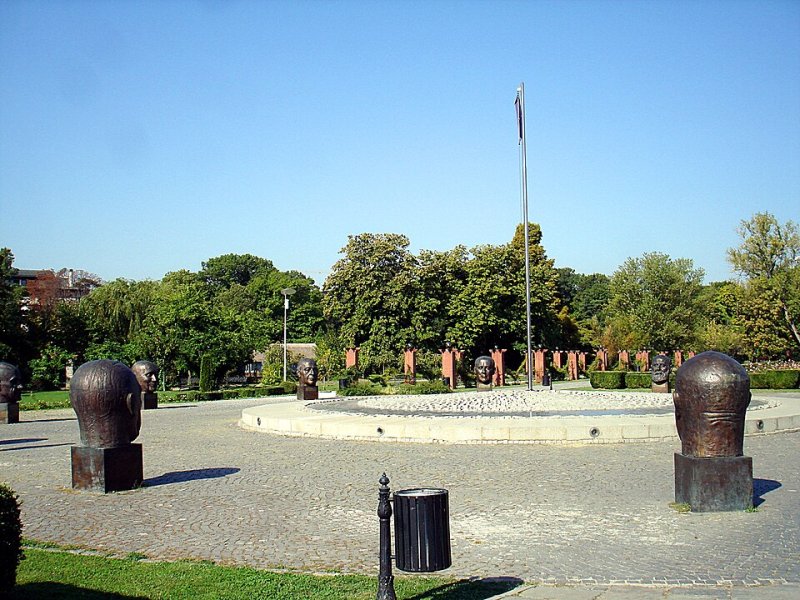
Photo: Miehs / Wikipedia
What stayed the same: the function, not necessarily the form
Beyond the monuments and the name changes, the island has kept the role it had in the interwar years — a place to walk, water on both sides, roses overhead, bridges that force a slower pace no matter how much of a hurry you're in. It remains one of the preferred spots in northern Bucharest for marriage proposals and wedding photography, alongside engagement shoots built around the season's flowers.
Details worth knowing
The island has two parallel promenade paths, laid out on two axes: one opens the view toward the Village Museum, the other connects back to the rest of the park. From the southern bridge, visitors can see directly the royal standard flown over Elisabeta Palace — a sign, under Royal House protocol, that the Family is in residence.
The park surrounding the island covers roughly 110 hectares, of which the lake takes up 74. The path circling the lake runs 5.92 kilometers.
Challenges and what's next
The island hasn't escaped wear. In April 2026, Bucharest's mayor, Ciprian Ciucu, publicly criticized the state of the paths on Rose Island — too much loose gravel, he said, which is why people avoid them — and called for a full, "meter by meter" assessment of the park, one that would redefine every function in it, from the boat dock to the street furniture.
For now, the island still looks much as it was designed to almost a century ago. What happens to it next depends on a review that's only just begun.
Also recommended 15 Interesting Things You Might Not Have Known About Herăstrău Park (King Michael I Park)