15 Interesting Things You Might Not Have Known About Herăstrău Park (King Michael I Park)
By Eddie Țone
- Articles
- 20 APR 26
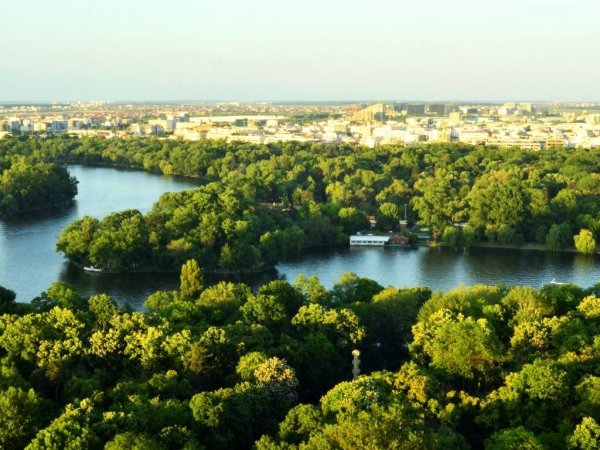
If Bucharest had a huge living room where it receives its distinguished guests, but where it also lets its children run barefoot through the grass, that would be Herăstrău. Or, for those who prefer administrative rigor, King Michael I Park.
Beyond the postcard image of boats and endless alleys, this place is the result of an engineering stubbornness of biblical proportions. Where we see fancy restaurants and running tracks today, our grandparents saw a dubious swamp, full of mosquitoes and less-than-cheerful urban legends. The transformation of this "no man's land" into a landscaped monument is, probably, the most successful urban magic trick in the history of the Capital.
Herăstrău is a warehouse of layered memories. Here, abdications that changed the course of the country were signed, statues of dictators were raised and torn down, and Japanese cherry trees were acclimated, completely ignoring the Dâmbovița dust. It is a space of contrasts, where you can see a sailboat gliding on the water while, in the background, you hear the metallic noise of the city that never stops. You step on alleys that have successively borne the names of Carol II, Stalin, and finally, that of the last monarch, in a succession of events that would make any history textbook seem like light vacation reading.
But let's look at 15 things you might not have known about Herăstrău Park:
1. In the beginning, it was a swamp. Nicolae Caranfil transformed it
Bucharest has always maintained a complicated relationship with water, oscillating between dusty droughts and floods that turned streets into small ad-hoc watercourses. In the north of the city, what we today officially call with pride King Michael I Park, and unofficially continue to call Herăstrău Park, represented, more than a century ago, a desolate expanse of stagnant puddles and reeds.
Locals viewed the area with a raised eyebrow, considering it a malaria focus and an obstacle to urban expansion. Everything changed in the 1930s, when the modernist spirit and royal ambition decided that those hectares of mud deserved a nobler fate. The project to drain the entire chain of lakes on the Colentina River constituted one of the largest civil engineering efforts of the time.
Under the rigorous guidance of engineer Nicolae Caranfil, the feat of transforming an unhealthy landscape into an oasis of vegetation was achieved. The works required impressive logistical efforts, thousands of labor hands, and a vision that exceeded the simple desire to plant a few trees. It happened between 1930-1935. The result is this vast space, which manages to breathe even when the rest of the city suffocates under asphalt and traffic.
2. The name of the park and its political metamorphoses
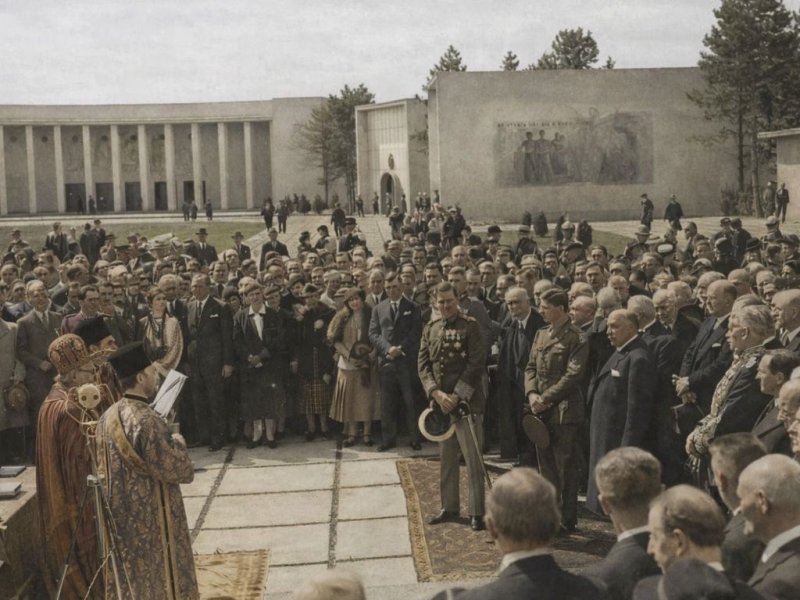
Photo from May 9, 1936, during the opening of the "Bucharest Month" exhibition—a day that coincided with the inauguration of Carol II Park. / Image restored and colorized using artificial intelligence, while keeping all original details intact.
If the park were a literary character, it would probably suffer from a rather severe identity crisis. The original name of Herăstrău comes from a rudimentary sawmill (gater), a water-powered saw (fierăstrău), which operated in the 17th century on the banks of the Colentina to cut the logs needed for constructions in the town of Bucharest. Over the decades, the official name was changed according to the political wind.
At the inauguration on May 9, 1936, it bore the name of King Carol II, the one who patronized the great "Bucharest Month" exhibition. With the arrival of the communist regime, the space received the name of I.V. Stalin Park, a historical irony considering that the Soviet dictator probably wouldn't even have appreciated the bourgeois aesthetics of the place. Only after Stalin's death and the ideological relaxation of 1956 did it return to the popular name of Herăstrău.
Since 2017, the park bears the name of King Michael I, a late recognition of the deep connection between the monarchy and this green perimeter. Every change of the sign at the entrance marked a new era, leaving behind layers of history that today's passers-by ignore while checking their phone notifications.
3. The Village Museum and the country neighbors moved to the city
Right at the edge of the lake is one of the most spectacular ideas of sociologist Dimitrie Gusti. The National Village Museum was conceived as a living laboratory, where houses brought from all corners of the country had to preserve the authentic Romanian spirit. In the first years after the opening (which took place on May 10, 1936, in the presence of King Carol II), these dwellings were populated by authentic peasants, specially brought to live there, take care of the households, and offer visitors the image of a rural Romania immortalized in the middle of the Capital.
These involuntary "actors" lived their lives under the curious eyes of the city dwellers, cooking polenta and tending to animals in a setting that today seems taken from a postmodern art installation. The experiment was considered a huge success, managing to preserve folk architecture that otherwise would have disappeared under the steamroller of forced modernization. Today, the museum remains an island of peace where the only noise disturbing the quiet is that of planes taking off from the nearby airport.
4. A record of dimensions hard to match
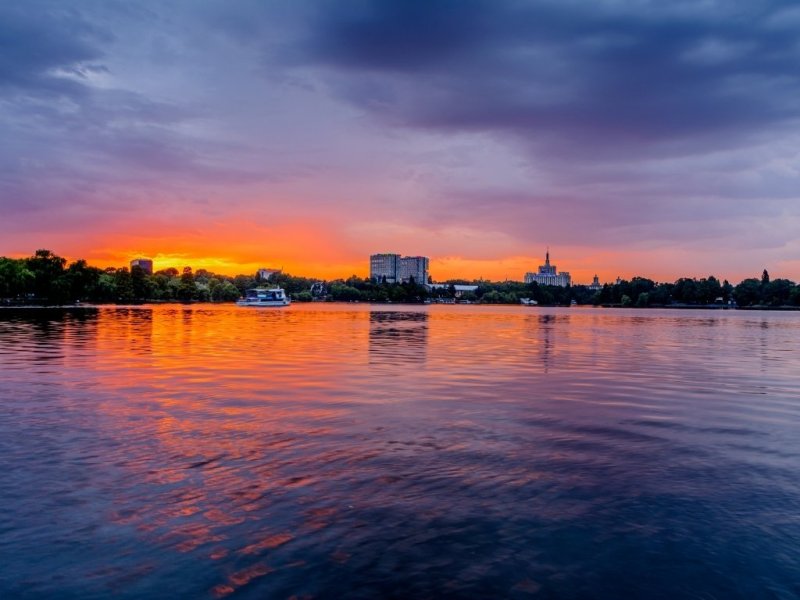
Official measurements place Herăstrău Park at an area of approximately 187 hectares, which propels it directly to the top of the hierarchy of urban parks in this part of Europe. It is difficult to cover the entire perimeter in a single walk without feeling a slight muscle soreness the next day. The lake occupies a considerable portion, namely 74 hectares, being the centerpiece of this ensemble. The landscape architects who worked on its design understood the importance of perspective, creating long alleys that seem to get lost in the horizon, offering the illusion of an endless forest right in the heart of an increasingly crowded city. Its imposing size allows for the existence of areas with completely different functionalities, from spaces dedicated to sports and concerts to botanical refuges where nature seems to have taken total control.
5. The Japanese Garden and the diplomacy of blooming cherry trees
Somewhere toward the north of the park, visitors can discover a piece of Japanese aesthetics that seems teleported directly from Kyoto. The Japanese Garden was arranged in 1998 under the auspices of the Embassy of Japan, being the result of close collaboration between landscape specialists from the two countries. The decorative elements, from stone lanterns to curved bridges, respect the strict canons of Zen. The highlight of this place is the period when the cherry trees bloom, transforming everything into a pink cloud that attracts thousands of photography enthusiasts. A superb place, where silence is almost mandatory, offering a welcome contrast to the bustle of the terraces on the other side of the lake.
6. Elisabeta Palace and the blue-blooded neighbors
Few of those who run on the park's alleys realize that they are neighbors with the Royal Family. Elisabeta Palace, strategically located near the Village Museum and designed by architect Corneliu M. Marcu, is a building that combines Moorish style with Brâncovenesc style, offering a distinct silhouette above the high fences. Built in 1936 for Princess Elisabeta, former Queen of Greece, the palace became the witness to one of the saddest moments in modern Romanian history. In the upstairs salon, King Michael I was forced to sign the act of abdication in December 1947, while the palace was surrounded by intervention troops. Today, the edifice serves as the official residence for Her Majesty Margareta, Custodian of the Crown, and represents a landmark for state protocol, while remaining a discreet presence in the daily landscape of the park.
7. The engineering behind the water's surface
Herăstrău Lake is a testament to human ingenuity in managing natural resources. Beyond its recreational utility, it fulfills a crucial role in protecting the city against floods. The system of locks and spillways allows for precise regulation of the water level, communicating with the other lakes downstream and upstream. The depth varies quite a bit, reaching approximately 5 meters in certain portions, although the average remains around 2 meters. The bottom of the lake has been cleaned several times over the decades, the operations bringing to light the most bizarre objects, from old tires to relics of the interwar period, confirming the fact that Bucharest residents have always considered the water a good place to hide their little secrets or waste.
8. Yachting in the noise of trams
A recurring image on the lake is that of small sailing boats gliding elegantly on the water. The tradition of yachting in Herăstrău has deep roots, from the interwar period, with sports clubs training generations of sailors right here, between the blocks in Aviației and the villas in Primăverii. Yachting is a sport that requires increased attention because the wind on an urban lake is capricious, being influenced by the tall buildings around that create unexpected currents. Seeing an "optimist" or a "laser" tilting under the pressure of the breeze gives the park an air of a Riviera resort, even if the breeze sometimes carries the smell of exhaust from Nordului Road.
9. Rose Island and the landscape vision
This small tongue of land connected to the rest of the park by elegant bridges represents a horticulturist's paradise. Rose Island hosts an impressive variety of species, some being selected to withstand Bucharest's capricious climate. The landscape architecture here was designed to offer a continuous visual spectacle, from early spring until late autumn. The statues decorating the island's main alley add a note of sobriety, transforming a simple walk into a discreet lesson in the history of monumental art in a place where many young people have chosen to utter vows of fidelity, encouraged by the fragrance of the flowers and the photogenic setting.
10. The Caryatids that survived ideology
At the entrance from Charles de Gaulle Square, visitors are greeted by an ensemble of columns supported by sculpted female figures, carrying jugs on their heads, representing peasant women from Muscel and Mehedinți, joined by an architrave. These caryatids, the work of artist Constantin Baraschi, have a turbulent history. The original version was installed in 1939, but the communist regime decided to remove them, considering them decadent decorative elements. After the year 2000, the authorities decided to restore this emblematic monument based on archive plans and photographs. Their reintegration into the landscape restored the former elegance to the park entrance, demonstrating that certain aesthetic values manage to return to their place even after decades of forced absence.
11. The Summer Theater and the nostalgia of revue shows
Inaugurated in the 50s, the Herăstrău Summer Theater was the meeting point for culture lovers under the open sky. Its architecture specific to socialist realism was softened by the luxuriant vegetation surrounding it. Great names of the Romanian stage climbed onto the stage of this theater, from Constantin Tănase to light music soloists who filled the bleachers to capacity. Today, the Herăstrău Summer Garden, freshly rehabilitated, continues to host various shows in the summer months.
12. Herăstrău has dozens of statues
The park functions as an open-air pantheon, hosting dozens of busts of writers, composers, and politicians who marked world history. This concentration of bronze and stone transforms an outing into the fresh air into a review of universal culture. You can pass by the bust of Victor Hugo, greet the statue of Shakespeare, or stop in front of the monument dedicated to Charles de Gaulle. Brâncuși, Hristo Botev, Theodor Aman, Caragiale, Chopin, Eminescu, Bălcescu are just a few other "big" names we find in the park in the form of statues. To them are added other statues representing Romanian myths, animals, or other symbols. This diversity reflects Bucharest's openness to European values, transforming the park's alleys into a visual history manual available to anyone with the patience to read the explanatory plaques.
13. Expoflora and the passion for botany
Every year, the Expoflora pavilion becomes the center of attention for those passionate about gardening and rare flowers. This section of the park is dedicated to temporary floral exhibitions, but also to permanent collections of ornamental plants. Landscape engineers work for months to create geometric patterns from flowers, which from above look like huge oriental carpets, in a proof of the fact that the park is a complex organism that requires meticulous care and long-term planning to maintain its charm.
14. The unexpected fauna in the heart of the metropolis
Herăstrău shelters a small wild world that has learned to coexist with people. The squirrels are already famous for the boldness with which they ask for nuts from passers-by, becoming social media stars. The lake is populated by colonies of wild ducks, and sometimes you can observe seagulls fighting for leftovers left by tourists. There are also less-frequented areas where hares still make an appearance, to the amazement of those who do not expect to find wildlife so close to the office buildings in Pipera. This biodiversity is an indicator of the health of the ecosystem created with such effort nearly a century ago.
15. Rare flora and trees with a story
Among the hundreds of common lindens and maples, Herăstrău also hides rare botanical specimens. One of the most interesting is the Ginkgo Biloba tree, considered a living fossil, whose fan-shaped leaves turn yellow during autumn. There are also oak specimens that have survived from the period when the park was just a forest on the edge of the city. The park administration carefully monitors these "elders" of the place, because the loss of a single secular tree would mean the disappearance of a piece of Bucharest's living history.
King Michael I Park remains a space of contrasts, where royal history meets communist heritage and where nature tries to keep pace with galloping modernization. Regardless of whether you visit it for a jogging session, for a boat ride, or for a portion of history at the Village Museum, this place always offers something new to those who know how to look beyond the asphalt of the alleys. It is, without a doubt, the most precious common asset of the Capital's residents, a place that has learned to adapt to each generation without losing its discreet elegance.
You may also like: The Bucharest neighborhood boasting the largest and most stunning parks