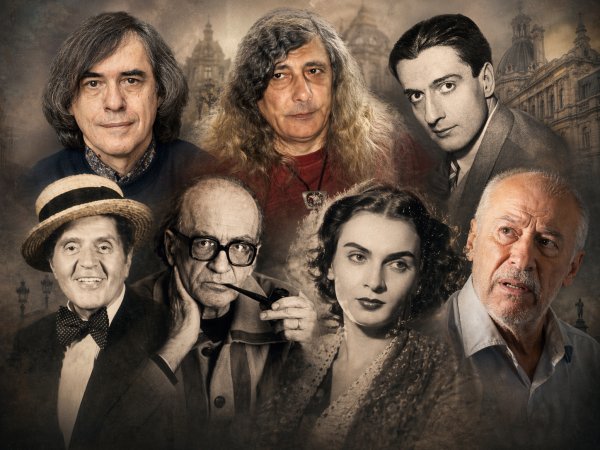
11 Born-and-Bred Bucharesters Who Shaped the Capital as We Know It Today
By Eddie Țone
- Articles
- 23 APR 26
Bucharest makes you feel, simultaneously, like you are in an open-air museum and on a perpetual construction site. Walking down Calea Victoriei, you get the sense that every peeling building has its own story, likely one involving spies, failed poets, or exiled princesses. Then, at the street corner, a long honk brings you back to the vibrant present, with strategically abandoned electric scooters and the scent of expensive coffee. This city is a palimpsest, a manuscript that has been written, erased, and rewritten countless times. But who, exactly, has held the pen?
Among the millions of souls who have treaded its alleys and boulevards, there is a special category of inhabitants. They are the natural-born Bucharesters—those born here who have breathed the city's air, dusty and filled with linden pollen, since the very first day of their existence. They understood the city's hidden rhythm; they knew both its bad habits and its irresistible charm.
Some of them achieved the feat of leaving behind something more than just a memory. They left buildings, songs, ideas, and entire boulevards. They are the ones who gave the city a backbone, a soul, and, in some places, a monumental headache. Here are just ten such characters, born and raised in this local Babylon, whose imprint we still feel today, even when we are complaining about the traffic. The order is random.
Horia Creangă: The Architect Who Dressed the City in Modernism
When you hear the name Creangă, your mind automatically goes to Humulești and the pranks of Nică. Well, the grandson of the great storyteller, Horia, was a character of an entirely different sort—a pure-blooded Bucharester who, instead of stealing cherries, designed some of the Capital's most iconic modernist buildings. Born in 1892, Horia Creangă had the vision to pull Bucharest out of its neoclassical and Neo-Romanian patterns and hurl it directly into the 20th century.
Stroll down Magheru Boulevard and look up. The ARO building (today, Patria) is his work. A massive block of concrete, elegant and functional, which in its time—the 1930s—seemed plucked from an American sci-fi film. Creangă understood that a modern city needs fluid spaces, light, and an aesthetic of simplicity. He is responsible for the Commodity Exchange building (today, the Central Library of ASE), the Obor Halls, the Malaxa Plants, and the apartment block at the intersection of Vasile Lascăr and Maria Rosetti streets.
His style, a tempered cubism with an almost Mediterranean elegance, gave interwar Bucharest a new face. It is an irony of fate that this man, who built for the future, was arrested by the communist regime and died under suspicious circumstances shortly after his release. Yet, his legacy still stands, a silent testimony to a Bucharest that dared to dream of skyscrapers.
Pache Protopopescu: The Mayor Who Drew the Boulevards (and Dueled for Honor)
Before Pache Protopopescu, Bucharest was largely an overgrown market town with muddy streets and a river, the Dâmbovița, which smelled of provincial melancholy on its good days. Emanoil Protopopescu-Pake, born in 1845, was the mayor who took a ruler and began drawing straight lines on the city map. Between 1888 and 1891, his mandate was a sprint of urban modernization.
He is the man to whom we owe the city's East-West axis—the boulevards connecting Rosetti Square to Gara de Nord, passing through University and Cișmigiu (today Carol I, Regina Elisabeta, etc.). He introduced horse-drawn trams, began sewage works, and built the first buildings for state primary schools—those sober and solid constructions we still pass by today.
Pache was a character. A staunch conservative, he was so fierce in defending his ideas that he challenged a political opponent, the liberal Georges Bibesco, to a duel at the Băneasa racetrack. Both fired, both missed, and honor was saved. Today, Pache Protopopescu Boulevard bears his name, a reminder that sometimes, to bring order to a chaotic city, you need a man with vision, an iron fist, and perhaps a dueling pistol at his belt.
Maria Tănase: The Voice That Gave Utterance to the Slum and the Salon
If Bucharest had a voice, it would undoubtedly sound like Maria Tănase's. Born in 1913 in the Cărămidari slum (mahalaua Cărămidarilor), somewhere behind today’s Tineretului Park, Maria absorbed the city’s musical essence from a young age. It was a mix of heartbreaking rural doine brought by servants and coachmen coming to the city, and languid tangos heard on gramophones in aristocratic homes.
Maria Tănase was a phenomenon. She took folk songs and passed them through an urban, intellectual, and charming filter. When she sang "Mărioară de la Gorj" in a luxury restaurant on Calea Victoriei, the audience of diplomats, industrialists, and poets felt a visceral connection to a Romanian DNA they might have forgotten.
She was loved by Brâncuși, admired by Iorga, and banned for a time by the Legionnaires for her social circle, which was considered decadent. Her funeral in 1963 paralyzed the city. Hundreds of thousands of Bucharesters took to the streets to see off the "Magic Bird" (Pasărea Măiastră). She remains living proof that you can be born in a slum and conquer the world without ever losing your accent or the soul of the place you came from.
Henri Coandă: The Inventor Who Gave His Name to the Airport
Any Bucharester who has ever flown on a plane has heard the name Coandă. Henri Coandă, born in 1886 in a house on Calea Griviței, was a visionary, a genius of fluid mechanics, and a character whose life beats any movie. Although his most famous invention, the jet plane (presented in 1910 in Paris), met an unfortunate fate on its first and only flight (it caught fire), the principle discovered then—the "Coandă effect"—is the basis for many modern technologies.
Coandă was a universal Bucharester. He studied in Berlin, Liège, and Paris, worked in England and France, and invented everything from prefabricated houses to seawater desalination systems. A delightful anecdote says that in his youth, he was so passionate about wind force that he mounted a small propeller on a kite and accidentally cut the telegraph cables of the Royal Palace.
He returned to Romania in the later years of his life, persuaded by Ceaușescu, and led the Institute for Scientific and Technical Creation. Today, the country's main airport bears his name—a fitting tribute to the man who wanted to teach us all how to fly.
Mircea Eliade: The Scholar Who Found the Sacred on Mântuleasa Street
For many, Mircea Eliade is a name on a high school textbook cover, a titan of the history of religions, and a complex novelist. For Bucharest, he is the boy who grew up near Mântuleasa Street and transformed this mundane quarter into a mythical territory. Born in 1907, the young Eliade was a precocious teenager and a devourer of books, spending his days in his attic writing thousands of pages.
His fantastic literature is deeply anchored in the topography of Bucharest. Streets like Mântuleasa or Popa Soare become, in his novels, gates to other worlds—places where time dilates and reality bends.
Eliade had the unique ability to look at a dusty street corner with old houses and chestnut trees and see in it a center of the universe—a place where the sacred could unleash at any moment. Even after he became a global academic celebrity in Chicago, a part of his soul always remained there, in the labyrinth of streets behind Pache Protopopescu Boulevard, searching for hidden meanings in everyday banality.
Victor Rebengiuc: The "Conscience" Actor of a Changing City
Victor Rebengiuc is a living monument of Bucharest. Born in 1933 right behind Amzei Market, his biography overlaps perfectly with the recent, often turbulent history of the city. He is a constant presence in the emotional memory of the Capital, from his legendary roles at the Bulandra Theatre to his unmistakable voice echoing in films and on the radio.
Rebengiuc has that rare quality of great actors to embody the spirit of the place. Whether he was playing Tipătescu, the prefect caught in small provincial dramas, or Ilie Moromete, the philosopher peasant watching the world change with perplexity, he always brought a Bucharest authenticity, a sharp intelligence, and a dry, observational humor.
His moment on December 21, 1989, when he appeared on television with a roll of toilet paper in his hand—asking those who had supported the regime to disappear—became a symbol of revolt and hope. Victor Rebengiuc long ago became a conscience of the city, a moral landmark in a town that has often sought its compass.
Dinu Lipatti: The Piano Genius Born Under Enescu’s Star
Bucharest is often noisy and agitated, but Dinu Lipatti’s music sounds like a whispered prayer. Born in 1917 into a family of musicians (with George Enescu as his godfather), Lipatti was a child prodigy who evolved into one of the greatest pianists of the 20th century. His technical perfection was coupled with an almost painful sensitivity, a capacity to find pure poetry in the scores of Bach, Mozart, or Chopin.
The Lipatti House on Lascăr Catargiu Boulevard is today a place of pilgrimage for music lovers, a space where one can still feel the echo of his presence. His life, tragically cut short at only 33, resembles a perfect but unfinished musical composition.
He left his beloved Bucharest to conquer the world's stages, but he always carried with him a certain Romanian melancholy. Listening to him play, you feel as though you are hearing, distilled into piano notes, the very essence of an interwar Bucharest: cultured, refined, and aware of its own fragility.
Gică Petrescu: The Gentleman-Lăutar, the Soundtrack of Bucharest Parties
If Maria Tănase was the city’s deep soul, Gică Petrescu was its charming smile. Born in 1915 near Buzești Market, Gică was, for over seven decades, the unofficial master of ceremonies for any self-respecting Bucharest party. With his inevitable carnation in his lapel and a glass of wine nearby, he sang about the stylish girls on Calea Victoriei, carriage rides on the "Șosea," and the small joys of a life lived with gusto.
Gică Petrescu managed to cross all political regimes, from monarchy to communism and democracy, remaining equally popular and beloved. His music—a mix of romance, swing, and urban folklore—is the soundtrack of optimism.
It is the music you listen to when you've fallen in love, when you've passed an important exam, or when you simply want to believe that life is beautiful. An unforgettable image of old Bucharest is that of Gică Petrescu riding his bicycle through the streets, tipping his hat elegantly to the left and right. He is the embodiment of a certain Bucharest spirit: the one that knows how to find a reason to celebrate even on the dullest of days.
George Călinescu: The Literary Titan, a Volcano in the Capital’s Landscape
George Călinescu was a force of nature. Born in 1899 in Bucharest, Călinescu was an overwhelming figure—a one-man orchestra of Romanian culture: literary critic and historian, novelist, poet, and playwright. He was a volcano of erudition and polemic, a man who could write a monumental masterpiece like "The History of Romanian Literature from Its Origins to the Present" while simultaneously arguing with neighbors over domestic issues.
Călinescu was Bucharest itself, with its brilliance and contradictions. His novel, Enigma Otiliei, is a fresco of Bucharest society at the beginning of the 20th century, featuring misers, social climbers, idealists, and mysterious girls.
His presence at the Faculty of Letters was a spectacle. His lectures were events, and his acidic retorts became legendary. He lived for a time in a chic house in the Primăverii neighborhood, now a museum, but his spirit seems to still float over the entire cultural landscape. Călinescu was proof that to leave a deep mark on a city, you need a massive amount of talent, but also a personality to match.
Mircea Cărtărescu: The Hallucinatory Cartographer of Bucharest's Anatomy
While many of his illustrious predecessors sang of the charm of interwar Bucharest, with its strolls on the "Șosea" and romances on Calea Victoriei, Mircea Cărtărescu did something radically different. Born in 1956 and raised in the height of the socialist systematization era, he turned his writer's magnifying glass toward the Bucharest of apartment blocks, peripheries, construction sites, and undefined spaces. He descended from the bohemian salons directly into the underground, into the secret biology of a city transforming before his eyes.
Cărtărescu was the first to give a grandiose literary dignity to the "dormitory-neighborhood," transforming the grey reality of Ștefan cel Mare or Colentina into raw material for a personal mythology of dizzying complexity. For Cărtărescu, Bucharest is a character in itself—perhaps even the main character. In his monumental trilogy Orbitor (Blinding), the city is a body. A gigantic body with organs, veins, and a complex nervous system. Statues are nerve endings, the Dâmbovița is a muddy aorta, the sewage and subway networks are an underground circulatory system, and the buildings are cells in a tissue undergoing continuous metamorphosis. He maps the city with the precision of an anatomist and the fantasy of a visionary under the influence of a potent narcotic.
Reading Cărtărescu means looking at Bucharest through a filter that dissolves concrete and reveals hidden layers of dream, memory, and hallucination. He is proof that to find the universal, you sometimes have to dig deep into the most specific and personal place—even if that is just a studio apartment in a block on Aleea Circului. Through his work, constantly nominated for the Nobel Prize, Cărtărescu has definitively placed this post-industrial Bucharest, with its insects, melancholies, and monstrous splendor, on the world's literary map.
Florian Pittiș: The Prophet in Jeans of Free Bucharest
In a Bucharest where the uniform—whether school or ideological—was the rule of the game, the appearance of Florian Pittiș was a breath of fresh, almost exotic air. With his rebel mane, stone-washed jeans, and round glasses that gave him the air of an intellectual fresh from Woodstock, he embodied the dream of freedom for an entire generation.
Born in 1943, Pittiș—or "Moțu," as his friends called him—was a sort of smuggler of the free spirit, an unofficial ambassador of a Western culture that the regime strove with all its might to keep at a distance.
Beyond being an actor or singer, Moțu was a translator in the deepest sense of the word. He took the lyrics of Bob Dylan, Leonard Cohen, or other poet-musicians of the West and transposed them into a Romanian language that kept the strength of the original message intact, making it relevant for the youth living among the apartment blocks of Drumul Taberei or Balta Albă. On the stage of the Bulandra Theatre, he was an actor of sparkling intelligence, part of that "golden generation," and on the concert stage, guitar in hand alongside Pasărea Colibri, he became the bard offering hope and solace through music.
Perhaps his most lasting imprint was left at the radio microphone. After 1989, his shows, especially on Radio 3net, became institutions. His warm and unmistakable voice, delivered with studied relaxation, was the guide for thousands of Bucharesters through a refined sound universe, from progressive rock to top-quality folk.
His shows were oases of good taste, a subtle declaration that one could live differently, with good music and unconstrained thoughts. Pittiș was a state of mind for Bucharest. He was the voice saying, with a mischievous smile and relaxed erudition, that freedom begins in each person's mind. He was living proof that you can wear long hair and nonconformist ideas even in the greyest urban landscape, bringing a splash of color and a promise of normalcy.
Each of these eleven characters added a layer of "paint," a musical note, or a line of concrete to the great manuscript of Bucharest. Walking through the city today, you can feel their presence. In an Art Deco building, in a refrain you hum without knowing why, in the name of a subway station, or simply in the air of a city that, thanks to them, is a little more complex, more interesting, and fuller of stories.
You may also like: Where Bucharest residents go when they need quiet: 7 places in the city where you forget you’re in the Capital