Zottu House, a building with stories from two wars, from a time when honor mattered more than life
By Raluca Ogaru
- Articles
- 18 AUG 26
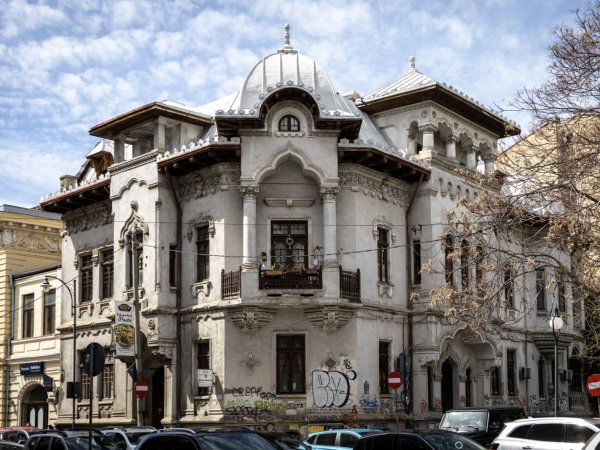
Just a few minutes’ walk from the Romanian Athenaeum, at the intersection of C. A. Rosetti Street and Nicolae Golescu Street, stands one of the most representative Neo-Romanian residences in central Bucharest. Located at No. 7, Zottu House was built in 1909 for General Vasile Zottu, an important yet controversial figure in the Romanian Army during the First World War.
The building is included in Romania’s List of Historical Monuments under code B-II-m-B-18827. Beyond its architecture, the house is associated with a dramatic episode: on November 12, 1916, General Vasile Zottu took his own life here. The reasons behind his decision were never clarified, while the accusations of treason circulated at the time were never proven.
A residence built in 1909 for General Vasile Zottu
The house was erected on a plot of land that had belonged to the Rosetti family during the 19th century and later passed through the ownership of several generations of the Mitilineu family. At least one earlier building had stood on the site before General Zottu commissioned the new residence.
Research conducted by art historian Oana Marinache and published by the Art History Association shows that the 1909 design was signed by August Reisz, an architect who worked for the Ministry of War. The contractor responsible for the original construction was architect Carol Ingor.
This distinction matters because other articles identify Italian contractor Josef Piantini as the builder of the entire house. Archival documents indicate, however, that Piantini became involved only in 1913, when the property was extended towards Nicolae Golescu Street.
By that time, Vasile Zottu already had a long military career behind him. According to a profile published by the National Military Club, he had served as an engineering officer in the Romanian War of Independence of 1877–1878 and was promoted to divisional general in 1911. He commanded the Second Army Corps and held several senior positions in the military leadership.
Oriental Neo-Romanian architecture and military symbols on the façade
Zottu House belongs to the Oriental-influenced branch of the Neo-Romanian architectural style, which spread across Bucharest at the beginning of the 20th century. Its composition is enhanced by its position on a street corner, allowing the building to open towards both streets.
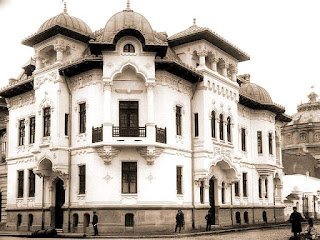 The building’s façade has remained almost unchanged to this day. (Photo source: Art History Association)
The façades are animated by bay windows, small domes, ogee arches, vegetal ornaments and decorative bands featuring a twisted-rope motif. These elements draw on traditional architectural forms and Oriental influences, reinterpreted for an urban setting. In the absence of a documented explanation from the architect, the rope motif cannot be said with certainty to represent concepts such as “infinity” or “the cosmos.”
Military-themed decorative elements can also be seen on the façade. They serve more than an ornamental purpose, pointing to the profession and status of the original owner. Oana Marinache notes that August Reisz’s design was influenced by the Neo-Romanian style promoted by architect Ion N. Socolescu, also visible in other Bucharest residences from the same period.
The interior has undergone several alterations, but the house has retained some of its period features. The current real-estate listing for two of its apartments mentions, for example, original Meissen porcelain stoves. This information comes from the property’s commercial presentation, rather than from an official inventory of its artistic components.
The general’s death and the accusations that were never proven
In August 1916, when Romania entered the First World War, Vasile Zottu was officially appointed head of the Great General Headquarters. Historical sources indicate, however, that a significant part of the operational responsibilities was carried out by General Dumitru Iliescu.
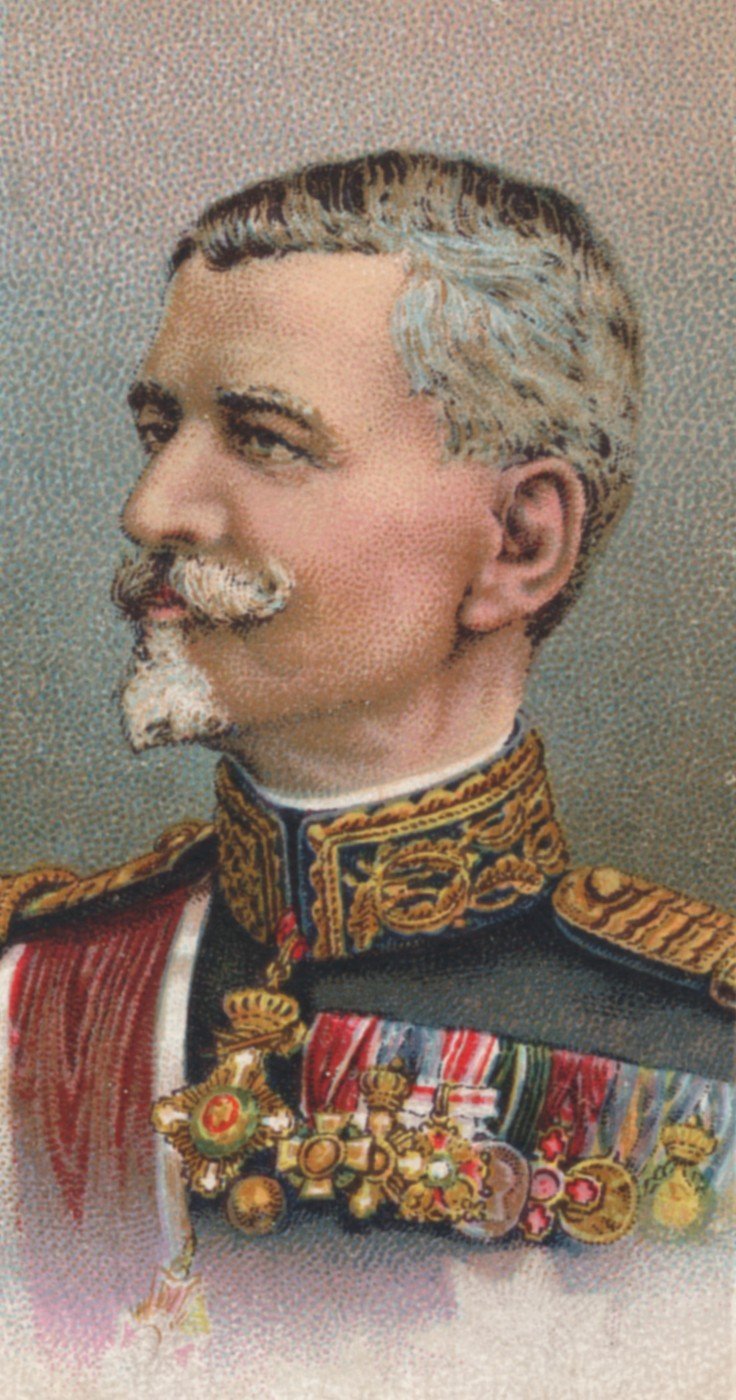 Basil Zottu (1853-1916), Romanian politician and general, 1917. Artist: Unknown
Basil Zottu (1853-1916), Romanian politician and general, 1917. From Will's Cigarettes 'Allied Army Leaders' cigarette card series, 1917.
Photo source: Profimedia
Basil Zottu (1853-1916), Romanian politician and general, 1917. Artist: Unknown
Basil Zottu (1853-1916), Romanian politician and general, 1917. From Will's Cigarettes 'Allied Army Leaders' cigarette card series, 1917.
Photo source: Profimedia
The first months of the military campaign were marked by serious defeats, including the disaster at Turtucaia. Against this background, suspicions and accusations began to surround several military officers and politicians. Zottu’s name was reportedly associated with the so-called “Günther list,” which was linked to people suspected of collaborating with the Central Powers.
On November 12, 1916, the general took his own life at his residence on C. A. Rosetti Street. He left no note explaining his decision. Several possible explanations have been proposed, including his poor health, depression, the impact of the military failures or fear that the suspicions raised against him might become public.
None of these explanations has ever been conclusively proven. Most importantly, there is no conclusive evidence that Vasile Zottu was a spy or had committed treason. The claim that the general took his own life “for the sake of honor” or following proven treason must therefore be treated as an interpretation, not as an established historical fact.
The house extensions and the apartment building that was never constructed
In 1913, the residence was extended towards Nicolae Golescu Street. The work overseen by Italian contractor Josef Piantini included a garage and an apartment for the chauffeur. Such facilities reflected the property’s high level of comfort at a time when the automobile was still a rarity in Bucharest.
Further alterations were carried out in 1923 and 1924 on the buildings facing Nicolae Golescu Street. Architect Jean Grefu is credited with designing a new staircase, added in 1924. Sources also record that diplomat and politician Trandafir Djuvara lived here temporarily in the autumn of 1920.
In 1939, Ana Zottu commissioned architect Sady Herivan to draw up a radical project: replacing the house with a seven-storey apartment building with an attic level. The project was never completed due to the outbreak of the Second World War. The house consequently survived a period when numerous residences in central Bucharest were demolished to make way for modern apartment blocks.
What is happening at Zottu House today
The building currently has mixed uses. The address at No. 7 C. A. Rosetti Street appears in the records of Romania’s National Union of Notaries Public as the registered office of a notarial practice.
At the time this article was researched, the Regatta real-estate agency had an active listing for two apartments in the villa, with a declared total area of 180 square metres. The asking price for the two units was €790,000. Because this is a commercial listing, both the availability and the price may change.
Zottu House’s status as a historical monument can be verified in the List of Historical Monuments published by the Bucharest Directorate for Culture. The property is classified as a Category B historical monument of local importance.
READ ALSO:
8 Lost Inns of Bucharest and the Buildings That Replaced Them
What abandoned buildings say about Bucharest – a history of ruin and resistance
Zottu House remains valuable both for its architecture and for the documents and events associated with it. It bears witness to the residences of Bucharest’s military elite at the beginning of the 20th century, the transformation of the city centre and an episode from the history of the First World War whose circumstances have yet to be fully clarified.