Bucharest in 2050, Through the Eyes of AI: Five Spectacular Scenarios for the Capital’s Future
By Eddie Țone
- Articles
- 17 NOV 26
What will Bucharest look like 24 years from now? Will the Dâmbovița River have promenades lined with cafés and cycle paths? Will silent trams glide along tree-shaded boulevards? Will the city's interwar buildings survive earthquakes and real estate development? Or will we reach a point where 35°C feels like a pleasantly mild temperature, just right for a quick walk to the shops?
The Bucharest of 2050 is already taking shape, even if the construction site sometimes seems to have gone on an indefinitely extended coffee break. The urban planning decisions made today will influence how the capital's residents travel, breathe and spend their summers two decades from now.
Artificial intelligence offers an interesting way of looking ahead. Drawing on climate research, public investment projects and current urban development trends, five visual scenarios explore how familiar parts of Bucharest might change.
Each image is an artistic interpretation of 2050, built around developments documented in 2026. Some present optimistic possibilities, while others explore what might happen if existing problems are allowed to accumulate.
And the result reveals something about the complicated relationship between Bucharest residents and their city. A relationship in which hope is always the last thing to die, usually somewhere between two traffic lights on Ștefan cel Mare Boulevard.
1. The Dâmbovița River in 2050: From a Concrete Channel to a Lively Urban Promenade
 AI generated image
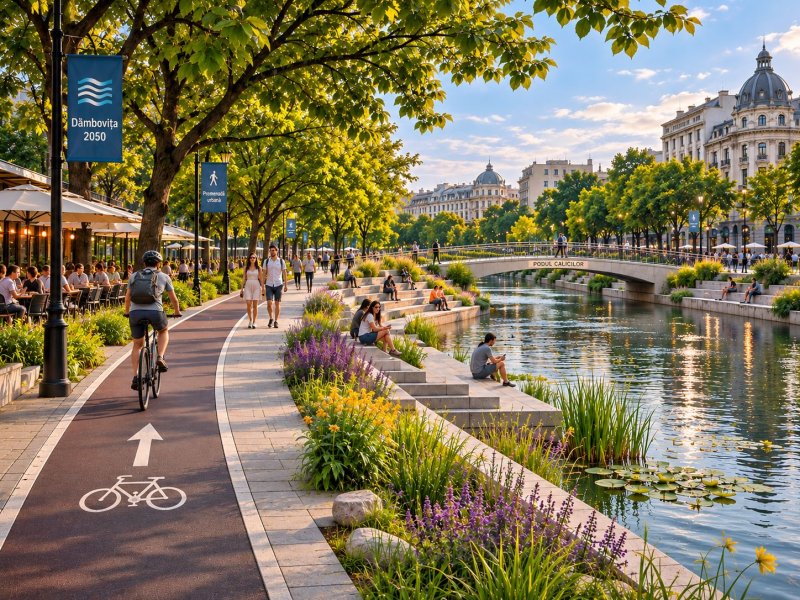
In the first scenario, the Dâmbovița River has become one of the capital's most pleasant places for a stroll. Its banks descend towards the water in a series of terraces, trees provide welcome shade, and people linger at outdoor cafés overlooking the river. Here and there, small rain gardens absorb water from heavy downpours.
It would be a remarkable transformation for a river that has long been treated as a piece of technical infrastructure, something Bucharest residents simply cross on their way somewhere else.
The scenario is rooted in real initiatives. In January 2025, the Bucharest branch of the Romanian Order of Architects supported the development of a master plan to revitalise the Dâmbovița. A working group dedicated to the river had been established in 2022, following initiatives involving representatives of the Ivan Patzaichin Association, among others.
In August 2026, Bucharest City Hall announced an agreement with the Romanian National Water Administration to regenerate the riverbanks. The first section targeted was the stretch between Unirii Square and Izvor Bridge.
The project put out to tender had an estimated value of RON 63.96 million, excluding VAT. It included improvements to approximately 11,000 square metres of public space along the river, as well as the reconstruction of Podul Calicilor (the Beggars' Bridge).
There is also a delightful historical detail here: Podul Calicilor would bring back a connection associated with old Bucharest, linking the Șelari area with Sfinții Apostoli. A city rediscovering its historical routes to become more pedestrian-friendly makes a certain amount of sense, at least on the drawing board.
The future of the Dâmbovița could also be shaped by civic projects such as Dâmbovița Apă Dulce, which has already begun opening up certain sections of the riverbank for public use.
The AI-generated image takes this idea further. The river becomes a destination in its own right, with connected public spaces stretching along its course. Creating such a landscape, however, would require hydraulic engineering works, consistent riverbank maintenance and coordination between several institutions. The attractive walkways in the image represent possibilities, while the projects approved today cover specific sections of the river.
With a little luck and enough administrative perseverance, Bucharest residents in 2050 might say "Let's go down to the Dâmbovița!" as naturally as they now say "Let's go to Herăstrău Park!"
2. Overheated Bucharest: A City Where Summer Becomes a Test of Endurance
 AI generated image
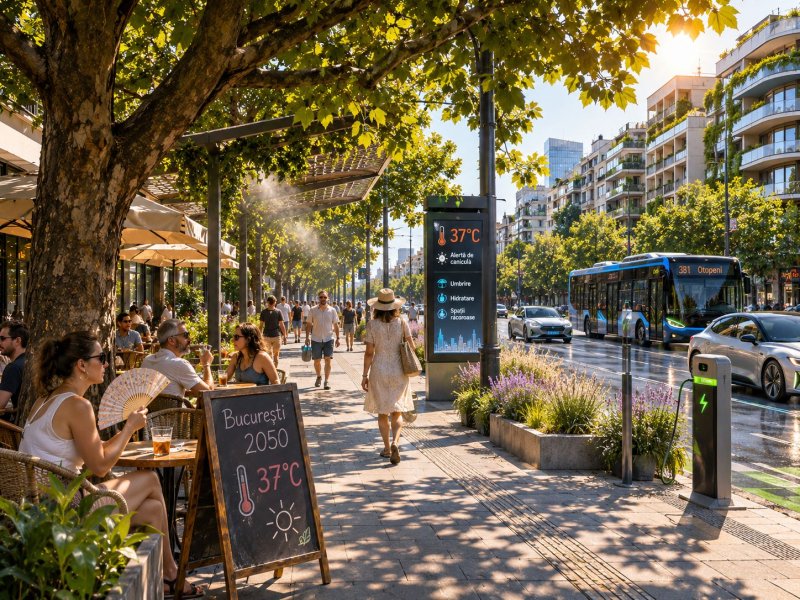
The second scenario presents a considerably less comfortable prospect. A Bucharest boulevard on a July afternoon, with scorching asphalt, harsh sunlight bouncing off building façades and pedestrians searching desperately for any available patch of shade. The scene resembles some recent summers, but climate research suggests the problem is likely to intensify.
According to the State of the Climate 2026 report, by 2050 Bucharest could experience approximately 20 additional tropical days per year, along with another 10–20 tropical nights. These figures are climate projections that depend on emissions scenarios and the evolution of local conditions.
A tropical night is defined as one in which the minimum temperature remains at or above 20°C. For residents of top-floor apartments, the definition may sound suspiciously familiar.
Urban heat is also closely linked to how the city is built. Concrete and asphalt absorb solar energy during the day and gradually release it after sunset. Heavily built-up areas, with impermeable surfaces and little vegetation, can remain unusually hot well into the night. This phenomenon is known as the urban heat island effect.
In its assessments of Romania's climate risks, the World Bank has warned that Bucharest already experiences significant temperature differences between densely urbanised areas and the surrounding countryside. Socially vulnerable neighbourhoods are often exposed to particularly high levels of heat.
In a report published in 2025, the institution also examined the health impacts of extreme temperatures in cities across Europe and Central Asia. For Bucharest, Athens and Istanbul, moderate emissions scenarios suggest the possibility of severe effects on heat-related mortality by 2050.
What might adaptation look like? Streets lined with mature trees would become essential climate infrastructure. The materials used to pave public spaces would matter increasingly, while schools and public squares would need shaded areas and surfaces capable of absorbing rainwater.
The AI image captures a future in which climate change advances faster than the city's ability to adapt. A future where the most valuable feature of a Bucharest café terrace will be a large, healthy tree, preferably old enough to remember the days when people actually looked forward to summer.
3. Calea Victoriei in 2050: A Bucharest That Reclaims Its Historic Buildings
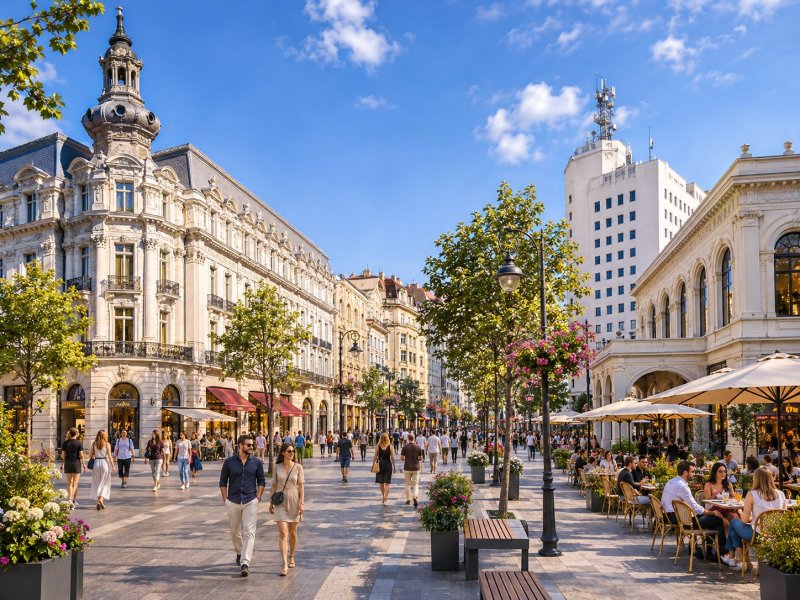 AI generated image
The third scenario is probably the most visually appealing. Calea Victoriei appears as a boulevard dominated by beautifully restored historic façades, with much of the public space given over to pedestrians. Mature trees shade outdoor cafés, buildings have regained their decorative details, and ground-floor shopfronts bring life back to the street.
A Bucharest where people look up to admire the architecture instead of checking whether the plasterwork above their heads is about to fall.
Beyond the image's aesthetic appeal, the future of the historic centre depends on tackling one of the capital's most difficult urban problems: the seismic vulnerability of its building stock.
Bucharest has experienced devastating earthquakes, and the one on 4 March 1977 remains a traumatic landmark in the city's history. Numerous buildings constructed before the introduction of modern seismic regulations still require assessment and structural intervention.
In October 2026, the Municipal Administration for the Consolidation of Buildings at Seismic Risk announced that 76 projects submitted under the National Programme for the Consolidation of Buildings at High Seismic Risk had been selected for funding. The total announced value was approximately RON 2.8 billion.
Of these buildings, 69 were residential properties and seven were public buildings. Many were located in historically protected areas or held listed-building status. Selection for funding is an administrative milestone. The actual consolidation process requires design work, permits and complex construction operations.
For the Bucharest of 2050, such interventions could make the difference between a building preserved for future generations and one left to deteriorate beyond reasonable repair.
The image offers an optimistic outcome. Architectural heritage has been saved, ground-floor commercial spaces have come back to life, and pedestrian movement has been given priority.
Calea Victoriei already provides evidence of Bucharest residents' enthusiasm for such spaces through the success of temporary pedestrianisation events. The paradox of Bucharest is that part of its architectural future could look rather wonderful precisely because it has recovered its past. And a properly restored interwar balcony can do more for a streetscape than yet another façade trying to impress everyone with the sheer quantity of glass it contains.
4. Trams in 2050: Green Boulevards and the End of the Battle for Every Metre of Asphalt
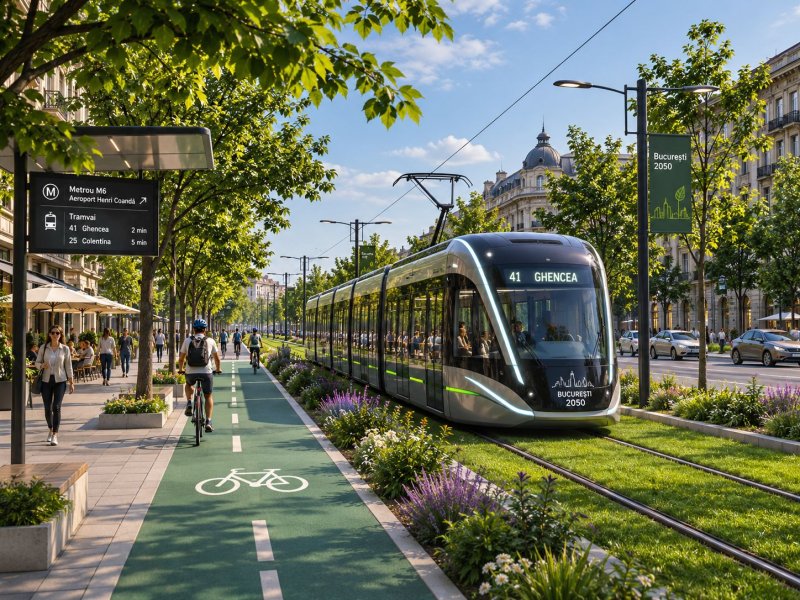 AI generated image
In the fourth scenario, Bucharest's traffic looks considerably calmer. Modern trams travel along segregated tracks integrated into green corridors. Cyclists use dedicated infrastructure, while pavements offer enough room for pedestrians. Cars are still around, but the way streets are organised gives public transport a much stronger advantage.
Bucharest residents who have spent countless hours stuck in rush-hour traffic might regard the image with a mixture of admiration and suspicion. Nevertheless, there are real investments that make such a scenario worth exploring.
In April 2026, the municipality announced the signing of a €265.6 million financing agreement with the European Investment Bank. The programme aims to modernise 50 kilometres of tram tracks, rehabilitate the Colentina depot and purchase 63 trams by 2030.
In December 2025, a financing agreement had also been signed for the extension of the tram network along Prelungirea Ghencea. The project includes new tracks and the purchase of 16 vehicles by the end of 2029.
As for underground transport, Metro Line M6 is intended to connect the existing metro network with Henri Coandă International Airport.
These investments are at different stages of development, and the transformation of the entire system depends on continuing the programmes and integrating them into a coherent network. A modern tram stuck at the same intersection as hundreds of cars quickly loses its advantages. That is why dedicated corridors and priority for public transport can matter just as much as the vehicles themselves.
In the visual scenario for 2050, space currently occupied by traffic lanes has been redistributed. Vegetation plays a prominent role, and short journeys around the city have become more comfortable.
Bucharest will probably retain plenty of heated arguments about parking spaces and traffic lanes. After all, these debates have been part of local life for so long that they probably deserve a chapter of their own in a history of urban attitudes. The real difference would be the time people get back.
5. Vertical Bucharest in 2050: New Towers, Old Neighbourhoods and the Battle for Remaining Space
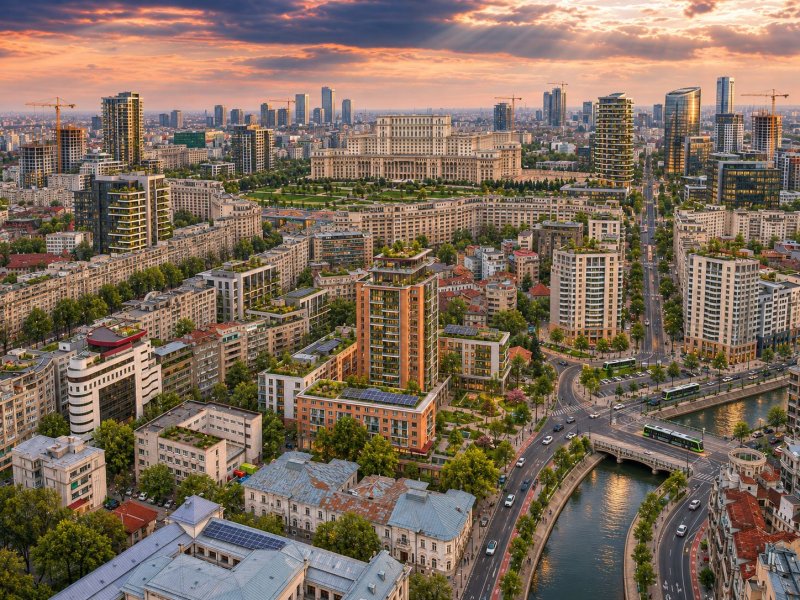 AI image generated
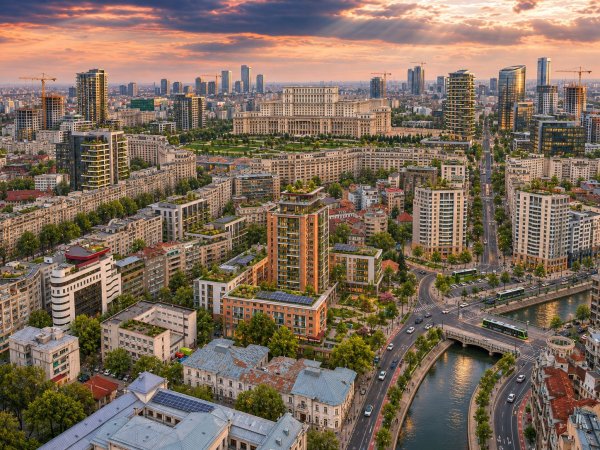
The final image looks at the city from above. Bucharest appears as a mixture of communist-era apartment blocks, neighbourhoods of traditional houses and contemporary towers. Construction cranes signal further property developments, while green spaces struggle to maintain some balance between the buildings.
This is probably the scenario that most closely resembles the capital's visible evolution over recent decades. Bucharest has seen office districts expand and large residential developments emerge, alongside the transformation of surrounding towns and villages. These changes have increased pressure on transport infrastructure and public services.
The central issue in 2050 may well be the quality of urban development. Under certain conditions, taller buildings allow land to be used more efficiently. Higher density can support public transport and local services, particularly in areas already well connected to existing networks.
Conversely, developments built without adequate infrastructure can aggravate traffic problems and shortages of public space. Bucharest's Integrated Urban Development Strategy for 2021–2030, approved by the General Council in August 2026, establishes priorities relating to accessibility and sustainable urban development. By 2050, the challenge will be turning such objectives into planning regulations that are consistently enforced.
The image also reveals another relevant detail. Old houses survive among apartment blocks and new developments, preserving some of Bucharest's architectural diversity. In reality, their future depends on heritage protection rules and the economic pressures placed on the land they occupy.
For a city with Bucharest's urban planning history, striking a balance between heritage and contemporary construction is a very real problem, visible on countless streets.
By 2050, a successful neighbourhood might be defined by how close its schools are and whether residents can walk to a park. Meanwhile, the view from the twentieth floor will undoubtedly retain its admirers, particularly among those who prefer to observe traffic from a respectable altitude.
What Can Artificial Intelligence Tell Us About Bucharest's Future?
The five images present different possible paths of development, each with a starting point that can be traced back to the realities of 2026.
Urban overheating is a risk estimated through climate models. Tram investments and projects involving the Dâmbovița River are concrete administrative initiatives, currently at various stages. The consolidation of historic buildings and future real estate development depend on funding, legislation and urban planning decisions.
Artificial intelligence can combine these trends visually to create possible future landscapes. The images remain artistic representations, however, and what actually happens will depend on decisions made over the next 24 years.
A greener city requires sustained investment in public spaces. Better mobility depends on projects being carried through to completion. Preserving historic buildings involves expensive technical interventions and careful heritage management.
The Bucharest of 2050 will inevitably bear the marks of every decision made today. Including those that were postponed.
And of the five scenarios, perhaps the most spectacular would be a surprisingly modest one: a Bucharest where trams arrive on time, where you can walk along a shaded pavement in summer, and where a restored historic building is an entirely ordinary sight.
Now that would be an interesting future, wouldn't it?
You may also like: The tallest building in Bucharest. SkyTower, symbol of strength and confidence in the urban future