What jewellery collections can you see in Bucharest? From Dacian bracelets to contemporary creations
By Raluca Ogaru
- Articles
- 20 AUG 26
Bucharest does not have a large museum devoted exclusively to jewellery. Its most valuable collections are divided among several institutions, each presenting the objects from a different perspective: archaeological, historical, ethnographic or artistic.
This means that anyone wishing to discover jewellery in Bucharest can follow an unexpected route through the city. The journey begins with prehistoric gold and Geto-Dacian ornaments, continues with Greco-Roman gems and royal jewellery, and reaches traditional coin necklaces, ornate belt buckles and beaded collars, as well as contemporary creations presented during Romanian Jewelry Week.
More than 3,000 precious objects in the Historical Treasury
The largest and most valuable public collection of jewellery and precious metal objects in Bucharest can be seen at the National History Museum of Romania.
The permanent Historical Treasury exhibition is located on the lower level of the Lapidarium. According to the museum, the route takes approximately 90 minutes and includes 40 display cases containing more than 3,000 objects made of precious metals and stones.
Among the exhibits are:
- The Dacian gold bracelets discovered near Sarmizegetusa Regia;
- The princely diadem from Bunești-Averești;
- Objects from the Agighiol, Peretu, Apahida, Hinova and Pietroasa treasures;
- Necklaces, earrings, fibulae, bracelets and complete sets of ornaments;
- Objects and jewellery associated with Alexandru Ioan Cuza;
- The crowns of Kings Carol I and Ferdinand I;
- The crowns of Queens Elisabeth and Marie;
- Queen Marie’s jewellery boxes;
- European jewellery sets dating from approximately 1800 to 1940.
One of the most spectacular exhibits is a bracelet created by Cartier, decorated with topaz, sapphire, ruby, emerald and brilliant-cut diamonds.
The complete presentation of the collection is available on the museum’s official Historical Treasury page.
The museum is usually open from Wednesday to Sunday, between 10:00 and 18:00. At the time this article was documented, a full-price ticket cost 32 lei, while pensioners paid 16 lei and pupils and students paid 8 lei. Opening hours and admission fees should be checked before visiting.
READ ALSO:
The National History Museum and the remarkable story of the former Postal Palace
Ancient jewellery in Dr George Severeanu’s former home
A smaller but exceptionally valuable collection can be found at the George Severeanu Museum, located at 26 Henri Coandă Street.
The museum occupies the former home of radiologist George Severeanu, the first director of the Museum of Bucharest. Together with his wife, Maria, he assembled thousands of archaeological objects and a numismatic collection comprising approximately 9,000 pieces. The collection was donated to the municipality in 1939, and the museum first opened to the public in 1956. It reopened in 2017 after restoration and reorganisation.
The exhibition includes engraved gems and cameos, fibulae, pendants, torcs and silver bracelets. Some of the oldest objects date from the Iron Age and the Roman period. Among the more unusual pieces are ivy-leaf pendants and miniature axe-shaped ornaments.
The jewellery is presented alongside Greek vessels, figurines, bronze objects, prehistoric ceramics, Roman glassware and coins. This context helps visitors understand not only how the ornaments looked, but also who wore them and what role they played.
The museum is generally open from Wednesday to Sunday, between 10:00 and 18:00, with last admission at 17:30. At the time of documentation, a full-price ticket cost 20 lei and a reduced ticket 10 lei.
Coin necklaces, ornate belt buckles and beaded collars at the Nicolae Minovici Museum
Traditional jewellery had more than a decorative function. It could indicate a person’s age, marital status, wealth or region of origin.
Examples can be seen at the Dr Nicolae Minovici Folk Art Museum. Its collections include beaded collars, 19th-century hairpins, earrings, necklaces, coin necklaces, bracelets, buckles and ornate belt clasps.
The museum holds a total of 4,303 objects, but this figure covers its entire folk-art collection, not jewellery alone. Not every piece is permanently displayed, and the selection available to visitors may change. Anyone interested in a particular type of ornament should check the current exhibition before visiting.
The museum is usually open from Wednesday to Sunday, between 10:00 and 18:00, with last admission at 17:30. It is located at 1 Dr Nicolae Minovici Street.
Where you should check the exhibition before setting out
The Museum of Art Collections brings together more than 30 private collections donated to the Romanian state. They include paintings, sculpture, decorative art, furniture and various personal objects.
Some collections may contain accessories or jewellery, but the museum does not have a permanent gallery devoted exclusively to jewellery. Visitors interested in such objects should therefore check which rooms and temporary exhibitions are open.
It is also important not to confuse permanent collections with exhibitions that have already ended. For example, the exhibition titled “Ancient Jewellery and Revealed Messages”, once hosted by Filipescu-Cesianu House, closed in March 2021 and should not be presented as a current attraction.
The Museum of Bucharest also owns a Gold and Precious Metals Collection, but the objects are not necessarily displayed simultaneously in a permanent exhibition.
READ ALSO:
Contemporary jewellery returns to Bucharest in autumn 2026
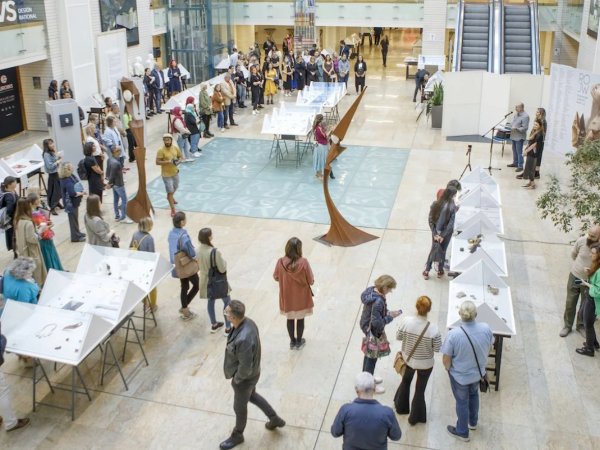
Visitors interested in contemporary design can also follow Romanian Jewelry Week. The seventh edition is scheduled to take place between 30 September and 4 October 2026.
The event traditionally brings together creators, design schools, galleries and international projects through exhibitions, fairs, conferences, workshops and guided tours.
Unlike historical collections, contemporary jewellery does not necessarily rely only on precious metals and gemstones. Artists may use ceramics, glass, textile fibres, wood, recycled materials or experimental combinations, turning jewellery into a form of wearable art.
The detailed programme, participating venues and ticketing information should be checked on the official Romanian Jewelry Week website.
Bucharest’s jewellery collections therefore offer at least three distinct perspectives. The National History Museum of Romania presents gold, royal crowns and objects connected to major historical periods. The George Severeanu Museum offers a more intimate journey through ancient adornment and collecting, while the Nicolae Minovici Museum shows how jewellery formed part of traditional dress and everyday identity.
In autumn, Romanian Jewelry Week adds the contemporary dimension, transforming the city itself into a temporary exhibition space.