Romania has the lowest prices in the EU. What this means for tourists and foreigners considering Bucharest

By Raluca Ogaru
- Articles
- 27 JUN 26
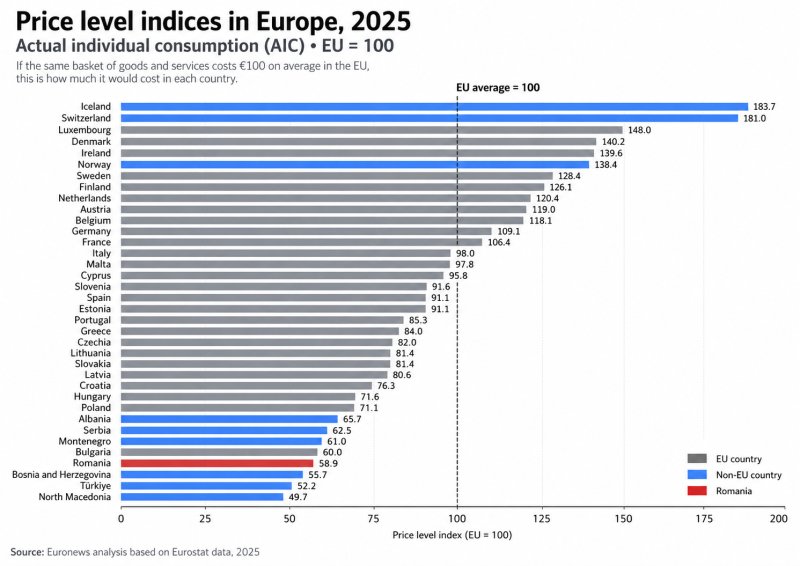
Bucharest remains one of the most accessible European capitals for tourists who want to discover a large city without the budgets usually needed in northern or western Europe. The latest Eurostat data, analysed by Euronews, shows that Romania has the lowest prices in the European Union compared with the EU average. This information is relevant not only for those coming here for a few days, but also for foreigners considering moving to the Romanian capital.
In concrete terms, if a basket of goods and services costs, on average, €100 across the European Union, the same basket would cost around €58.9 in Romania, according to the cited analysis. This does not mean that everything is cheap in Bucharest or that everyday life is easy for locals, especially in the context of inflation and rising energy costs. It does mean, however, that when viewed from the outside and compared with other European countries, Romania remains a destination with lower prices for services, shopping, restaurants and current expenses.
How Bucharest looks in the European price comparison
The data analysed by according to Euronews: is based on Eurostat’s price level indices. These compare how much the same set of goods and services costs in each country in relation to the European Union average. An index of 100 represents the EU average, above 100 means higher prices than the average, while below 100 means lower prices.
Within the European Union, the differences are significant. Luxembourg is listed as the most expensive EU country in this comparison, while Romania appears as the country with the lowest prices. According to the same source, consumer prices in Luxembourg are around 2.5 times higher than in Romania. If EU candidate countries and EFTA states are also included, Iceland becomes the most expensive country, while North Macedonia is the cheapest, widening the gap to almost 3.7 times.
For Bucharest, these figures should be read with an important nuance: the data is national, not specific to the capital. Bucharest is generally more expensive than many smaller cities in Romania, especially when it comes to rents, central restaurants, premium services or tourist areas. Even so, for a tourist coming from Switzerland, Iceland, Denmark, Ireland, Norway, the Netherlands, Austria, Belgium, Germany or France, the city may still seem considerably more affordable in many everyday spending categories.
What this means for tourists visiting Bucharest
For tourists, the most visible advantage is the balance between experience and budget. Bucharest offers restaurants, cafés, museums, public transport, parks, historic buildings and nightlife at costs that can be lower than in major Western capitals. A city break in Romania’s capital can include accommodation, meals out, local transport and cultural activities without reaching the spending levels usually associated with cities such as Copenhagen, Dublin, Amsterdam, Vienna or Paris.
Eurostat data helps explain this advantage. In the official analysis regarding household consumption in 2025, Romania appears among the cheapest EU countries, while in the category of food and non-alcoholic beverages it is listed as the cheapest country in the Union, with prices at 80% of the EU average. For a tourist, this may translate into meals, basic shopping and everyday expenses that are more budget-friendly than in many well-established European destinations.
At the same time, Bucharest should not be presented as a “cheap” destination in every context. Central and highly touristic areas can have prices close to those in other European cities, especially in popular restaurants, well-located hotels or during busy periods. This is why, for visitors, the European comparison is useful as a general benchmark, not as a guarantee that every service in the city will automatically be cheap.
Why Bucharest can be interesting for those who want to move here
For those considering a move to Bucharest, whether they are expats, digital nomads, relocated employees or international students, the cost of living is one of the first factors taken into account. From this perspective, Romania starts with a clear advantage in the European comparison: the general price level remains below the EU average and far below the levels recorded in northern and western Europe.
This can make Bucharest attractive for those who earn income from abroad or work remotely for companies based in economies with higher salaries. With an income aligned with standards in Germany, the Netherlands, France, Ireland or Scandinavia, everyday expenses in Bucharest can be easier to manage. This includes eating out, subscriptions and services, local transport, regular shopping and part of the costs related to leisure time.
However, for those who move here and rely on a local salary, the picture is more complex. Experts cited by Euronews point out that prices must be analysed together with incomes. A country may seem cheap for a visitor, but the living standard of residents depends on what a local salary can buy, not only on how much products cost compared with the EU average. In other words, Bucharest can be advantageous for a foreigner paid at an international level, but more challenging for someone living exclusively on an average local income.
Low prices do not automatically mean cheap living for everyone
The European comparison shows where prices are lower, but it does not tell the full story about affordability. Romania has prices below the European Union average, but the real costs for someone living in Bucharest depend on income, rent, lifestyle, neighbourhood, transport, family, education, healthcare and recurring expenses. An apartment in a central area, a private school or private medical services can quickly change a monthly budget.
This distinction is important both for tourists and for future residents. For a city break, Bucharest can be a very good choice in terms of cost versus experience. For a long-term move, however, a more careful analysis is needed: net income, rent, utilities, proximity to the metro, transport costs, schools, medical services and the pace at which prices are rising.
READ ALSO:
7 Restaurants in Bucharest with tasty lunch menus at affordable prices
Micro-spaces in Bucharest and their huge prices. How much does an 8-square-meter studio sell for?
Eurostat data and the Euronews analysis confirm an important point: Romania remains one of the most accessible countries in Europe in terms of consumer prices. For Bucharest, this can be a strong calling card for tourists and for those looking for a more affordable European capital. But the correct conclusion is a balanced one: Bucharest can be cheaper than many European capitals, yet the real experience depends on how you live in the city, the area you choose and the income you have.