From the cinemas of old Bucharest to the capital’s large multiplexes. Where Bucharest residents go to watch films
By Raluca Ogaru
- Articles
- 14 SEP 26
Bucharest discovered cinema only a few months after the Lumière brothers’ famous screening in Paris. Since then, the moving-image spectacle has passed through improvised salons, open-air venues, elegant boulevard cinemas, neighbourhood theatres and, eventually, the multiplexes found inside shopping centres.
Today, audiences can choose between IMAX screens and 4DX theatres, a single-screen arthouse cinema or an evening dedicated to classic films. Experiences and prices vary considerably, and the most expensive ticket is not necessarily the best choice for the film you want to see.
From the first screening to permanent cinemas
Romania’s first public film screening took place in Bucharest on 27 May 1896, in the salons of the French-language newspaper “L’Indépendance Roumaine”. The audience watched films made using the Lumière cinematograph, an invention that had been demonstrated in Paris only a few months earlier.
This was not yet a cinema in the modern sense. Films were screened in salons, theatres, circuses and other temporarily adapted spaces. Documents from the beginning of the 20th century mention Cinema Oser, described in 1905 as one of the city’s first permanent cinemas.
A more easily identifiable landmark is Cinema Volta, which opened in 1909 at 7 Doamnei Street. It is frequently described as Bucharest’s first purpose-built venue used regularly for film screenings. The auditorium offered several seating categories, with the most expensive seats located at the back because audiences believed films could be seen more clearly from a distance.
READ ALSO:
When central Bucharest was a boulevard of cinemas
During the interwar period, going to the cinema became an urban ritual. Venues such as Trianon, Capitol, Scala, ARO, Select, Lux and Eforie operated along Calea Victoriei, Elisabeta Boulevard and Magheru Boulevard. Some were used exclusively for screenings, while others also hosted performances, conferences and society events.
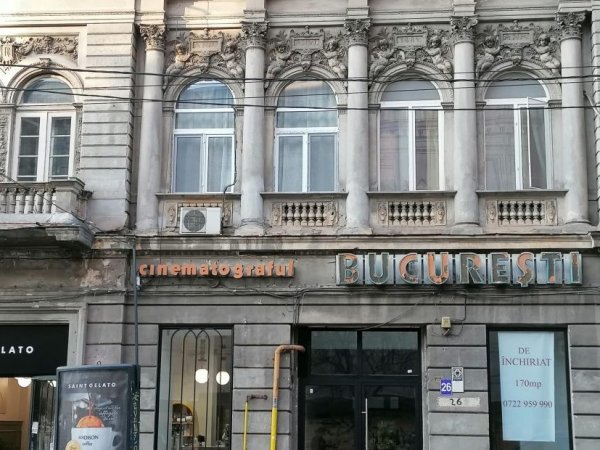
Cinema ARO, later renamed Patria, opened in January 1935 inside the modernist building designed by Horia Creangă. With almost 2,000 seats, it was the largest cinema in Bucharest at the time. Trianon, later known as Cinema București, remains closely connected to the beginning of sound films in Romania.
After the communist regime was established, cinemas were nationalised and some received new names. The network also expanded into residential neighbourhoods. Cinemas such as Favorit, Gloria, Cultural, Floreasca, Volga and Dacia became part of the city’s everyday life. For many families, the cinema was one of the few widely accessible forms of entertainment.
After 1990, cable television, video cassettes, changing audience habits, ownership disputes and the deterioration of the buildings led to the closure of many cinemas. Cinema Patria suspended its activity in 2015 because of seismic risk, while other historical venues remained abandoned or operated without a regular programme for years.
READ ALSO:
How shopping centres moved cinema from the city centre into the neighbourhoods
The year 2000 marked an important change. Hollywood Multiplex, opened inside București Mall–Vitan, became Romania’s first multiplex. Instead of one auditorium with hundreds or even thousands of seats, the new model offered several screens, numerous daily showings, restaurants and shops inside the same building.
Today, most major commercial releases reach cinemas located inside shopping centres. These venues offer comfortable seating, extended opening hours and special screening formats, but ticket prices depend on the day, time, type of auditorium and seat category.
The main options include:
Cinema City
Operates cinemas in AFI Cotroceni, Mega Mall, ParkLake and Sun Plaza.
AFI Cotroceni has an IMAX auditorium.
The Mega Mall cinema has 14 screens, a total capacity of approximately 2,366 seats and a 4DX auditorium.
Ticket prices vary according to the cinema, screening format, day and time.
Cineplexx
Operates cinemas in Băneasa and Titan.
The difference between weekday and weekend prices can be significant.
Separate rates may apply to children, pupils, students and pensioners.
Hollywood Multiplex
Located inside București Mall–Vitan.
It has ten auditoriums and a total capacity of more than 2,100 seats.
Its programme mainly consists of commercial premieres, with discounted tickets available on certain days.
Movieplex
Located inside Plaza România.
It offers both 2D and 3D screenings.
Promotions and loyalty-card discounts are available, but the final price must be checked for each film and screening time.
Happy Cinema
Operates cinemas in Vitantis Shopping Center and Colosseum Mall.
The Vitantis location generally has a lower standard ticket price.
The Colosseum cinema offers both standard and VIP options, as well as selected promotions.
The choice should not be based solely on screen size. A dialogue-driven drama does not necessarily need IMAX, while an action film may benefit from a larger screen, advanced sound or motion effects. The screening time, available seats and distance from home may ultimately matter more than the technology.
Lesser-known cinemas that preserve the arthouse experience
Bucharest cinema is not limited to blockbusters, large shopping centres and multiple daily screenings. Several smaller venues focus on European productions, Romanian films, restored classics, documentaries, festivals and meetings with filmmakers.
These cinemas usually have fewer screenings and smaller auditoriums. In return, they offer programmes that are rarely available in commercial multiplexes and create a more intimate relationship between the audience and the film.
Three venues are particularly worth following:
Cinema Elvire Popesco, 77 Dacia Boulevard
Opened in 1979 and renovated between 2011 and 2012.
It has 183 seats and can screen films in both 35 mm and digital formats.
Its programme includes European and Romanian cinema, arthouse productions, festivals, previews and special events.
Practical information is available on the official French Institute website.
Cinemateca Eforie – Jean Georgescu Hall, 2 Eforie Street
Its programme focuses on Romanian and international film heritage.
Audiences can see classics, restored films, retrospectives and screenings accompanied by discussions.
The current schedule and tickets are available on the official ticketing page.
Cinema Muzeul Țăranului – Horia Bernea Studio
Hosts independent films, documentaries, festivals and special screenings.
It is one of the city’s alternatives for productions with limited commercial distribution.
The cinema has standard and reduced prices, with separate rates for selected events.
Further information is available on the official museum cinema page.
Because these venues have limited capacity and fewer daily screenings, booking in advance is recommended, especially during festivals and special events.
How much a cinema ticket costs in Bucharest
Ticket prices vary according to the venue, day, screening time, format and audience category. A standard 2D ticket may cost less than 20 lei during a promotion, while a weekend screening or premium experience can exceed 40 lei.
The figures below provide an overview of the prices available when the information was checked. They should not be treated as fixed rates for every film or screening.
Cinema | Indicative ticket price | Important details |
|---|---|---|
Cinema City | 21.90 lei for 2D; 23.90 lei for 3D | CINEMARȚI prices apply on Tuesdays and exclude IMAX, 4DX, VIP screenings, previews and selected events |
Cineplexx Băneasa | 41 lei Monday–Thursday; 47 lei Friday–Sunday | Adult 2D ticket; premieres and special events may cost more |
Cineplexx Titan | 28 lei Monday–Thursday; 32 lei Friday–Sunday | Adult 2D ticket; reduced categories are available for children, students and pensioners |
Happy Cinema Vitantis | 19 lei | Standard auditorium; special screenings and events may have different prices |
Happy Cinema Colosseum | 19 lei on Wednesdays | Promotional price; previews and productions listed as “Shows” are excluded |
Cinema Elvire Popesco | 27 lei full price; 16 lei reduced; 11 lei for children under 12 | Special events may cost 35 lei |
Cinemateca Eforie | 15 lei full price; 5 lei reduced | Subscription tickets may cost 10 lei; the venue states that the box office accepts cash |
Cinema Muzeul Țăranului | 15 lei full price; 9 lei reduced | Special screenings may cost 20 lei at full price and 12 lei at the reduced rate |
The final cost may also include online booking fees, 3D glasses or supplements for premium seats, VIP auditoriums and special formats. Prices displayed at the beginning of the booking process should therefore be checked again before payment.
For families or groups, the day of the screening can make a considerable difference. A weekday promotion may reduce the total cost substantially, while a weekend premium screening can double it.
Where to go, depending on the film you want to see
For a major international premiere and a choice of several screening times, shopping-centre multiplexes remain the most convenient option. AFI Cotroceni offers IMAX screenings, while Mega Mall has a 4DX auditorium for productions designed around visual and motion effects.
For European cinema, Romanian productions, retrospectives, restored films and discussions with filmmakers, Cinema Elvire Popesco, Cinemateca Eforie and Cinema Muzeul Țăranului generally offer more suitable programmes.
Bucharest has lost many of its old cinemas, but it has not lost the habit of going to the movies. The difference is that today the choice is no longer only about which film to see. It is also about how you want to experience it: on a very large screen, inside a moving chair, in a historical cinema or in a small auditorium where the screening may be followed by a conversation.