Extracurricular activities children can do in Bucharest
By Raluca Ogaru
- Articles
- 29 MAY 26
Bucharest offers many options for children who need extracurricular activities, from sports, dance, theatre and music to robotics, foreign languages, painting, chess, creative workshops or holiday programmes. For parents, the challenge is not the lack of options, but choosing an activity that suits the child’s age, the family schedule, the budget and the child’s real pace.
Extracurricular activities can help children discover their passions, make friends, use their energy in a healthy way and develop skills that school does not always cover enough. In a large city, however, distance, traffic and a busy schedule can turn a good activity into a source of fatigue. That is why the choice should be made not only based on the popularity of the course, but also on how easily it can fit into everyday life.
Sports activities for energy and discipline
Sport is one of the most popular options for children in Bucharest, especially for those who spend a lot of time at school, in the car or in front of screens. Football, basketball, swimming, tennis, gymnastics, martial arts, sports dancing or athletics can help children develop coordination, endurance, discipline and the ability to work in a team.
For very energetic children, team sports may be suitable because they give them the chance to interact constantly with other children. For more introverted children or those who need concentration, swimming, tennis, martial arts or gymnastics may be better options. What matters most is that the activity is not perceived as extra pressure, but as a space where the child feels safe and can use their energy.
In Bucharest, there are private clubs, sports facilities, schools that organize after-school activities, as well as public programmes or programmes supported by local administrations. For families looking for more affordable options, it is worth checking periodically the programmes announced by city halls, children’s clubs or local public institutions, as some offer free courses or courses with reduced fees.
Art, theatre and music for creativity
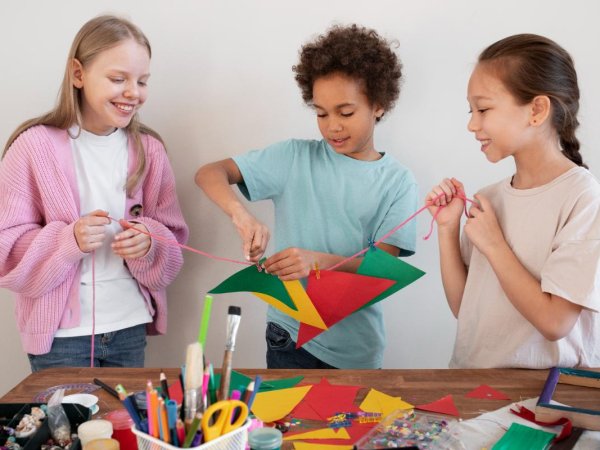
For children with imagination, artistic sensitivity or a need for self-expression, creative activities can be a very good choice. Painting, drawing, modelling, theatre, music, dance or creative workshops can help them develop patience, attention to detail and self-confidence. These activities are also useful for children who do not feel attracted to sports competitions.
In Bucharest, one of the important institutions for extracurricular activities is the National Children’s Palace. According to the information published on the institution’s website, enrolment in courses is conditional on submitting the registration form, and teachers may propose tests or selection methods depending on the type of activity and the minimum age, if the number of registered children exceeds the allowed limits. Details are published on the registration page of the National Children’s Palace in Bucharest.
Another option for creative activities is creart, a cultural institution of Bucharest City Hall. On the page dedicated to creative workshops for children, creart mentions workshops for children aged 4 to 12, including painting, decorative art and personal development through theatre. Such activities may be suitable for children who want to try something creative without immediately entering a very demanding programme.
Technology, robotics and applied science
For children attracted to logic, construction, computers or experiments, robotics, programming, IT, 3D design or applied science courses can be very interesting. These should not be seen only as preparation for a career in technology, but also as exercises in patience, critical thinking, problem-solving and teamwork.
In Bucharest, there are private robotics academies, STEM clubs, online courses and programmes organized in schools or educational centres. Some are suitable for younger children, with activities based on play and construction, while others are aimed at older students who can already work with programming concepts, electronics or digital projects.
For curious children, educational activities do not necessarily have to be weekly courses. A visit to an interactive museum, a weekend workshop or a practical activity can be a good form of non-formal learning. For example, Bucharest Children’s Museum, located at 11 Decebal Boulevard, is presented on București.ro as one of the largest non-formal learning hubs in Romania, with spaces dedicated to technology, geography, history, art, gastronomy, physics and chemistry.
Another option for children passionate about mechanics, inventions and applied science is the “Dimitrie Leonida” Technical Museum, located in Carol I Park. The location can complement STEM activities very well, especially for children who want to see concretely how different mechanisms, devices or inventions work.
Foreign languages, chess and educational activities
Foreign languages remain an important category of extracurricular activities. English, German, French, Spanish or other languages can be learned through classic courses, conversation, games, themed workshops or exam preparation programmes. For children who already have many homework assignments and school activities, parents should choose an age-appropriate programme, not one that adds unnecessary pressure.
Chess is another suitable activity for children who need to develop attention, patience and decision-making skills. Unlike very dynamic activities, chess helps children think before they act, accept mistakes and look for solutions. For some children, it may be more suitable than a competitive sport.
In some districts, parents can also find free courses or programmes supported by the local administration. For example, the free courses platform of DGASPC Sector 6 lists activities such as tennis, theatre, chess, street dance, storytelling/creative writing, robotics, painting, Spanish and English. The list can be checked on the official page for free courses for children in Sector 6, but available places, registration periods and groups should be checked regularly.
Creative workshops and cultural experiences
Not all extracurricular activities need to take the form of a classic course. For some children, weekend workshops, guided visits, holiday programmes or cultural experiences may be a better option. They offer the chance to test a field without the pressure of a long-term commitment.
A suitable example is Piscu School Museum-Workshop, located in Ilfov, close to Bucharest. The location is a good option for children interested in crafts, folk art and creative activities. On București.ro, the museum is presented as a space where workshops and activities for children and families are organized, while weekend visits can be an alternative to regular courses in the city.
The Comic Opera for Children is another important institution for families in Bucharest. On the institution’s website, information is published about the Summer School of the Comic Opera for Children, presented as an opportunity for children aged 4 to 12 to explore the world of art and culture in a safe and friendly environment.
For children who do not yet know what they like, such experiences can be a good way to test different interests. A painting workshop, a musical show, a short theatre course or a holiday programme can show whether it is worth continuing the activity long term. Parents can more easily observe whether the child’s interest is real or just a momentary curiosity.
Music and specialized artistic education
Music can begin as an extracurricular activity, but for some children it can turn into a more serious educational path. Piano, violin, guitar, singing, percussion or music theory courses can help children develop discipline, memory, attention and expressive skills.
For children who show a constant interest in music, Bucharest also has specialized educational institutions. The “George Enescu” National College of Music is presented on București.ro as an institution dedicated to music education, with programmes for primary, middle school and high school levels. It is not an extracurricular activity in the sense of an occasional workshop, but it can be a useful reference for parents who notice a real inclination toward music in their child.
At the beginning, parents can choose individual or group lessons, depending on the child’s age and the instrument they want to learn. It is important that the first musical experiences are pleasant, not very rigid. If a child associates music only with the pressure of practice or with comparisons, their interest may disappear quickly.
How to choose the right activity for your child
The first criterion should be the child’s interest, not just the parent’s wish. A very active child may need sport, but not necessarily a competitive sport. A creative child may love painting or theatre, but may reject a programme that is too rigid. A child passionate about technology may be attracted to robotics, but may need a course with a slower pace and a lot of practice.
Age matters a lot. For young children, activities should be short, playful and adapted to their attention span. For middle school students, activities with clear objectives, projects, competitions or performances may work better. For teenagers, it is important that the activity makes sense to them and is not perceived as an imposed obligation.
The family schedule is just as important. A very good activity that is one hour away can become tiring after a few weeks. In Bucharest, proximity to home, school or the daily route matters enormously. Sometimes, a good course in the neighbourhood is more suitable than an excellent course at the other end of the city.
Common mistakes parents make
A common mistake is overloading the schedule. If a child has school, homework, two sports, foreign languages, robotics and piano, the risk is that activities become pressure, not joy. Children also need free time, unstructured play and rest.
Another mistake is choosing activities only because they are fashionable. If many children go to robotics, that does not mean all children should go. If a sport is popular, that does not mean it suits every temperament. Extracurricular activities should complement the child’s personality, not force it.
Parents should also avoid comparisons. One child may need more time to adjust, another may give up after a few sessions, while another may discover an unexpected passion. What matters is for the parent to observe, ask questions and adjust, not turn the activity into an obligation.
What to ask before enrolment
Before enrolling your child in an activity, ask what the recommended age is, how long one session lasts, how many children are in the group, who coordinates the activity, what experience the instructor has, what materials are needed and whether there is a trial session. For sports activities, also ask about equipment, safety, changing rooms and the presence of a responsible adult.
For art, technology or foreign language courses, it is useful to ask how progress is measured. Not all activities need to end with grades, exams or diplomas, but parents should know what they can follow: a final project, an exhibition, a performance, better conversation in a foreign language or more confidence in the child.
Also ask about the policy for making up missed sessions, additional fees, holiday periods and how communication with parents works. In Bucharest, where family schedules can be complicated, flexibility matters a lot.
What to remember
Bucharest offers many extracurricular activities for children: sport, art, theatre, music, dance, robotics, foreign languages, chess, creative workshops, holiday programmes and courses organized by public or private institutions. The right choice depends on the child’s age, real interest, the family schedule and the distance from home or school.
The best activity is not necessarily the most popular one, but the one the child attends with pleasure, where they feel safe and have room to grow. For parents, the secret is balance: enough stimulation, but not overload; enough structure, but not pressure; enough variety, but not constant changes from one week to another.