“What hidden gems do you recommend in Bucharest?” Here are the answers received by someone who wants to discover a different side of the city
By Raluca Ogaru
- Articles
- 20 AUG 26
Bucharest hides museums arranged inside former artists’ homes, inner gardens, historical buildings where exhibitions can be visited free of charge and parks that have preserved some of their spontaneous vegetation. These were precisely the places that dominated the answers received by a user who asked Bucharest residents what “hidden gems” they had discovered around the city.
“It could be anything unpopular but incredibly cool: restaurants, places to visit, interesting buildings and so on,” the author wrote in a 2024 post published on the r/bucurești Reddit community.
The recommendations are appealing, but the list needs updating. In August 2026, several of the museums praised in the comments are temporarily closed, Lacul Morii Island has undergone extensive redevelopment work, and some restaurants or independent cultural venues may have changed their opening hours during the two years since the discussion was published.
The Storck House was the leading recommendation, but the museum is closed
One of the most appreciated replies pointed to the Frederic Storck and Cecilia Cuțescu-Storck Museum: “It is small, uncrowded and also has an inner garden. It is one of my favourites.”
The recommendation is based on a remarkable place. The house at 16 Vasile Alecsandri Street was built between 1911 and 1913 and preserves the works of an entire family of artists. The collection includes sculptures, paintings, drawings, watercolours, pastels, medals, coins and icons. The interior decorated by Cecilia Cuțescu-Storck is itself an essential part of the experience.
However, the museum cannot currently be visited. According to the Bucharest Municipality Museum, the Storck House has been temporarily closed for technical reasons since 6 August 2025. At the time this article was documented, the institution had not announced a reopening date.
The Storck House therefore remains a good place to keep on a future list, but not one to include in an immediate itinerary. The comments about the low temperatures inside the building or its conservation conditions cannot be presented as verified information either. They are personal impressions reported by individual visitors.
Small museums received the highest number of recommendations
One alternative that can currently be visited is the Theodor Aman Museum, located at 8 C.A. Rosetti Street, close to the Romanian Athenaeum. The artist’s home and studio was built in 1868 according to Aman’s own plans and has remained almost unchanged. Its furniture, paintings, sculptures, stained-glass windows and decorations were conceived as parts of the same artistic ensemble.
The museum is open from Wednesday to Sunday, between 10:00 and 18:00, with last admission at 17:30. Its modest size makes it suitable for a visit of around one hour, which can be followed by a walk around the Athenaeum and Revolution Square.
The K.H. Zambaccian Museum, arranged inside the former home of collector Krikor H. Zambaccian, also appeared on the list. Its collection brings together modern Romanian art and works by European artists such as Renoir, Cézanne, Pissarro, Matisse and Picasso.
The museum is open from Wednesday to Friday between 10:00 and 18:00, and at weekends between 11:00 and 19:00. Admission is free on the first Wednesday of every month.
Located in the Old Town, the Little Paris Museum was described by one participant as “a jewel.” It is a private space featuring furniture, costumes and objects that recreate the atmosphere of Bucharest in the late 19th and early 20th centuries. Opening hours and admission conditions should be checked before visiting.
Two of the recommended houses are temporarily unavailable
The suggestions also included Melik House – Theodor Pallady Museum. The building on Spătarului Street is one of the oldest surviving merchant houses in Bucharest and contains the collection assembled by Serafina and Gheorghe Răut.
The museum reopened in April 2026 following renovation and reorganisation work. MNAR subsequently announced, however, that it had been closed again starting on 5 August 2026, without providing a reopening date. The recommendation remains worthwhile, but the museum cannot currently be included in a confirmed itinerary.
The same caution applies to the Ligia and Pompiliu Macovei Art Collection on 11 Iunie Street. The Bucharest Municipality Museum states that this venue will remain closed until 27 September 2026 inclusive.
The Reddit comment claims that Pompiliu Macovei died “around 2011.” This is incorrect. The museum’s records show that the architect and diplomat lived between 1911 and 2009. More details about the collection can be found in Bucharest.ro’s article on the Ligia and Pompiliu Macovei Memorial House.
Cesianu-Racoviță Palace and a leisurely walk through Cotroceni
Cesianu-Racoviță Palace, located at 5 C.A. Rosetti Street, was recommended both for its architecture and for the exhibitions organised inside. The building houses the Artmark Galleries, where works scheduled to enter upcoming auctions are frequently displayed to the public.
Admission to these exhibitions is generally free, but the schedule depends on the auction calendar. The palace should not be confused with a public museum operating a permanent exhibition. Before going, check Artmark’s current events and the period during which the exhibition you want to see is open.
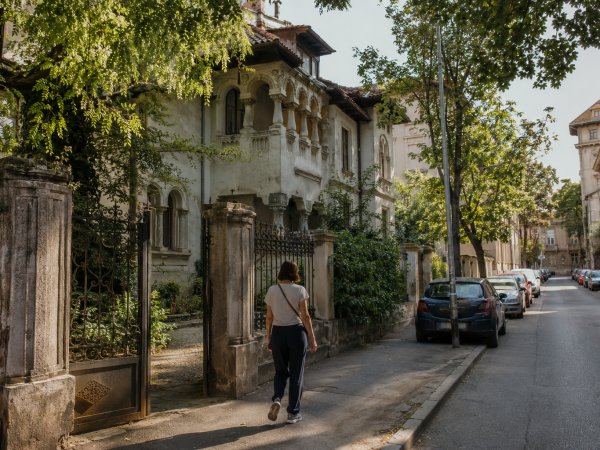
Cotroceni received a much simpler recommendation: explore it on foot. There is no single “secret attraction” here. Its charm comes from its tree-lined streets, villas built in different architectural styles, small courtyards, stairways and decorative details that are easier to notice when you leave the car behind.
READ ALSO:
Sticlăriei Park and Mărcuța reveal another side of eastern Bucharest
Sticlăriei Park is one of the recommendations that still fits the meaning of “hidden gem.” This ecological park in Sector 2 covers approximately five hectares and was arranged through limited interventions: gravel paths, benches, lighting and work to clean the lake and surrounding vegetation.
You will not find the appearance of a conventional city park, with perfectly maintained lawns and geometrical flower beds. The vegetation is less controlled, while the lake attracts several bird species. Daylight hours, comfortable footwear and behaviour that does not disturb wildlife are advisable.
The nearby Mărcuța Church is another place worth discovering. It is one of Bucharest’s oldest surviving religious monuments. The church dates from the late 16th century and belongs to an ensemble that still includes its surrounding wall and bell tower.
As this is an active place of worship rather than a museum, visits should be discreet. Religious services and occasional restrictions may affect access to the interior.
Lacul Morii and Bellu Cemetery come with different rules
Bellu Cemetery can be regarded as an open-air museum of funerary sculpture and urban history. It contains the graves of writers, actors, politicians, doctors and artists, alongside monuments designed by important architects and sculptors.
It is not, however, a theme park. Visitors should remain quiet, avoid photographing ceremonies or people without their permission and respect the funerary nature of the site.
Lacul Morii was recommended for its island and for sunsets viewed from the dam. The renovated promenade remains suitable for walking or cycling.
The island was closed for construction work in February 2025, and in May 2026 the redevelopment project was still officially described as being under implementation. Access should therefore be checked before setting off. The fact that the island could be visited when the comment was published in 2024 does not guarantee that the entire route is currently accessible.
Night-time recommendations and restaurants should be checked separately
The Grivița Footbridge was suggested for the view of trains arriving at and departing from Gara de Nord. One commenter described the atmosphere as “steampunk,” particularly at night. The footbridge is pedestrian infrastructure, however, rather than an officially managed tourist attraction, and lighting and safety conditions may vary.
A recommendation to visit at night should not be turned into general advice for tourists. If you want to explore the area, choose daylight hours, remain on designated pedestrian routes and never enter railway tracks or technical areas.
The discussion also mentions restaurants, tea houses, bars and independent theatres. T5 Social, Infinitea, The Great Hill, Beautyfood, Un Poco Pizza Fresca, Zelato, Grain Trip and Cuibul Artiștilor are among the names suggested. Comments about their food, service or atmosphere are personal opinions rather than objective assessments.
The list was published in 2024. Some venues may have changed their address, menu, opening hours or concept, while others may have closed. Checking their current status before visiting is essential.
In its updated form, the discussion offers three good ways to discover a less predictable Bucharest: visiting small museums, exploring residential neighbourhoods on foot and seeking green spaces away from the city’s central tourist routes. Not all these places are genuinely secret. Many are simply overlooked.